
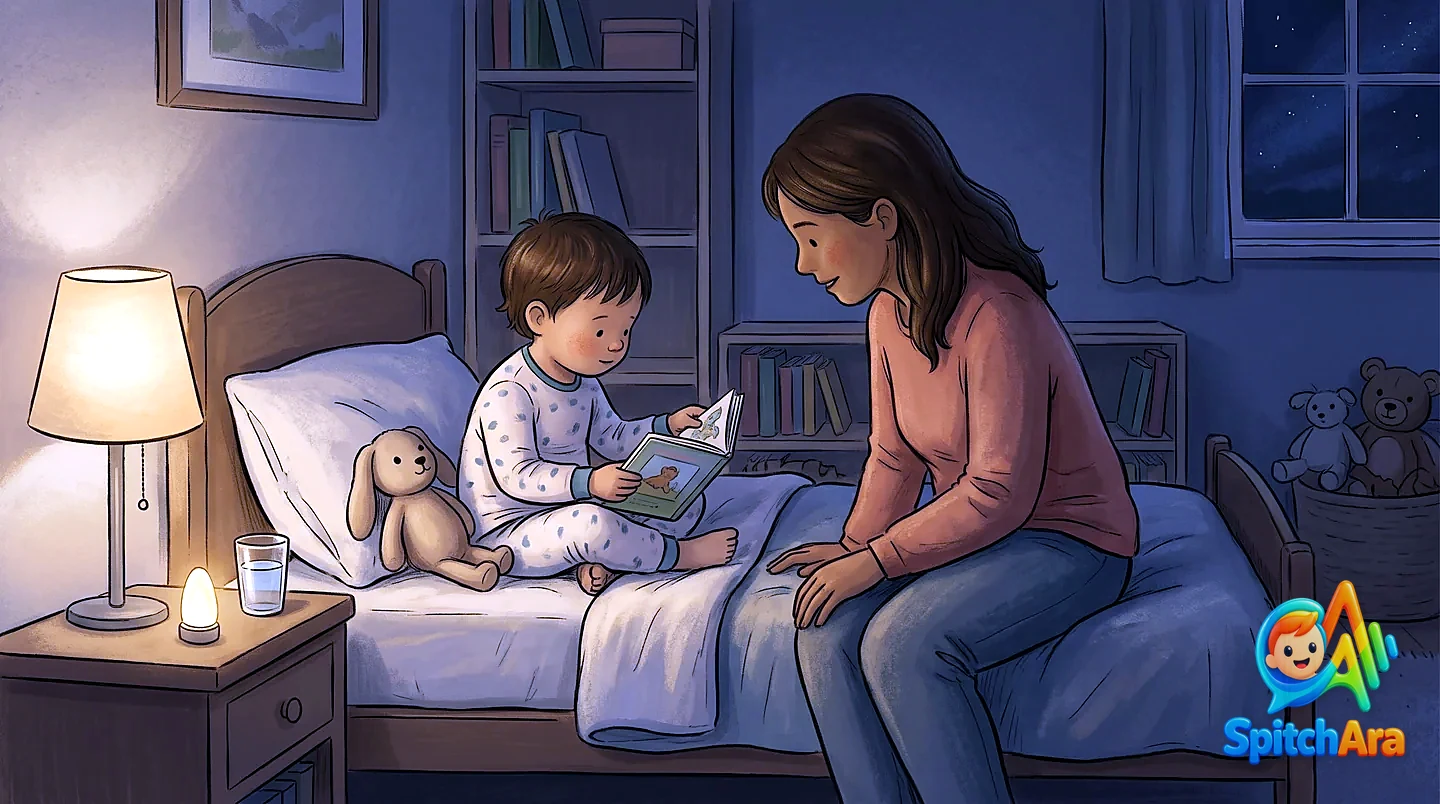
Some evenings, a child wants the same page three times. On other evenings, the book is pushed away before the first sentence. Both responses tell you something about the child in front of you. A bedtime routine can contain language without requiring the same amount of talking every night.
The most useful bedtime language activity is usually one that supports the routine rather than competing with it. A short comment while choosing pyjamas, a familiar line in a book, or a chance to say “finished” may be enough. When everyone is tired, reducing demands can make communication easier to notice.
Begin with predictability rather than more activities
Think about the sequence your family already follows. Perhaps it is washing, pyjamas, a drink, a book, and bed. You do not need to add another stage labelled speech practice. Instead, consider where your child already makes a choice or seeks your attention.
For example, a child brings a particular book from the shelf. You can acknowledge “You chose the bus book” and open it. The child's action has begun the exchange. Asking them to name the book before you read it may interrupt the very participation you wanted to encourage.
If the routine changes, explain the change in a way the child can access. “One book, then bed” may work for some children; others use familiar pictures or objects to understand what is next. Use the supports already appropriate for your child rather than introducing a complicated new system at the end of a tiring day.
Let a familiar story do some of the work
Familiar books reduce the need to work out a completely new event. A child may anticipate a character, point to a favourite picture, or make a sound at the same place. You can respond to that contribution without requiring the child to repeat a sentence (Dowdall et al., 2020).
Suppose a child points towards a dog hidden behind a chair. “There he is” follows the discovery. If the child turns back to find the dog again, you can share the search. The story may become a conversation about one picture rather than a complete reading, and that can still be a meaningful bedtime exchange.
The NHS includes picture sharing and expanding children's language among its everyday suggestions (National Health Service, 2023). In practice, expansion can be small. “Dog” might become “Dog hiding.” The aim is to add meaning the child can connect with the picture, not to replace their contribution with a long explanation.
Pause where a contribution could fit
You might briefly pause before an anticipated sound in a familiar story or song. Then notice whether the child wants to take a turn. A smile, a movement, a sign, or a sound can be an answer. Continue naturally if the child does not respond; the pause is an opportunity, not a test.
The difference is in what happens next. In an invitation, the adult remains warm and the story continues. In a test, the adult repeats the prompt, withholds the next page, or waits until the child produces the expected word. At bedtime, that added demand may quickly overwhelm the purpose of being together.
Consider a hypothetical goodnight game. The child touches a toy bear; the adult says “Goodnight, bear.” The child then touches the blanket, and the adult follows with “Goodnight, blanket.” The child has changed the direction of the game. Following that change makes the exchange more personal than repeating a fixed list of objects.
Use the language that belongs to your family
A bedtime phrase often carries affection as well as information. Use the language in which that affection feels natural. A grandparent's familiar expression, a parent's lullaby, or the child's own name for a toy can belong in the routine without being translated into a lesson.
If caregivers use different languages, they can still recognise the same sequence and respect the same signals. One person may say goodnight in one language and another in a different language. The useful consistency is that the child understands what is happening and can contribute, not that every adult reproduces identical words.
You can share a few practical notes between caregivers. “She likes to choose the last page” or “He uses this gesture when he wants the story to stop” may be more useful than a demand to follow the exact script. Leave room for the child's preferences to change from one evening to another.
Distinguish reluctance from a problem to solve
If a child leaves the book, there may be many explanations. They may be tired, uncomfortable, interested in something else, or simply finished. A single evening does not tell you why. Before trying to improve attention, check whether the activity still fits the moment.
You might offer a shorter choice: “One picture or goodnight now?” only if both answers are acceptable. Alternatively, put the book away and describe the next care step. The child does not have to earn the end of the routine by completing a language task.
If bedtime regularly becomes difficult, separate the concerns. Questions about sleep, pain, breathing, distress, or daily functioning deserve appropriate professional advice. They should not be interpreted as failures of speech practice. A language activity cannot resolve every difficulty that happens during a routine.
Keep the adult's role manageable
Caregivers sometimes feel that every quiet moment is a missed developmental opportunity. That expectation can make an ordinary evening exhausting. You can support communication through one attentive exchange without narrating every movement until the lights go out.
Choose a moment that is likely to happen anyway. Notice the child's contribution, respond to its meaning, and add a short phrase if helpful. If the evening is rushed, complete the routine and try again on another occasion. There is no need to compensate with a longer session the next day.
If a clinician has suggested a particular home goal, ask where it fits most comfortably. A goal that works during morning play may not belong at bedtime. Explain what happens in your home so that professional advice can be adapted rather than treated as another task the family must force into the evening.
End with a message the child can recognise
A consistent closing phrase can make the end of the shared activity clear. “Book finished. Goodnight” is one possibility; your family will have its own. Pair the phrase with what actually happens next so that the words have a dependable meaning.
At the next bedtime, notice one thing your child chooses, anticipates, or communicates. You may discover that the most successful moment is very brief: a finger on a picture, a familiar sound, or a request to hear the same line again. Responding to that moment is enough to begin. The routine can stay a place of comfort while still making room for language.
References
Centers for Disease Control and Prevention. (2026, February 16). Concerned about your child’s development? https://www.cdc.gov/act-early/families/concerned.html
Dowdall, N., Melendez-Torres, G. J., Murray, L., Gardner, F., Hartford, L., & Cooper, P. J. (2020). Shared picture book reading interventions for child language development: A systematic review and meta-analysis. Child Development, 91(2), e383–e399. https://doi.org/10.1111/cdev.13225
National Health Service. (2023, April 26). Help your baby learn to talk. https://www.nhs.uk/baby/babys-development/play-and-learning/help-your-baby-learn-to-talk/
National Institute on Deafness and Other Communication Disorders. (2022, October 13). Speech and language developmental milestones. https://www.nidcd.nih.gov/health/speech-and-language
Petrie, A., Mayr, R., Zhao, F., & Montanari, S. (2023). Parent-child interaction during storybook reading: Wordless narrative books versus books with text. Journal of Child Language, 50(1), 104–131. https://doi.org/10.1017/S0305000921000763
Roberts, M. Y., Curtis, P. R., Sone, B. J., & Hampton, L. H. (2019). Association of parent training with child language development: A systematic review and meta-analysis. JAMA Pediatrics, 173(7), 671–680. https://doi.org/10.1001/jamapediatrics.2019.1197
