
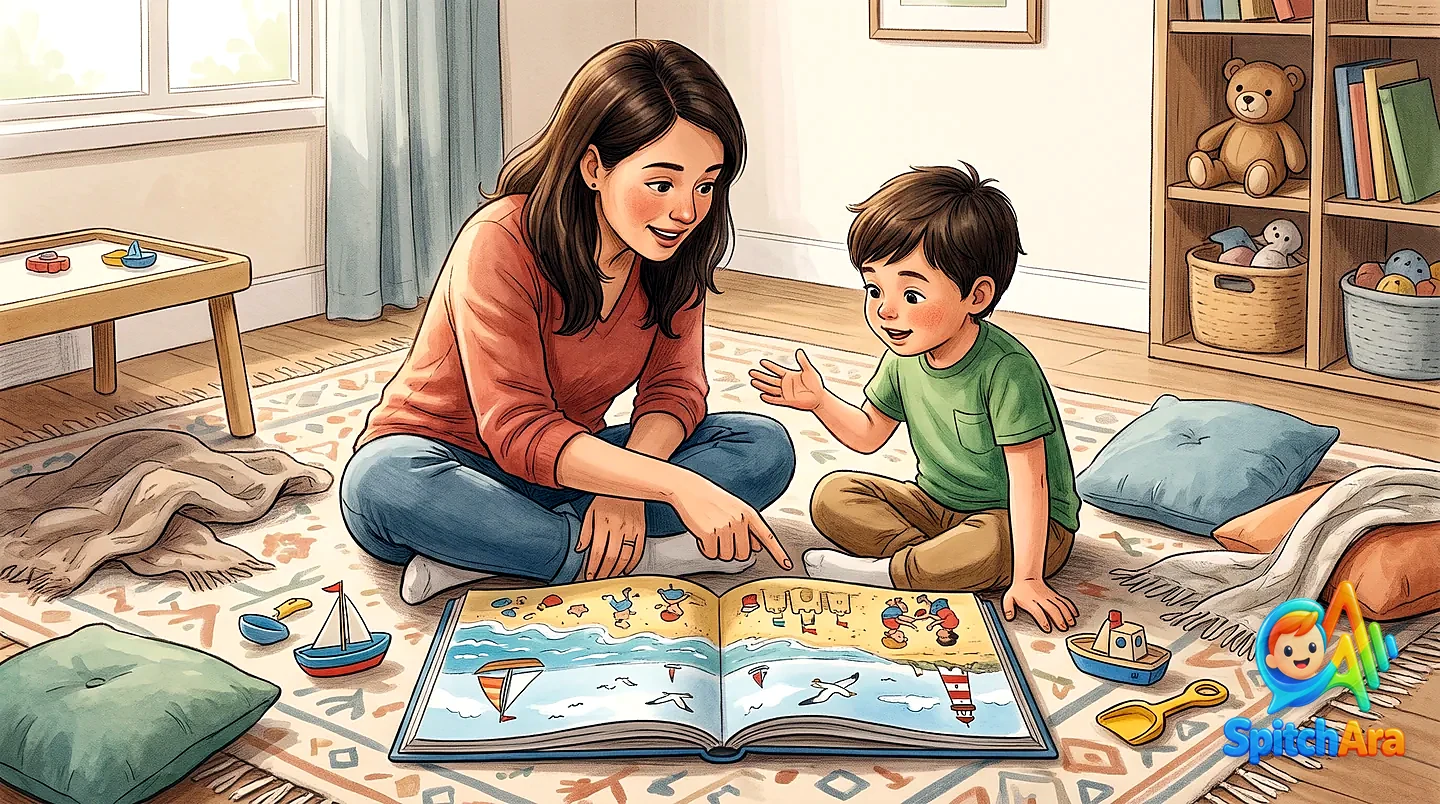
A book without printed sentences can feel surprisingly difficult to open. There is no script to follow, and an adult may worry about telling the story incorrectly. Yet that empty space can also be useful: both reader and child have something to discover.
A wordless picture book invites you to build meaning from illustrations. You can notice an action, wonder about a character, or follow a small detail across pages. You do not need to narrate every object. The aim is a shared conversation that suits your child's interests and communication, not a flawless performance of an invisible text.
Look before you invent a story
Begin with the cover or a page the child chooses. Give yourselves a moment to look. Before deciding what the story must mean, identify what is actually visible: a child carrying a basket, a door standing open, a cat watching from a window.
This keeps the conversation grounded. “She is carrying a basket” is an observation. “She must be visiting her grandmother” is a possible interpretation. Both can be useful, but separating them leaves room for the child to suggest something different.
You might say, “I see a basket. I wonder what's inside.” If the child points to a later picture of apples, you can connect the discovery: “There they are. She brought apples.” A question has led somewhere because the next page supplies information, not because the adult already knows the answer.
For a child using few words, the same sequence might be “Basket,” followed by “Apples inside.” Meaning can grow through gesture, sounds, signs, or pictures as well as longer spoken sentences.
Follow one thread instead of describing everything
Illustrated pages can be busy. An adult may feel obliged to name the tree, the bicycle, the dog, the clouds, and every person before moving on. That can leave the child listening to a list rather than participating in a story.
Choose one thread that the child seems interested in. Perhaps a red hat appears on several pages. You can follow where it goes, who notices it, and whether it is found. Another reading may follow a different character.
This gives the conversation continuity. “The hat was on the bench. Now it is in the dog's mouth” links the new picture with the previous one. The child is not starting a separate naming exercise on each page.
At the same time, be willing to abandon your thread. If the child becomes interested in a puddle, pause there. A coherent conversation can take a detour without losing its value.
Make room for different interpretations
Wordless stories often leave motives and feelings open. That is an opportunity to model uncertainty: “He might be surprised,” “Perhaps she is looking for someone,” or “I cannot tell whether they are waiting or leaving.”
These phrases show how ideas can be proposed and revised. If the next page contradicts your first guess, say so. “I thought he was going home, but he is walking towards the shop.” Changing your mind is part of understanding a story.
Avoid correcting an interpretation simply because it differs from yours. Ask what the child noticed. If they think the character is frightened, perhaps they have spotted a detail you missed. For a child who cannot explain verbally, you can offer two possible pictures or actions and see which one they choose.
Not every picture needs an emotional explanation. Sometimes “That looks funny” and a shared laugh are enough. A conversation that constantly asks the child to identify feelings can become as demanding as a vocabulary quiz.
Use a small bridge between pages
The page turn is a natural place to connect ideas. Before turning, briefly recall what is happening. Afterwards, notice what changed. “The ball rolled behind the fence. Now the girl is looking through the gate.”
For a child ready for more complex language, you might add a reason: “She is looking because she wants her ball back.” If that is too much, return to the visible action. The amount of explanation should follow the child, not a predetermined reading level.
You can also pause before a page turn and invite anticipation. The child might reach, point, make a prediction, or ask to see what happens. Do not hold the page closed until a word is spoken. The interest in finding out is already a reason to continue together.
A useful ending can return to the beginning: “At first the hat was lost. In the end it was back on her head.” This models a simple story shape without requiring the child to retell the entire book.
What the research does and does not show
In a study involving 36 parent-child pairs, wordless and printed-text books produced different patterns of interaction. Wordless reading prompted more child contributions, while narration from the book with text contained more varied vocabulary and complex grammar (Petrie et al., 2023).
The practical conclusion is not that wordless books are universally better. Different formats offer different possibilities, and the study involved a small group of preschool children. A family can use both, choosing according to the moment and the child's interests.
A separate study with 201 German preschoolers found small benefits from a structured wordless-book intervention for some vocabulary and story-understanding outcomes; many effects were short term (Grolig et al., 2020). That intervention cannot be reproduced simply by buying the same kind of book.
These findings support trying a different conversational format, not promising a treatment outcome. The value in your living room is whether the pictures make it easier for you and your child to share an idea.
Adapt the conversation across languages and communication methods
A wordless book does not require an adult to translate a printed script. A grandparent can tell the story in one language, while another caregiver uses another. The pictures remain a common reference even when the wording changes.
You do not need to deliver every sentence twice. If the family switches languages naturally, keep the story understandable and enjoyable. A child may know one character's name in one language and an action word in another; respond to the meaning before worrying about making the sentence uniform.
For a child using AAC, look for vocabulary that can support comments as well as requests. “Funny,” “lost,” “again,” “not,” or a familiar character's name may open different kinds of participation. Work with the child's existing system rather than creating a new set of symbols for every book.
Access to the page matters too. Position it where the child can see and reach comfortably, and let them choose whether to sit, stand, or look beside you when that is safe. Participation does not have to look like sitting still with hands in a lap.
Try one book in three different ways
On a first reading, simply explore. Let the child choose what to notice, and avoid making a complete story compulsory. On another occasion, follow one character or object. Later, if the child enjoys it, revisit how a problem began and what changed.
These are optional approaches, not stages the child must pass. You may return to the exploratory version indefinitely because it is the one that creates a shared conversation.
Finish while there is still room to enjoy the book again. A child who closes it may be saying that the activity is over, not that the book has failed. Keep the invitation open, and let the next reading begin with something worth noticing together.
References
Centers for Disease Control and Prevention. (2026a, February 16). Concerned about your child’s development? https://www.cdc.gov/act-early/families/concerned.html
Dowdall, N., Melendez-Torres, G. J., Murray, L., Gardner, F., Hartford, L., & Cooper, P. J. (2020). Shared picture book reading interventions for child language development: A systematic review and meta-analysis. Child Development, 91(2), e383–e399. https://doi.org/10.1111/cdev.13225
Federal Trade Commission. (n.d.-b). Protecting your child’s privacy online. https://consumer.ftc.gov/articles/protecting-your-childs-privacy-online
Grolig, L., Cohrdes, C., Tiffin-Richards, S. P., & Schroeder, S. (2020). Narrative dialogic reading with wordless picture books: A cluster-randomized intervention study. Early Childhood Research Quarterly, 51, 191–203. https://doi.org/10.1016/j.ecresq.2019.11.002
Petrie, A., Mayr, R., Zhao, F., & Montanari, S. (2023). Parent-child interaction during storybook reading: Wordless narrative books versus books with text. Journal of Child Language, 50(1), 104–131. https://doi.org/10.1017/S0305000921000763
Roberts, M. Y., Curtis, P. R., Sone, B. J., & Hampton, L. H. (2019). Association of parent training with child language development: A systematic review and meta-analysis. JAMA Pediatrics, 173(7), 671–680. https://doi.org/10.1001/jamapediatrics.2019.1197
