At nursery drop-off, a parent may explain that a child pushing a cup away means “finished,” while holding it out means “help.” By lunchtime, another adult is on duty. The explanation has disappeared with the parent, and the child has to start again with someone who does not yet understand.
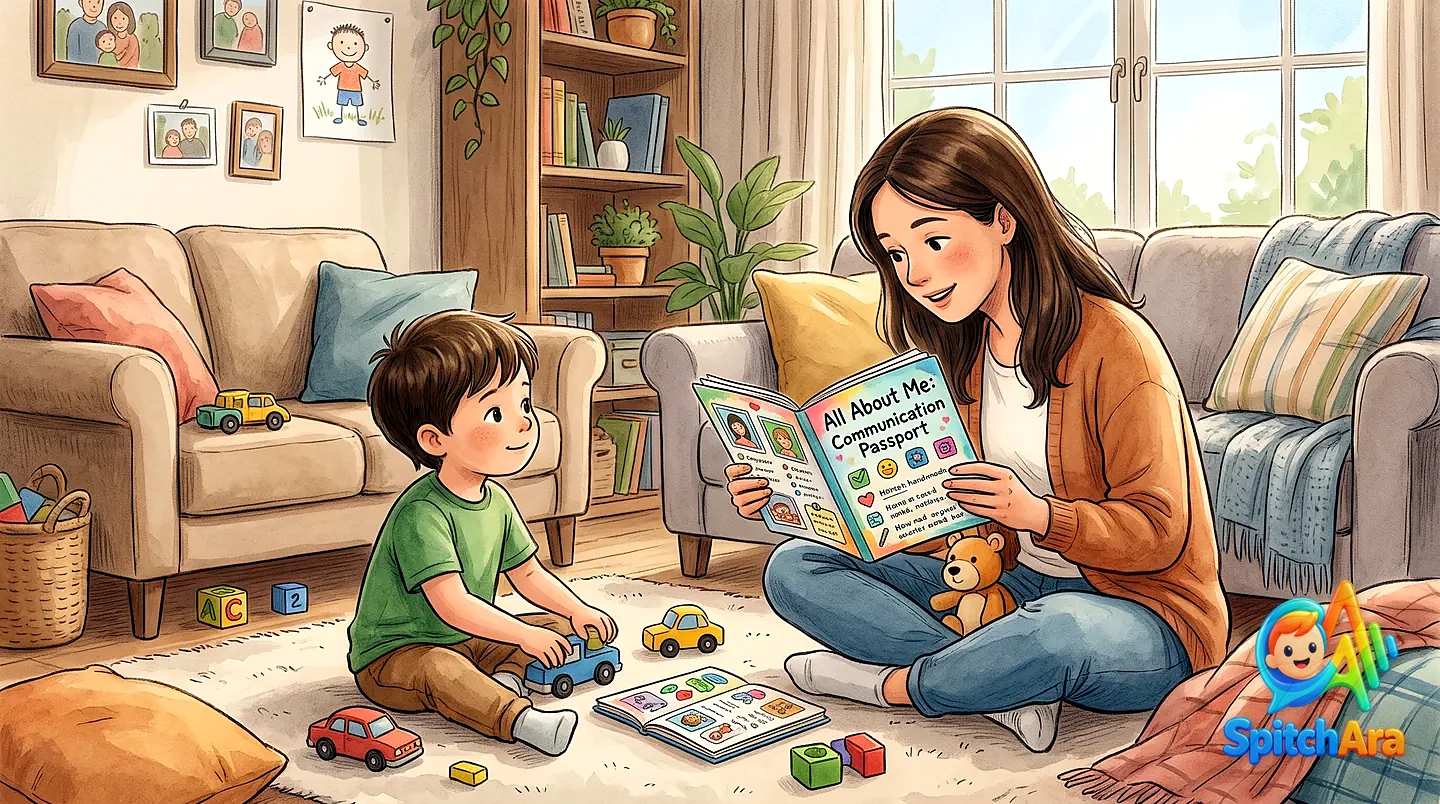
A communication passport can carry that practical knowledge between people. It is a short, regularly updated introduction to how a child communicates, what matters to them, and what helps a conversation work. The aim is not to summarize a child's whole life. It is to make the next interaction easier, while leaving room for the child to show something new.
Begin with the moments that are being missed
Before choosing a template, identify a real difficulty. Perhaps new staff overlook a quiet request for help. Perhaps relatives keep asking for spoken answers when the child usually points. Or perhaps an adult interprets turning away as refusal when the child needs a break from noise.
These situations call for different information. A passport that begins with several pages of medical history may never reach the detail that would help at snack time. Instead, ask: “What does a new communication partner need to notice, and what should they do next?”
For example, an entry might say: “When I bring you a closed container, pause and ask whether I want help. I may nod, point to the lid, or use my communication board.” That tells the adult where to look, acknowledges several possible responses, and avoids treating the behaviour as a code with only one meaning.
If the child can contribute directly, invite them to choose photographs, symbols, words, or messages. If adults are interpreting on their behalf, make that uncertainty visible. “We think this often means…” is more accurate than presenting every adult assumption in the child's voice.
Include the child beyond their support needs
A good first page should introduce a person, not a list of difficulties. Include a preferred name, interests, enjoyable activities, and ways to join in. “I like watching wheels turn; sit beside me and comment on what you notice” gives someone a way into a shared activity.
Next, explain how the child usually communicates. That may involve speech, facial expression, movement, gestures, signing, pictures, or a speech-generating device. The Communication Health Support Association (2026) describes AAC as a range of individualized supports that can be used alongside speech or instead of it.
The practical implication is that a passport should not reduce communication to the number of words a child says. A message expressed by pointing deserves a response. Likewise, a child who speaks comfortably at home may still need pictures or extra time in a noisy unfamiliar setting.
Include what the child wants other people to know about themselves, where possible. A favourite song, a dislike of sticky hands, or a preferred place to sit may be more immediately useful than a diagnostic label. Keep private information only when it has a clear purpose for the people receiving the passport.
Describe signals without turning them into fixed rules
Consider a hypothetical child who puts a toy into an adult's hand. On one occasion, the child wants help winding it. On another, they are giving the adult a turn. The movement is similar, but the meaning changes with the situation.
A strong entry therefore combines signal, context, and response. It might read: “When I hand you a toy, notice what happened just before. You can say ‘Help, or your turn?’ and show the two possibilities. Give me time to confirm.”
This is more useful than “Giving a toy means help.” It teaches the adult to remain curious rather than assume that they already know the answer. It also protects the child's right to change their mind or express an unfamiliar idea.
Describe refusal with equal care. “Stop,” turning away, moving an object aside, or selecting a break symbol should not vanish from the passport because adults prefer positive messages. The National Joint Committee for the Communication Needs of Persons With Severe Disabilities (n.d.) includes refusal, meaningful choices, and a response to communication among its communication rights.
Where a request cannot be met, the passport can still describe a respectful response. An adult might acknowledge “You want outside,” explain that the gate is closed, and offer the next available opportunity. Acknowledging a message does not require promising its requested outcome.
Make the support instructions usable in a busy room
General instructions such as “be patient” are easy to agree with and difficult to apply. Replace them with observable actions. “Ask one question, then leave a quiet pause” is clearer. “Keep the communication board within reach during meals” gives someone something specific to check.
For a child using a device, explain where it goes, how it is charged, and which person can help with technical problems. Do not put passwords in a widely shared passport. If a device is unavailable, describe an agreed backup that the child already knows, rather than inventing an unfamiliar system during a difficult moment.
The same principle applies to access. If the child needs objects positioned within a particular reach, a familiar seating arrangement, or a lower-noise space, describe what works and who has advised it. Avoid guessing at physical positioning or changing specialist equipment without the relevant professional.
A short demonstration can be more useful than another paragraph. With appropriate privacy and consent, a caregiver and staff member can practise using the passport together. The receiving adult should be able to explain the response in their own words rather than simply sign that they have read it.
Keep essential information short and sensitive details separate
A practical structure is a brief front page followed by optional detail. The front page can cover interests, communication methods, signs that help is needed, and three important partner responses. A second page can explain a device, language preferences, or the handover between settings.
This is an editorial suggestion, not a validated clinical form. Adapt the length to the audience. A grandparent visiting for an afternoon needs different detail from a school team planning daily support.
Decide who receives which version. A child's address, medical history, family circumstances, or identifying photographs should not be included merely because a template has a box for them. Ask the receiving organisation how records are stored, who can see them, and how old copies are replaced.
The passport should also complement established care plans. It cannot replace an emergency plan, medication instructions, a swallowing plan, or an individual clinical assessment. Where such plans exist, the passport can direct the appropriate person to the current document without copying sensitive detail unnecessarily.
Test it in one ordinary interaction
Try the passport in a low-pressure setting before relying on it during a major transition. For example, another trusted adult might use it during a familiar ball game. Afterwards, ask what they understood, what was confusing, and what they still needed to ask.
Watch the child's experience too. Did the adult notice a request? Did they leave enough space for the child to respond? Did an instruction lead them to talk over the child or assume a meaning too quickly? Those observations reveal whether the document is helping.
One successful exchange does not validate every entry. Instead, it identifies wording that is useful enough to retain and wording that needs clarification. Remove instructions that no longer reflect the child's communication, especially if a new word, gesture, symbol, or access method has become available.
Set a review point that fits real use, such as a change of class or a new communication system. Date the working copy so people know which version to use. The most helpful passport is the one that stays accurate, travels to the right people, and leaves the child more able to speak for themselves in whatever way works.
References
Centers for Disease Control and Prevention. (2026a, February 16). Concerned about your child’s development? https://www.cdc.gov/act-early/families/concerned.html
Communication Health Support Association. (2026, May 8). Augmentative and alternative communication (AAC). https://helpingyoucommunicate.org/article/augmentative-and-alternative-communication-aac
National Institute on Deafness and Other Communication Disorders. (2022, October 13). Speech and language developmental milestones. https://www.nidcd.nih.gov/health/speech-and-language
National Joint Committee for the Communication Needs of Persons With Severe Disabilities. (n.d.). Communication bill of rights (3rd ed.). https://www.asha.org/njc/communication-bill-of-rights/
Petrie, A., Mayr, R., Zhao, F., & Montanari, S. (2023). Parent-child interaction during storybook reading: Wordless narrative books versus books with text. Journal of Child Language, 50(1), 104–131. https://doi.org/10.1017/S0305000921000763
World Health Organization. (2022, April 27). Caregiver skills training for families of children with developmental delays or disabilities: Introduction. https://www.who.int/publications/i/item/9789240048836
