
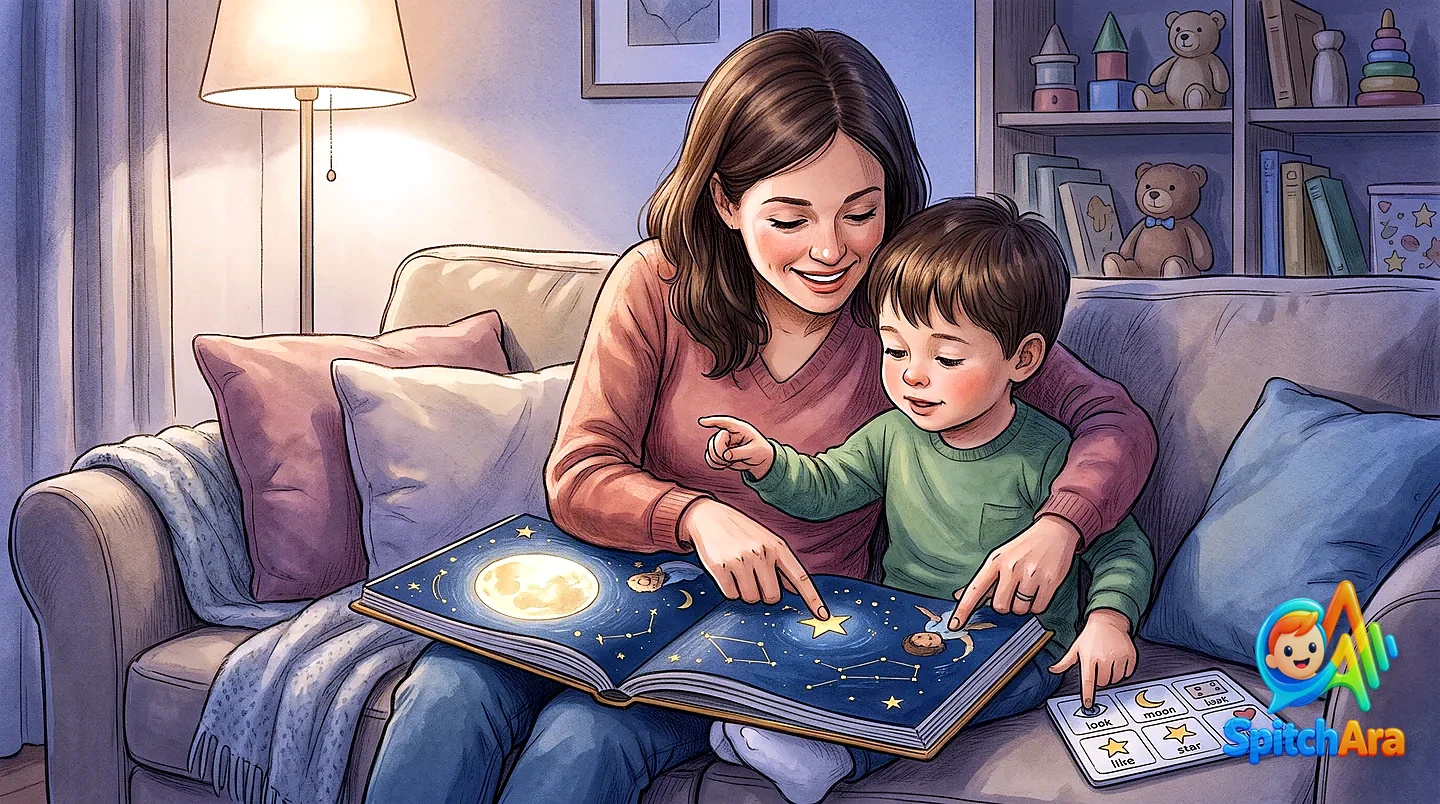
You open a picture book, ask “What's that?”, and wait. Your child touches the page without answering. After a few more questions, you hear yourself naming every picture while the child tries to turn ahead. What began as a story has quietly become a test.
There is another way to share the book. You can follow the picture your child notices, say something brief about it, and respond to whatever comes back. A sound, a smile, a movement, or a point can keep the exchange going. Using few spoken words does not prevent a child from taking part in a story.
Find the part of the book that matters today
Start by observing rather than explaining. The child may be interested in a tiny dog at the edge of a page while you are trying to introduce the main character. That dog is a usable starting point because you already have a shared topic.
You might say, “The dog is hiding,” then leave space. If the child touches it, you can add, “Behind the chair.” If they turn the page instead, follow the change rather than returning them to the answer you expected.
This does not mean every reading must be child-led from beginning to end. It means the adult adjusts to what the child can join. Some days a child enjoys hearing the complete story. On another day, one picture may support the whole conversation.
Choose a book you can both handle comfortably. Clear pictures, familiar actions, a sturdy format, or a topic the child loves may help you find a starting point. The right choice is not necessarily the book advertised for a particular birthday.
Offer language without asking the child to prove it
A useful comment describes something visible or interesting. “The cup fell,” “That is a huge bus,” or “He wants the ball” gives the child language linked to an event. The NHS includes talking about pictures and adding a little to children's words among its practical language suggestions (National Health Service, 2023).
Consider a hypothetical exchange. A child points at a muddy boot. The adult says, “Dirty boot.” The child makes a splash sound. The adult answers, “Splash! It went in the puddle.” Nobody has asked the child to repeat, yet the child's contribution has changed what the adult says next.
If the child already uses a word, expand its meaning without turning the moment into correction. “Dog” might become “Dog sleeping.” If the child says “dog sleep,” you might respond, “The dog is sleeping on the bed.” Keep the reply small enough to fit the conversation.
The point is not to calculate the perfect sentence length. Notice whether your reply helps the child stay with the topic. If you are explaining three new ideas while the child is still exploring one picture, shorten your contribution.
Leave a real space for a response
Adults often pause briefly and then fill the silence with another question. A more useful pause is one in which the child has a chance to act. Put the book where they can see it, keep your own response relaxed, and notice movement as well as speech.
There is no universal number of seconds that makes every child respond. Some children need more processing time; others are ready immediately or prefer to listen. Use the child's pace and any individualized advice from their clinician.
If nothing happens, you can simply continue. A pause is an invitation, not a demand with a countdown. “I wonder where the cat went” can be followed by looking together, rather than repeating the question until the child produces an answer.
For a child who uses signing, pictures, or a communication device, keep those methods available during the story. Positioning the book so it blocks the device or occupies both the child's hands can unintentionally remove their easiest way to participate.
Ask fewer questions and make the useful ones count
Questions are not forbidden. The issue is what they ask the child to do. “What colour? What animal? How many?” may be easy for an adult to deliver but can leave little room for the child's own interests.
A genuine question has an answer you are willing to hear. “Which page should we look at?” lets the child influence the activity. “Do you think he wants to go home?” may open a conversation for a child who already enjoys talking about stories.
If a question is too difficult, offer a comment rather than rapidly adding hints. For example, instead of repeating “Why is she crying?”, you might say, “Her tower fell. She looks upset.” The child can then point, make a sound, connect it to their own experience, or simply listen.
The same picture can support different levels of conversation. One child may enjoy “ball,” another “ball under chair,” and another “He cannot reach it because the chair is in the way.” You do not need to push every child towards the most complex version.
What research adds to this everyday activity
A review of 19 randomized trials found that interventions teaching caregivers to share picture books produced modest average benefits in children's language, alongside larger changes in caregivers' book-sharing skills (Dowdall et al., 2020). The studies involved structured interventions, so they do not establish that any single reading technique will produce a particular result for your child.
That distinction is useful. It supports investing attention in the interaction, while avoiding a promise that finishing a book each day will resolve a language difficulty. A child can enjoy shared reading and still need assessment or individualized support.
For a family, the immediate question can be simpler: “Did we make it easier for our child to join?” You may notice a new way of choosing a page, a longer exchange about a picture, or less pressure to perform. These are practical observations to discuss, not a substitute for clinical outcome measures.
When the book does not hold your child's attention
First, check the situation. Is the child hungry, tired, uncomfortable, or interested in something nearby? Moving reading to a different moment may be more useful than insisting on a longer session.
You can also change the format. Try looking at one page on the floor, pairing a picture with a familiar toy, or using a homemade page about a recent event. If the child repeatedly returns to the same book, repetition can be a comfortable way to re-enter a shared conversation.
Avoid treating closing the book as failure. You might say, “Finished with the book,” and put it aside. Later, an object or event may bring the same idea back naturally. A bus on the street can remind you both of the bus in the picture.
If concerns extend beyond book time, such as persistent difficulty communicating needs or understanding everyday language, discuss them with an appropriate professional. Making reading more enjoyable is useful, but it should not become a reason to postpone advice.
Choose one change for the next story
For the next reading, choose a single adjustment: comment before asking, follow the child's chosen picture, or leave more space after your own turn. Trying everything at once can make the adult feel as though they are performing a method.
Afterwards, remember one specific moment. “He touched the umbrella, and we made rain sounds together” tells you more than “Reading went well.” If you did not find a shared moment, note what made the activity difficult and choose a smaller starting point next time.
The book can remain a place for closeness, surprise, and shared attention. When the conversation grows out of what the child actually notices, even a quiet page can contain plenty to say.
References
Centers for Disease Control and Prevention. (2026a, February 16). Concerned about your child’s development? https://www.cdc.gov/act-early/families/concerned.html
Dowdall, N., Melendez-Torres, G. J., Murray, L., Gardner, F., Hartford, L., & Cooper, P. J. (2020). Shared picture book reading interventions for child language development: A systematic review and meta-analysis. Child Development, 91(2), e383–e399. https://doi.org/10.1111/cdev.13225
Federal Trade Commission. (n.d.-b). Protecting your child’s privacy online. https://consumer.ftc.gov/articles/protecting-your-childs-privacy-online
National Health Service. (2023, April 26). Help your baby learn to talk. https://www.nhs.uk/baby/babys-development/play-and-learning/help-your-baby-learn-to-talk/
Petrie, A., Mayr, R., Zhao, F., & Montanari, S. (2023). Parent-child interaction during storybook reading: Wordless narrative books versus books with text. Journal of Child Language, 50(1), 104–131. https://doi.org/10.1017/S0305000921000763
World Health Organization. (2022, April 27). Caregiver skills training for families of children with developmental delays or disabilities: Introduction. https://www.who.int/publications/i/item/9789240048836
