
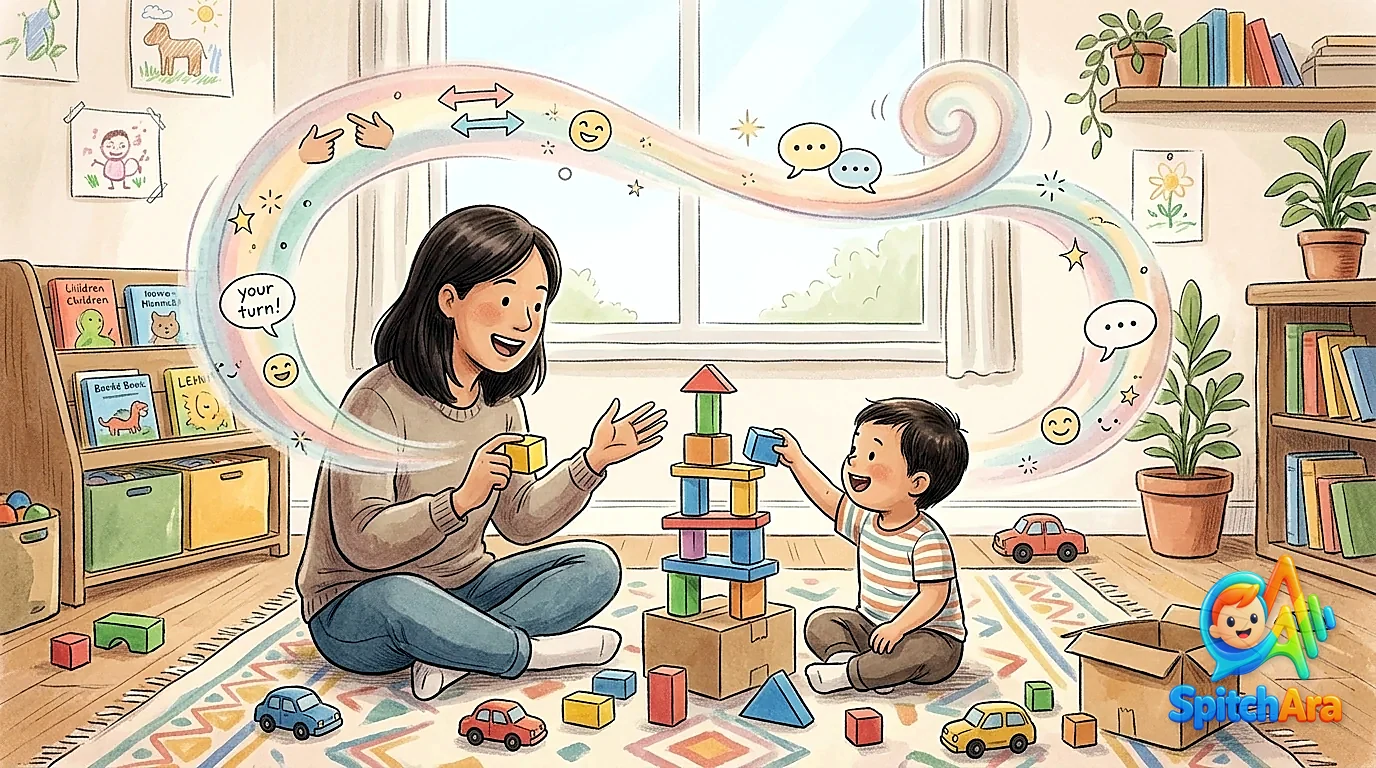
One caregiver has been told to use short phrases. Another thinks the child should hear only one language. A grandparent wants to help but has received instructions in unfamiliar words. A multilingual family can end up with several well-intended plans that do not fit together.
A home communication plan for more than one language should begin with one shared purpose, such as helping the child ask for help or take part in a familiar game. Caregivers can support that purpose in their own natural language. Consistency does not require everyone to use an identical script or to remove a language from family life.
Map the family before choosing activities
Write down who spends regular time with the child, which languages they use, and which routines they share. Include grandparents, siblings, childcare staff, and other important people. A plan based only on the person attending appointments may overlook much of the child's week.
Then ask each caregiver which interactions already feel comfortable and which are difficult. One person may have easy conversations during cooking; another may find shared play more natural. These differences can help place support where it has a realistic chance of happening.
Research discussion of bilingual family strategies describes several approaches rather than one necessary arrangement for every home (Byers-Heinlein & Lew-Williams, 2013). Use that flexibility. A plan should reflect the people and opportunities the family actually has, not an ideal timetable that nobody can maintain.
Agree on a purpose that matters to the child
“Increase language” is too broad to guide an ordinary afternoon. “Make it easier to ask for help when a toy gets stuck” is clearer. The goal identifies a situation, a message, and a reason another person should respond.
Consider a hypothetical child who brings a closed container to whichever adult is nearby. The family agrees to recognise that gesture, help promptly, and model a short phrase in the language each adult uses. The shared purpose is accessible help. The exact words can differ.
If a clinician is involved, ask how the home purpose connects with the assessment and recommended support. Do not turn a convenient family idea into a clinical goal without discussion. The professional can help decide what is appropriate for the child's current needs.
Keep the message available in different forms
The child may use a word with one person, a gesture with another, and a picture at nursery. Describe those methods so that caregivers know what to look for. A communication attempt should not become invisible because it differs from the form an adult expected.
If the child has an established communication support, agree on where it stays and how it travels between settings. A plan that mentions a device but leaves it out of reach during play is incomplete. Ask the child's professional for help with access or vocabulary questions.
The family can also agree to check uncertain interpretations. “I think you want help opening it” gives the child a chance to correct the adult. A shared understanding of a signal should remain responsive to context rather than becoming a rigid rule.
Translate the purpose rather than every sentence
An English example such as “Car goes” may not map neatly onto the most natural short phrase in another language. Ask what the example is intended to accomplish: naming an action, adding a detail, or modelling a request. Then express that purpose naturally.
A caregiver who feels awkward using a translated script may speak less freely or focus on remembering the wording. Invite them to suggest an equivalent expression they would actually use. The plan should make interaction easier, not make every adult sound like a workbook.
If professional guidance is unclear, bring the question back: “What feature of this phrase matters, and can we use this expression in our language?” That conversation is more productive than either copying the wording mechanically or abandoning the strategy entirely.
Put the plan into one ordinary routine
Choose a routine that happens reliably and does not already feel overloaded. A few minutes of shared play may work better than a rushed morning meal. Identify what the adult will notice, how they will respond, and how the child can indicate that they are finished.
For example, during a favourite car game, one caregiver may comment on the action and then leave room for the child to choose the next turn. Another caregiver can do the same later in a different language. Neither needs to count identical phrases or reproduce the other's play exactly.
Keep the initial plan small enough to review. If you introduce several new strategies at once, it becomes harder to tell which part is useful or burdensome. A clear small change gives the family something concrete to discuss.
Record examples without comparing caregivers
A shared note can include the situation, the child's message, and what the adult did. “During the puzzle, he handed me the piece and used his help sign” is enough. The note is there to support understanding, not to rank which adult elicited more words.
Different caregivers may see different responses because the activities, languages, and relationships differ. Treat that as information. Ask what was easier in one setting and whether any useful support can be carried into another.
Avoid turning the record into a competition between languages. More words in one language on one day do not tell the whole story. The family's aim is communication across meaningful relationships, not an equal score in every column.
Revisit worries without blaming multilingualism
If the child continues to struggle, seek appropriate professional advice and bring the plan and observations. Learning more than one language does not cause developmental language disorder (National Institute on Deafness and Other Communication Disorders, 2023). Removing a language should not replace an assessment of a persistent concern.
Ask how each language and setting will be represented in the evaluation. Explain where the plan helped and where it did not. That information can guide adjustments even when the family cannot yet explain the underlying difficulty (American Speech-Language-Hearing Association, n.d.-a).
Keep the child's strengths visible too. A gesture that becomes easier for several caregivers to understand may improve daily participation even if spoken vocabulary changes little. It is worth describing accurately without treating it as proof that all concerns have resolved.
Review the plan as a family conversation
After trying the routine, discuss three practical questions: Was the purpose clear? Could each caregiver use the approach naturally? Could the child influence the exchange? If any answer is no, simplify or seek guidance on the difficult part.
Agree on one adjustment and who needs to know about it. A short explanation in the caregiver's preferred language may be more useful than a long set of translated instructions. Keep the plan where it is easy to find, alongside any relevant professional recommendations.
A multilingual home plan works when it protects the family's ways of connecting while making communication easier. The shared element is the response to the child. The languages can remain as varied and familiar as the people who use them.
References
American Speech-Language-Hearing Association. (n.d.-a). Multilingual service delivery in audiology and speech-language pathology [Practice Portal]. https://www.asha.org/practice-portal/professional-issues/multilingual-service-delivery/
Byers-Heinlein, K., & Lew-Williams, C. (2013). Bilingualism in the early years: What the science says. LEARNing Landscapes, 7(1), 95–112. https://pmc.ncbi.nlm.nih.gov/articles/PMC6168212/
Centers for Disease Control and Prevention. (2026a, February 16). Concerned about your child’s development? https://www.cdc.gov/act-early/families/concerned.html
National Health Service. (2023, April 26). Help your baby learn to talk. https://www.nhs.uk/baby/babys-development/play-and-learning/help-your-baby-learn-to-talk/
National Institute on Deafness and Other Communication Disorders. (2023, May 8). Developmental language disorder. https://www.nidcd.nih.gov/health/developmental-language-disorder
World Health Organization. (2022). Caregiver skills training for families of children with developmental delays or disabilities: Introduction. https://www.who.int/publications/i/item/9789240048836
