
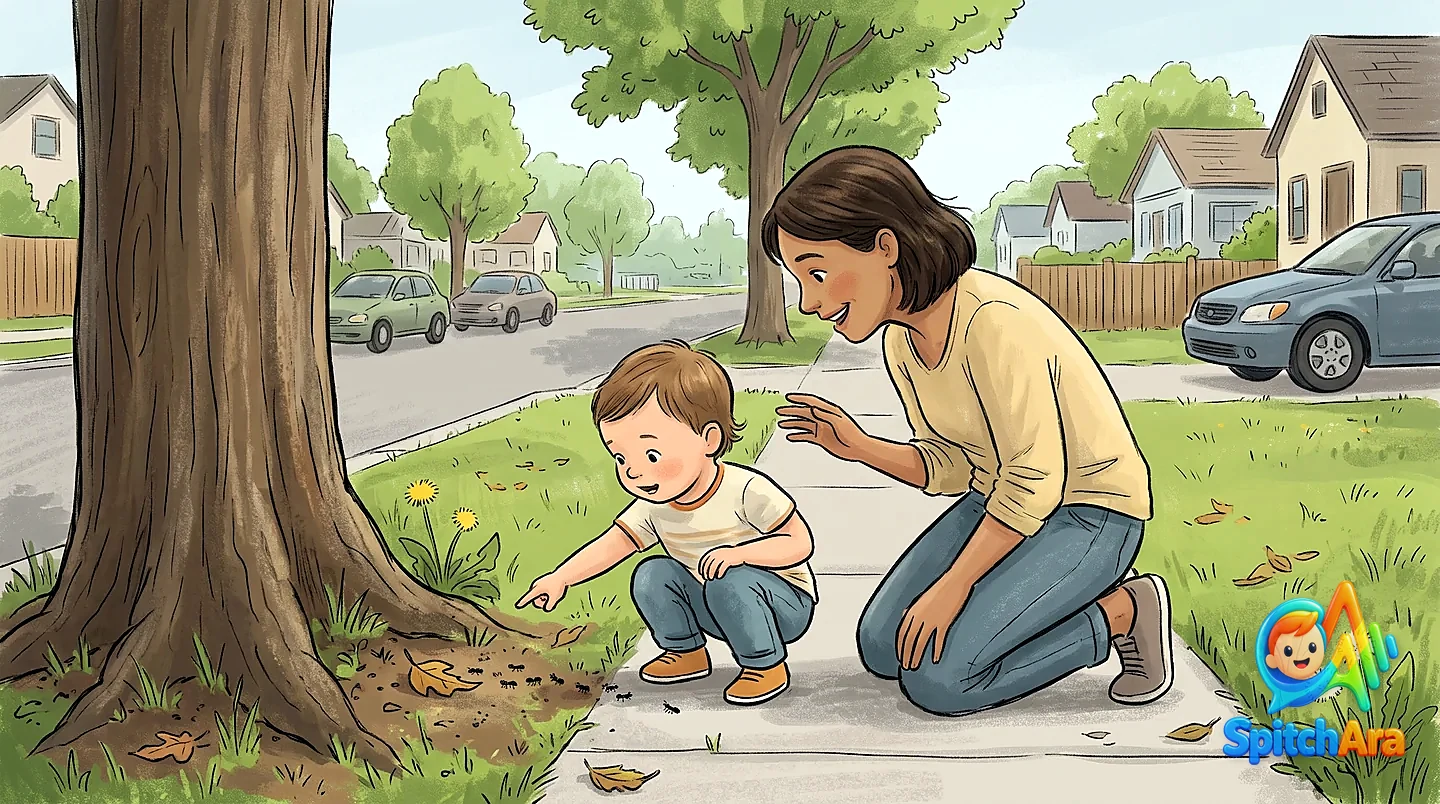
A delivery van stops, a leaf catches on a shoe, and a dog barks behind a gate. A short walk can contain more things worth discussing than a box of learning materials. The difficulty is often deciding which event to follow, especially when an adult is also watching the road, managing bags, or trying to arrive somewhere on time.
Language play outdoors can be simple: notice what your child has noticed, add a few useful words, and allow a response. You do not need a special destination or a running commentary. Safety and access come first, so choose moments when you can comfortably share attention without losing track of the surroundings.
Let the child choose the subject when possible
An adult may want to name flowers while the child is watching a drain. Start with the drain. “Water goes down” links language to the child's current interest. Once the message has a shared reference, there may be more room for another observation.
You can tell that a subject interests the child in different ways. They may point, slow down, move towards it, make a sound, or return to look again. If you are unsure, say what you think they mean and leave space for correction. “You saw the bus?” is an interpretation, not a conclusion you must defend.
Suppose a child in a stroller keeps turning towards a building site. The caregiver stops in a safe place and says “Big truck.” When the truck moves, the child vocalises. “Truck going” follows the event. No quiz was needed to create several connected turns.
Match the amount of language to the moment
A busy street may already make listening difficult. A brief comment can be easier to follow than a detailed explanation of every vehicle. When you reach a quieter spot, you can say more if the child remains interested.
The NHS suggests naming what a child can see and adding detail as language develops (National Health Service, 2023). Outdoors, the detail might be an action or change: “Bird flying,” “Door open,” or “Leaves moving.” The phrase should fit the child's current understanding and the event, rather than being selected because it contains a target colour or number.
If the child says “dog,” you might answer “Dog running.” If they point without speaking, you can offer the same comment. In both cases, the adult adds language while keeping the child's message at the centre of the exchange.
Use the route as a story with a few memorable events
A familiar route can develop its own small sequence: leaving the gate, passing a shop, crossing safely, and reaching the park. You can mention what is happening now and, when useful, what comes next. “Shop first, then park” is an example, not a rule for every child's level of understanding.
After an interesting event, connect it to another moment. “The dog was here yesterday” may fit a child who enjoys recalling familiar encounters. A child using fewer words might simply hear “Dog again.” This provides continuity without requiring an elaborate retelling.
On the way home, you could revisit one event rather than asking the child to recount the entire trip. “That truck was loud” invites a reaction. A movement, sound, or word may show what the child remembers. If nothing comes, you can share your own comment and move on.
Make room for asking, refusing, and changing plans
Walks create practical messages: wanting to stop, needing help, choosing a direction, or asking to leave. These messages matter more than completing a planned language game. Notice them and respond within the safety limits of the situation.
If your child uses an established communication aid, plan how it remains accessible outdoors. Carrying it is not the same as making it available. Think about weather protection, positioning, and how the child will signal that they want it. Follow their existing access plan rather than improvising a replacement that removes familiar choices.
A refusal can also guide the walk. If the child turns away from a noisy area, you can acknowledge the reaction and find a quieter route when possible. You do not have to decide immediately whether the response reflects noise, fatigue, uncertainty, or another need. Describe what you observed and check what helps.
Adjust for the way your family moves
An outdoor conversation does not require a child to walk independently. It can happen from a wheelchair, stroller, bench, doorway, or window overlooking a shared space. Choose a position from which the child can notice the subject comfortably and you can understand their response.
Likewise, an outing does not need to be long. A few minutes near the entrance may provide more enjoyable interaction than a complicated trip. The relevant question is whether the environment offers something the child wants to share, not how many steps the family completes.
If you are accompanying more than one child, let each contribute without making the quickest speaker answer for everyone. You might acknowledge a sibling's observation and then return to the other child's signal: “You saw it too.” This keeps the exchange inclusive without turning the walk into a formal turn-taking exercise.
Avoid turning curiosity into a test
Repeatedly asking “What is that?” can make an outing feel like a naming assessment. Sometimes you genuinely need information, and a question is appropriate. At other times, a comment better communicates that you are interested in sharing the experience.
Compare “What colour is the van?” with “The van stopped right here.” The second phrase gives the child something to respond to without demanding a predetermined answer. They may notice the door, the driver, or the noise instead. That difference is useful because conversation is about exchanging meanings, not merely demonstrating labels.
You can still repeat familiar words naturally. “Bus coming,” “Bus stopped,” and “Bus gone” arise because the event changes. Repetition tied to a real sequence is different from asking the child to say “bus” five times before the walk continues.
Bring one observation home
If you keep communication notes, record a small event with its context. “At the crossing, she pointed to the red light. I said ‘Wait,’ and she looked towards the traffic.” The note does not prove a particular skill, but it gives a professional or another caregiver a concrete example to discuss.
You may also discover that the child communicates differently outdoors than at home. Treat that difference as a question. Is the subject more interesting? Is the environment harder to hear in? Does the child have easier access to you? Several explanations may be possible.
For your next outing, choose a safe place to pause and follow one interest. You do not need to manufacture a learning moment. The passing van, the moving leaves, or the familiar shop may already provide one, if there is enough space for the child to share it with you.
References
American Speech-Language-Hearing Association. (n.d.). Late language emergence [Practice Portal]. https://www.asha.org/practice-portal/clinical-topics/late-language-emergence/
American Speech-Language-Hearing Association. (n.d.). Spoken language disorders [Practice Portal]. https://www.asha.org/practice-portal/clinical-topics/spoken-language-disorders/
National Health Service. (2023, April 26). Help your baby learn to talk. https://www.nhs.uk/baby/babys-development/play-and-learning/help-your-baby-learn-to-talk/
National Institute on Deafness and Other Communication Disorders. (2022, October 13). Speech and language developmental milestones. https://www.nidcd.nih.gov/health/speech-and-language
World Health Organization. (2022, April 27). Caregiver skills training for families of children with developmental delays or disabilities: Introduction. https://www.who.int/publications/i/item/9789240048836
