
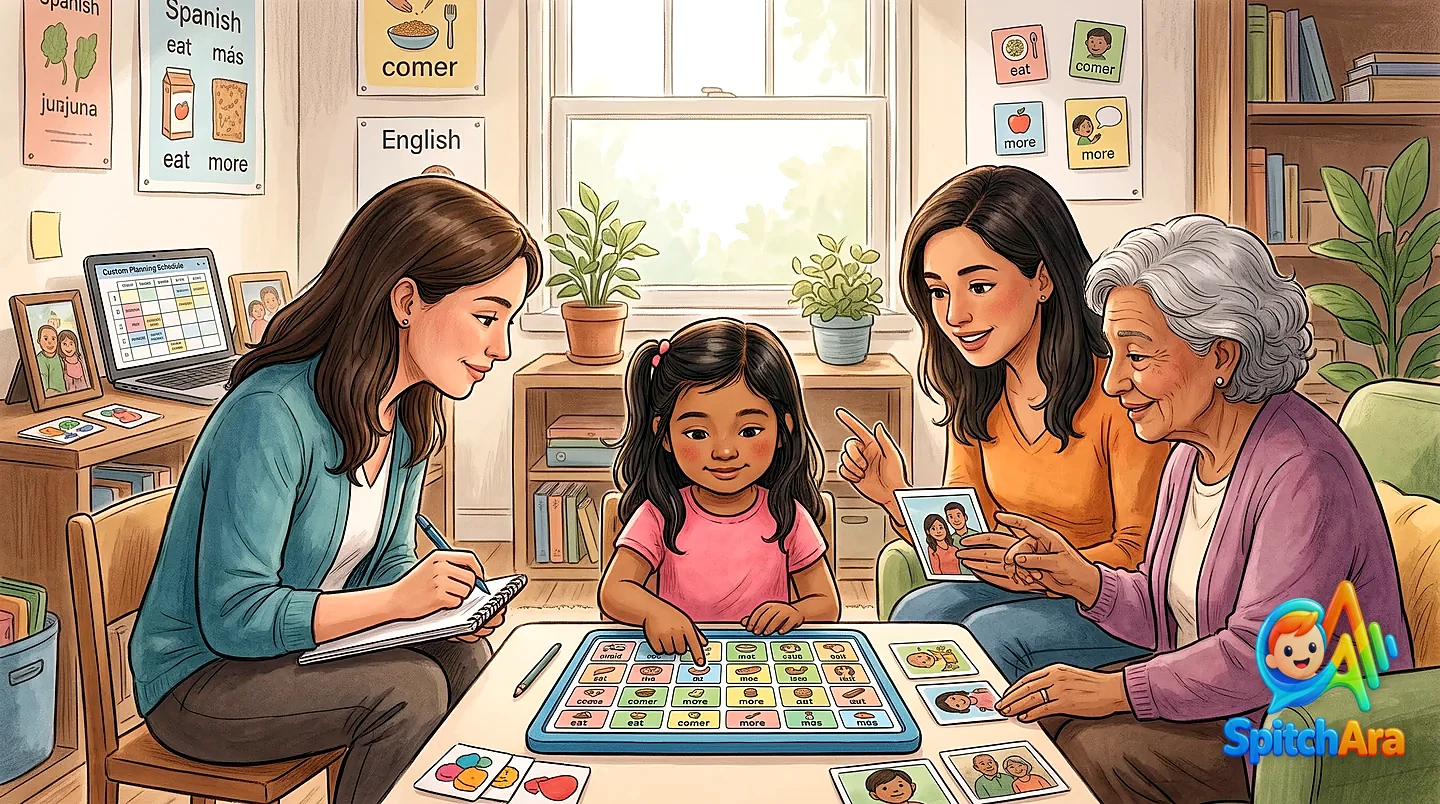
A child uses one language with a parent, another with a grandparent and a third at preschool. Their communication device, however, offers only the language used in therapy. The device may work during an appointment while leaving important family conversations out of reach.
AAC planning needs to include the languages and people in the child's actual life. A language selector on an app is only one part of the question. Vocabulary, voice, grammar, navigation, literacy and partner support can all affect whether the child can communicate meaningfully across settings.
Make a map of real conversations
Start with people and situations rather than a list of languages alone. Who helps the child get ready, shares meals, plays, tells stories or offers comfort? Which language does each person use naturally? Which messages are difficult for the child to convey in those exchanges?
A simple note might identify a grandparent who uses a home language during meals, a sibling who mixes languages during play and preschool staff who use the community language. This shows the assessment team where communication access is needed. It also prevents the language of the clinic from becoming the default simply because it is easiest for the professional (Byers-Heinlein & Lew-Williams, 2013).
ASHA's AAC guidance advises considering language history and culturally relevant vocabulary, including access to the languages used in the person's environment (American Speech-Language-Hearing Association, n.d.). The practical implication is to assess the whole communication setting, not just the child's performance in one language.
Look beyond translated buttons
Two systems may both advertise a language but provide very different experiences. One may translate menu labels while leaving the vocabulary and speech output unchanged. Another may offer a voice but require awkward navigation between languages. A third may include words that are technically correct but unfamiliar to the family.
Ask to try a representative exchange. Can the child address a relative by the name actually used at home? Can they express a refusal, ask for help and comment on a familiar activity? Can a caregiver understand how to model a message without translating every step mentally?
Grammar matters too. Word order and inflections differ across languages. A literal English-to-another-language mapping may not produce a natural message. Ask how the system handles the language rather than assuming that every translated word can be combined in the same way.
Keep family expressions and personal vocabulary visible
Names, nicknames, familiar foods, places and culturally meaningful routines can make a system more relevant. These are not decorative additions. They allow a child to participate in conversations that matter to the people around them.
Suppose a child wants to ask for a particular story told by a grandparent. A generic “book” symbol may not convey that request. A suitable way to refer to the story, person or familiar opening phrase could make the exchange more specific. The exact solution should fit the child's access and vocabulary plan.
At the same time, avoid building a system consisting only of personalized nouns. The child also needs flexible language to comment, question, refuse and connect ideas. Work with the AAC professional to balance frequently useful language with personally meaningful content.
Plan how language changes will work
Ask what happens when the child moves between languages during an ordinary activity. Is switching accessible? Does the layout remain understandable? Can partners model their language without disrupting the child's familiar navigation? The answer may differ between systems and access methods.
Try these questions in real settings, not only in a sales demonstration. A switch that is manageable at a desk may be difficult during travel or play. Document the barrier and ask whether there is a simpler configuration or another suitable option.
Do not change the child's established system abruptly to solve a language problem. Preserve a workable means of communication while the team trials and teaches adjustments. The child should not lose familiar access while adults debate which language arrangement is best.
Include adults who use each language
Caregivers may need demonstrations and instructions in a language they understand. A family member who cannot follow the training should not be blamed for using the system inconsistently. Ask about interpreters, translated resources or a professional with relevant language skills.
Invite relatives to contribute natural wording and explain everyday routines. They may recognize an expression that a direct translation misses. Their input should be combined with clinical and access expertise, rather than treated as a substitute for professional assessment.
An adult can speak naturally while modelling a relevant message, according to the child's plan. They do not need to narrate every action or use a language they cannot manage comfortably. The aim is a communication partner who is available and responsive, not a perfect technical performance.
Do not remove a language because communication is difficult
Families sometimes receive advice to use only one language to avoid confusion. Such advice needs careful scrutiny. Learning multiple languages does not cause developmental language disorder, and meaningful home-language relationships remain important (National Institute on Deafness and Other Communication Disorders, 2023).
That does not mean every multilingual AAC arrangement is effortless. There may be real limitations in voices, vocabulary or access. The response should be to identify and address those barriers, not assume that the child's family must abandon a language as the default solution.
If the team recommends prioritizing particular features or introducing changes gradually, ask why and how the other languages will remain available. A practical implementation sequence should not quietly become permanent exclusion.
Review whether the child can participate with more people
At follow-up, discuss specific exchanges. Could the child ask a grandparent for a familiar activity? Could preschool staff understand a message used at home? Were there messages the system could not express naturally? These examples reveal more than the number of languages listed in the product description.
Communication rights include culturally and linguistically appropriate interaction (National Joint Committee for the Communication Needs of Persons With Severe Disabilities, n.d.). For a multilingual family, that principle becomes concrete when the child can speak to the people who matter through an accessible system.
The next step is to bring your language-and-people map to the AAC team. Ask for a trial that includes real messages in real routines. A multilingual system is successful when it supports those exchanges, not merely when a settings menu contains the right language names.
References
American Speech-Language-Hearing Association. (n.d.). Augmentative and alternative communication (AAC). https://www.asha.org/practice-portal/professional-issues/augmentative-and-alternative-communication/
American Speech-Language-Hearing Association. (n.d.). Spoken language disorders [Practice Portal]. https://www.asha.org/practice-portal/clinical-topics/spoken-language-disorders/
Byers-Heinlein, K., & Lew-Williams, C. (2013). Bilingualism in the early years: What the science says. LEARNing Landscapes, 7(1), 95–112. https://pmc.ncbi.nlm.nih.gov/articles/PMC6168212/
National Institute on Deafness and Other Communication Disorders. (2023, May 8). Developmental language disorder. https://www.nidcd.nih.gov/health/developmental-language-disorder
National Joint Committee for the Communication Needs of Persons With Severe Disabilities. (n.d.). Communication bill of rights (3rd ed.). American Speech-Language-Hearing Association. https://www.asha.org/njc/communication-bill-of-rights/
Roberts, M. Y., Curtis, P. R., Sone, B. J., & Hampton, L. H. (2019). Association of parent training with child language development: A systematic review and meta-analysis. JAMA Pediatrics, 173(7), 671–680. https://doi.org/10.1001/jamapediatrics.2019.1197
