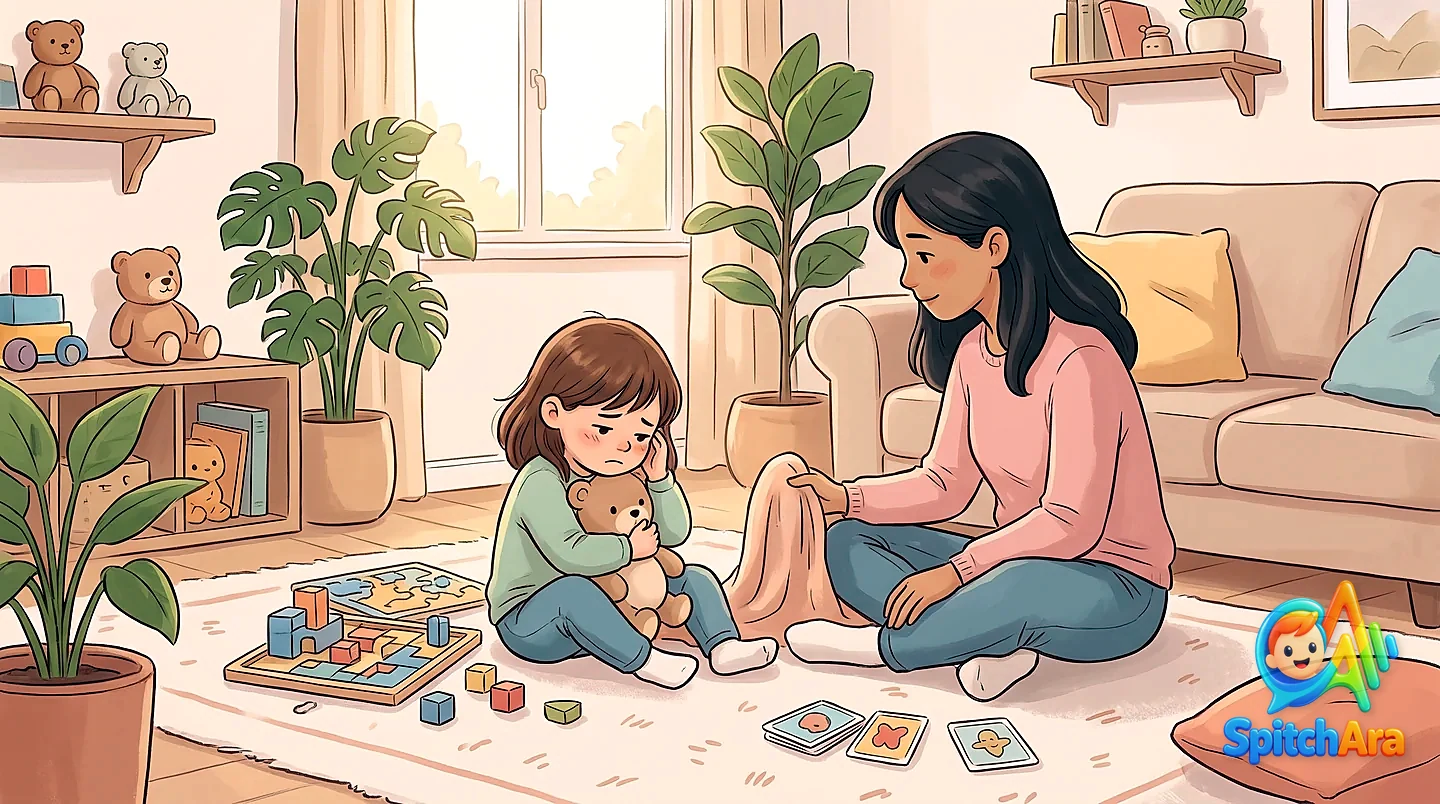
The activity seemed manageable yesterday. Today your child turns away, covers their ears and pushes the materials aside. It is easy to interpret this as resistance to practice. A more useful first question is what has changed in the child's experience of the activity.
When a child appears overwhelmed, reduce the demand and support comfort before trying to teach more language. Noise, fatigue, pain, uncertainty, physical access and the interaction itself can all matter. A home practice plan should be adjustable enough to respond to those conditions.
Notice the situation before naming the behaviour
Describe what you see: “She moved away when the music started,” or “He pushed the cards aside after the third question.” These descriptions preserve information that labels such as uncooperative or unmotivated lose.
Then consider the surrounding events. Was the room busier? Had the child just returned from a demanding day? Was a familiar sequence changed? Is there a possible physical discomfort? You may not know the answer immediately. The point is to investigate rather than assume that more encouragement will solve the difficulty.
For autistic children, sensory and environmental factors can affect communication and participation, and support should consider the individual profile (American Speech-Language-Hearing Association, n.d.). This does not explain every difficult moment. New or significant changes, especially with possible pain or illness, warrant appropriate health advice.
Stop adding demands while you work out what is needed
Repeated instructions, questions and explanations can increase the load when a child is already struggling. Pause the optional activity, lower your voice and make the immediate situation simpler. Keep established communication supports available.
If the child moves away, allow space when safe. If they seek closeness, respond according to their preferences. Do not assume that every child finds touch, a quiet corner or a particular object calming. Familiar caregivers may know what is usually helpful, but the child can still need something different today.
A clear “finished” or “we're pausing” can explain what is happening. Avoid turning the pause into a bargain in which comfort is available only after one more response. The child should not have to demonstrate a communication target to obtain relief from an optional demand.
Change one feature of the activity
Once the child is comfortable, consider whether to resume at all. If they want to continue, choose a smaller version. You might use fewer objects, remove background sound, shorten the sequence or replace questions with comments.
For example, imagine a book activity that has become a rapid series of “What's this?” questions. The adult could close the questioning loop and simply notice one picture: “The dog is wet.” The child can look, turn the page or leave. The adjustment changes the interaction, not merely the length of the session.
Another child may need a physical adaptation: a stable tray, a larger item or an easier way to select a message. If access is a recurring problem, ask the relevant professional to observe the task rather than repeatedly asking the child to try harder.
Make transitions understandable without making them rigid
Some children benefit from knowing what will happen next. A familiar object, photograph or simple sequence can support that understanding. Introduce the support during real routines and check whether the child appears to use it meaningfully.
Research on visual supports at home and in the community describes varied approaches and outcomes, emphasizing the need for individualization (Rutherford et al., 2020). A schedule is therefore an option to explore, not a guarantee that distress will disappear.
It also needs to accommodate real changes. If the planned walk is cancelled, show or explain the new plan in an accessible way. Do not insist on completing an unsuitable activity simply because it appears on a visual sequence. Predictability should help the child understand life, not force life to follow a card.
Preserve the child's ways to refuse and ask for help
A child may use a gesture, movement, sound, word or AAC message to show that an activity is too much. Respond before demanding a more recognizable signal. Later, a professional can help broaden the child's available ways to communicate the need.
Check whether adults consistently honour “stop,” “break” and “different.” If a message is acknowledged only when the child is calm and precise, it may fail at the moment it is most needed. Communication rights include refusal and access to individualized communication systems (National Joint Committee for the Communication Needs of Persons With Severe Disabilities, n.d.).
A practical family agreement might be, “When he pushes the materials away, we pause and check. We do not immediately put them back in front of him.” The exact response will depend on the situation, but the principle is to treat the signal as information.
Review the plan with the professional
Bring a concrete account of a difficult routine: what the activity involved, what happened before distress, what the child did and what seemed to help. Avoid presenting a guessed cause as a fact. “The room was quieter when she rejoined” is different from “Noise caused the problem.”
Ask whether the goal, materials, length or expected response should change. A home plan may need to fit the family's available time and the child's energy more closely. If the professional gives a strategy, ask for a demonstration and a way to tell whether it is helping.
Choose a useful ending
An activity can end without a final successful trial. Put materials away, acknowledge the child's contribution and return to an ordinary routine. Ending while everyone is settled may preserve willingness to engage another time.
Later, choose one change for the next attempt, or decide that a different activity would serve the goal better. Success is not measured only by completed minutes. A child who can communicate discomfort earlier, and an adult who can respond sooner, may have gained something more useful than another repetition.
References
American Speech-Language-Hearing Association. (n.d.). Autism and autism spectrum disorder. https://www.asha.org/practice-portal/clinical-topics/autism/
American Speech-Language-Hearing Association. (n.d.). Spoken language disorders [Practice Portal]. https://www.asha.org/practice-portal/clinical-topics/spoken-language-disorders/
American Speech-Language-Hearing Association. (n.d.-a). Augmentative and alternative communication (AAC). https://www.asha.org/practice-portal/professional-issues/augmentative-and-alternative-communication/
Centers for Disease Control and Prevention. (2026a, February 16). Concerned about your child’s development? https://www.cdc.gov/act-early/families/concerned.html
National Joint Committee for the Communication Needs of Persons With Severe Disabilities. (n.d.). Communication bill of rights (3rd ed.). American Speech-Language-Hearing Association. https://www.asha.org/njc/communication-bill-of-rights/
Rutherford, M., Baxter, J., Grayson, Z., Johnston, L., & O'Hare, A. (2020). Visual supports at home and in the community for individuals with autism spectrum disorders: A scoping review. Autism, 24(2), 447–469. https://doi.org/10.1177/1362361319871756
