
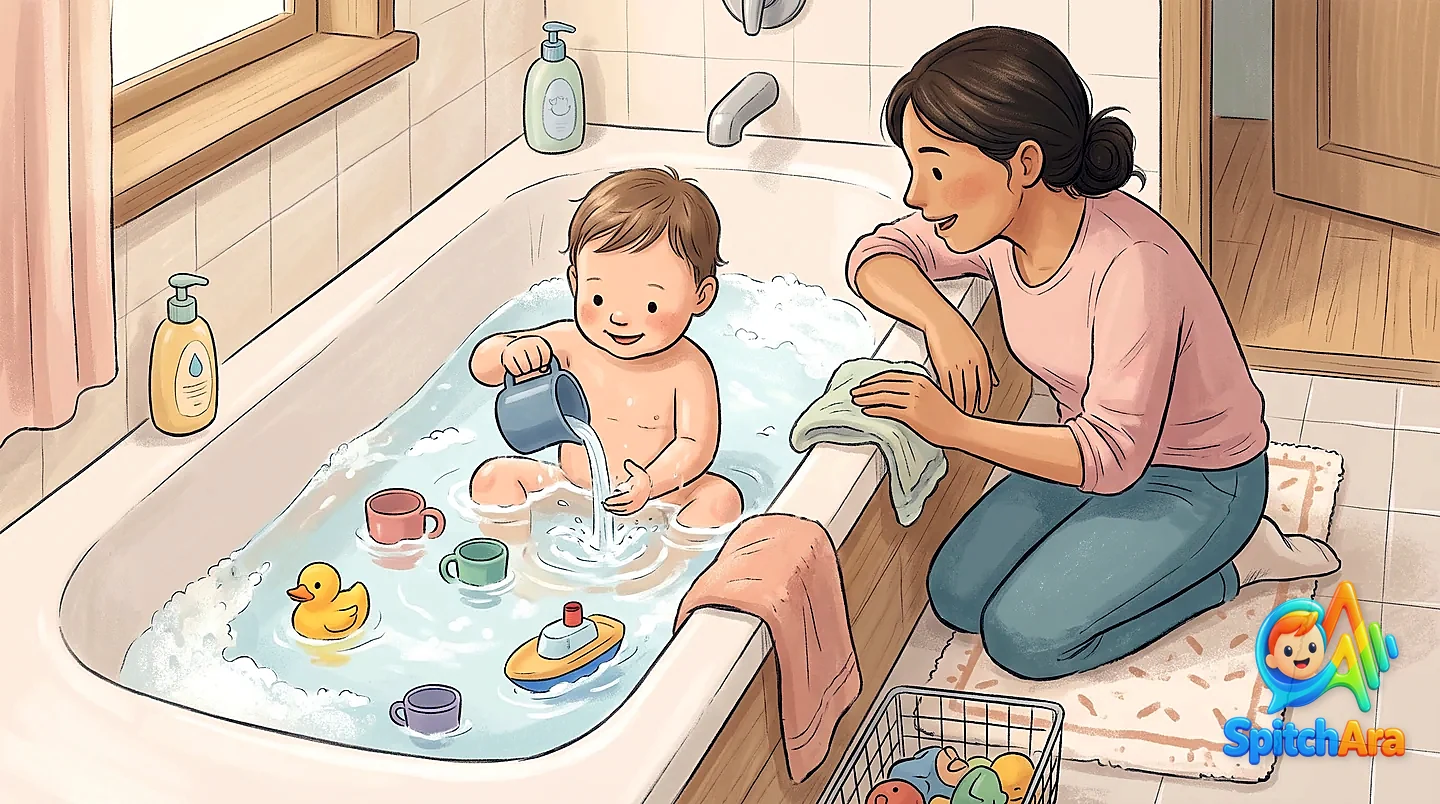
The cup is full, then empty. Water goes in, pours out, and runs away. For a child who enjoys bath time, these ordinary changes can be more interesting than a carefully planned language game. An adult can join with “Full” or “All gone” and let the action carry the meaning.
However, bath time is first a care routine. Bath-time language play should fit around safe supervision, comfort, and washing. It should never require looking away to complete an activity, delaying help, or keeping a child in an uncomfortable bath for an extra speaking opportunity. If the bath is difficult, language support can happen elsewhere.
Find the part your child already enjoys
Before choosing words, notice what holds the child's interest. One child watches water pour; another likes squeezing a cloth; another wants to finish quickly. These are different starting points. A pouring game will not be helpful simply because it appears in an activity list if your child dislikes water moving near their face.
Suppose your child repeatedly tips water from a familiar cup. You might say “Pour” as the action begins and “Empty” when it ends. Then stop speaking long enough to see what happens next. If the child holds the cup towards you, refill it as appropriate while acknowledging the invitation. The child has contributed to the sequence.
This approach draws on the general idea of talking during everyday care described by the NHS (National Health Service, 2023). The particular example is an illustration of how an adult might do that, not a prescribed therapy exercise with a guaranteed result.
Connect a word with a visible change
Bath time can make action words unusually clear. “Pour,” “wash,” “wipe,” and “dry” happen as they are said. Describing one change can therefore be more useful than naming every object around the tub. The child can see what your words refer to without having to shift attention repeatedly.
Choose the phrase according to the exchange. If the child uses a single word, you might add one useful detail: “Wash feet” or “Cup empty.” If the child uses no spoken words, the same short phrases can still accompany an action. Do not insist that the child imitate before the routine continues.
For example, a child touches the cloth and makes a questioning sound. “Wet cloth” names what is there. If the child then pushes it away, you can acknowledge “No cloth” and check what they need. A useful conversation can change direction; it does not have to stay with the word you intended to teach.
Use choices only when both options work
Some choices are easy to honour: “Blue cloth or green cloth?” or “Wash hands first or feet first?” Other questions are not genuine choices because an essential care task still needs to happen. In that case, explain what comes next and offer control over a practical detail rather than asking a question whose answer you cannot accept.
A child can choose by reaching, pointing, looking towards an option, signing, speaking, or using an established support. Confirm your interpretation when necessary. “You chose the green one” is a response to a decision. “Say green” adds a different demand that may have nothing to do with the child's purpose.
If a child appears overwhelmed by the question, make it easier or remove it. You can show the available cloth, describe the next step, and complete the routine calmly. Reducing a communication demand is a reasonable adjustment, not evidence that the activity has failed.
Turn a repeated action into a shared sequence
A repeated action can make your turn easier to anticipate. You fill the cup; the child pours; you comment; the child offers the cup again. The sequence gives each person a place. Nevertheless, it should remain responsive. If the child stops offering the cup, do not treat that as a missing answer to be extracted.
You might add a small variation when the child seems interested. A cup can pour into a familiar bath container instead of directly into the water. “In the pot” describes the change. If the variation distracts or upsets the child, return to the simpler action. Novelty is optional; understanding the exchange is more valuable than continually inventing new games.
Avoid turning the routine into a rapid series of questions: “What colour? What is it? Where is it going?” Try one comment and observe whether the child adds anything. The pause is there to make room for a contribution, not to create a deadline for speech.
Keep refusal and discomfort understandable
An adult can be so focused on encouraging “more” that “stop” receives less attention. Bath time makes this imbalance especially important. A child may move away, stiffen, push a hand aside, or use a familiar signal when something feels unpleasant. Treat the signal as information and work out what needs to change.
You can provide words while responding: “Water away from face” or “You want a break.” These phrases are examples of adult interpretation, so check rather than assume. A movement might mean discomfort, surprise, fatigue, or something else. Its meaning depends on the child and situation.
When a care task remains necessary, explain it simply and use the child's established supports. If a clinician or other professional has helped the family with sensory, movement, or care needs, follow that individual plan. A general language article cannot decide what adjustment is appropriate for every child.
Carry the conversation beyond the water
The towel stage offers another kind of exchange. “Warm towel,” “Foot out,” and “All dry” connect language with what is happening. A child who is cold or tired may need less talk, however. Finish care first and return to a conversation later if that suits them better.
At another time, a toy cup on a dry floor might recreate part of the pouring routine without the same care demands. You can pretend to fill it, offer it to a toy, or let the child decide what it becomes. This is useful when the bath itself is too busy for shared play. The family does not need every routine to perform the same job.
For the next bath, choose one action to describe and one signal to notice. Afterwards, ask yourself whether the words followed the child's attention and whether the child could affect what happened. If the answer is yes, a short exchange may have been enough. There is no requirement to turn washing into a lesson that lasts longer than the child wants.
References
American Speech-Language-Hearing Association. (n.d.). Spoken language disorders [Practice Portal]. https://www.asha.org/practice-portal/clinical-topics/spoken-language-disorders/
Centers for Disease Control and Prevention. (2026a, February 16). Concerned about your child’s development? https://www.cdc.gov/act-early/families/concerned.html
National Health Service. (2023, April 26). Help your baby learn to talk. https://www.nhs.uk/baby/babys-development/play-and-learning/help-your-baby-learn-to-talk/
National Institute on Deafness and Other Communication Disorders. (2022, October 13). Speech and language developmental milestones. https://www.nidcd.nih.gov/health/speech-and-language
Roberts, M. Y., Curtis, P. R., Sone, B. J., & Hampton, L. H. (2019). Association of parent training with child language development: A systematic review and meta-analysis. JAMA Pediatrics, 173(7), 671–680. https://doi.org/10.1001/jamapediatrics.2019.1197
