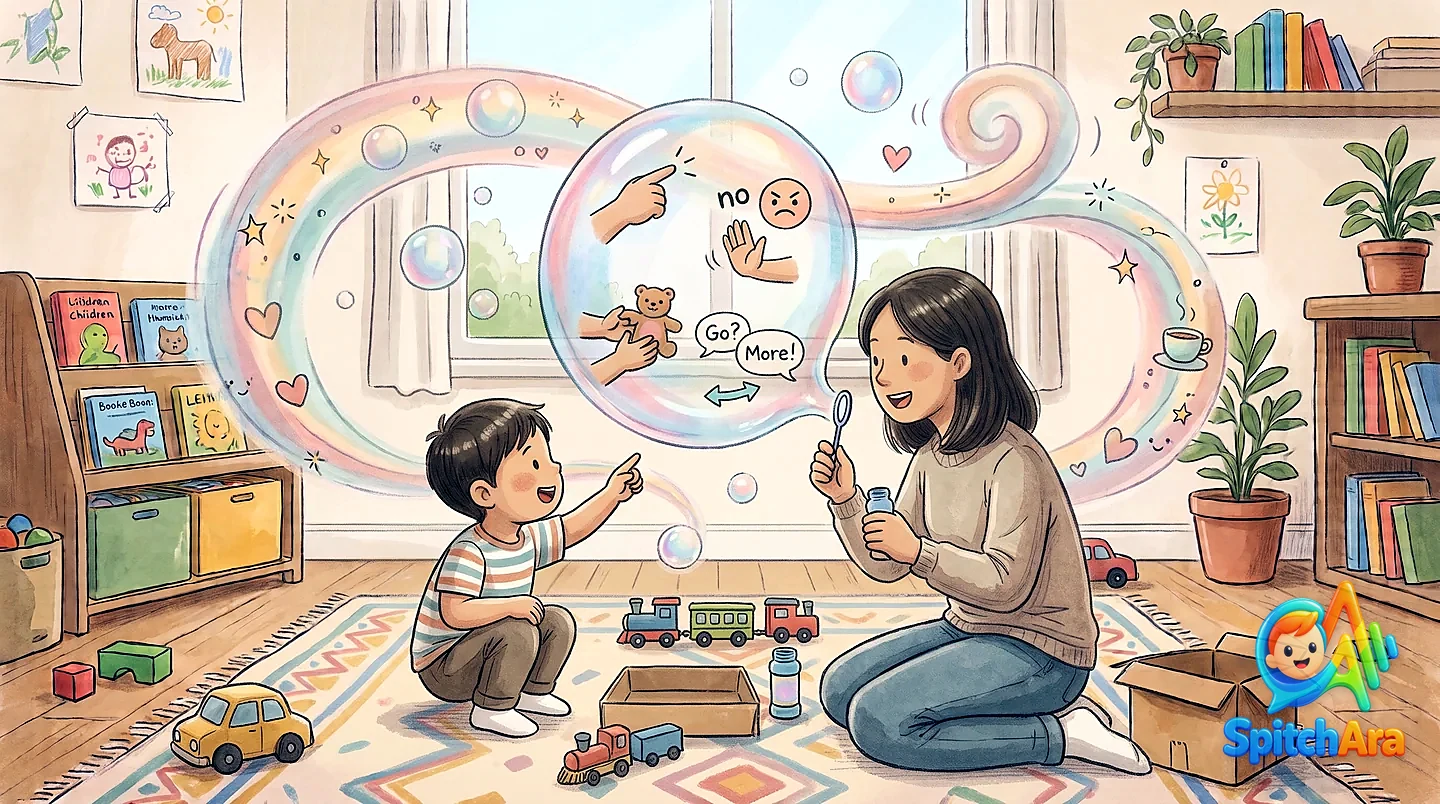
Imagine blowing a small cloud of bubbles while your child watches one drift towards the curtain. You are ready to ask, “More?” Yet the interesting part, from your child's point of view, may be the bubble that landed, the wet patch on the floor, or the surprise of a sudden pop. If every exchange returns to requesting more bubbles, much of that conversation disappears.
Bubble play can make room for noticing, protesting, sharing and choosing as well as requesting. The activity works best when you respond to what your child is already communicating and make your own words easy to connect with the moment. It is an invitation to interact, not a test of whether a child can say a particular word.
Start with comfort and practical safety
Before opening the bottle, consider whether bubbles are enjoyable for this child today. A child who turns away from the wand may dislike the unpredictability, the smell or the possibility of liquid touching their face. Move the activity farther away or choose something else. Watching quietly is also a legitimate way to take part; chasing or popping is not compulsory.
Use a product intended for the child's age, follow its label and keep the liquid out of the child's mouth and eyes. An adult should manage the bottle and wand when needed. Choose a stable surface, wipe slippery spills promptly and avoid blowing directly towards anyone's face. These arrangements leave you freer to notice communication because you are not trying to rescue the activity every few seconds.
A child with particular medical, sensory or swallowing needs may need an alternative agreed with their professional. You can explore the same conversational ideas through a rolling ball or a slowly moving scarf. There is no special therapeutic ingredient in the bubble itself.
Give the child's interest a name
Begin with one short comment about something both of you can notice: “Up it goes,” “That one popped,” or “On your sleeve.” Then leave room. Your child might point, laugh, lean forward, make a sound or use a familiar picture. Respond to that contribution before adding another instruction.
For example, suppose a child points at a bubble caught on the adult's hand. The adult could say, “It landed,” keep the hand still briefly and see what happens. If the child reaches towards it, “Pop” fits the action. If they pull back, “You want to watch” is a tentative interpretation, not a fact to insist on. The adult can wait and revise the interpretation if the child shows otherwise.
The reason for keeping the comment close to the action is practical: both people have a shared reference. NHS guidance recommends naming what children can see, responding to their early words and using meaningful everyday sounds (National Health Service, 2023). That general principle does not prescribe a bubble script or guarantee a new word after a set number of turns.
Let more than one message be possible
“More” is useful, but it is only one message. A child may want the adult to stop, move the wand, blow towards a sibling, help with a lid, or look at something unexpected. If you accept only one answer, you may miss the reason the child approached you.
One way to broaden the conversation is to describe your own choices naturally. “I'll blow gently.” “That was too many.” “I'm putting it here.” You can also offer a real choice between two acceptable options, such as blowing near the window or towards an open part of the room. Accept a gesture or the child's established communication method. If neither option appeals, an honest “Neither” is useful information.
Avoid manufacturing frustration to obtain a request. Holding the bottle out of reach while repeatedly saying “Use your words” changes a shared activity into a condition the child must satisfy. A brief, comfortable pause is different: it makes space without withholding an essential response or ignoring an already clear message.
Follow a small exchange instead of counting repetitions
Here is a hypothetical sequence. An adult blows a few bubbles. The child watches one behind the chair and points. The adult turns, says “Behind the chair,” and waits. The child moves around the chair. The adult follows at a comfortable distance and says, “You found it.” The child laughs when it pops. “Gone,” says the adult, before offering the next turn.
Nothing in that exchange requires the child to repeat a word. Nevertheless, the child's point changes what the adult does, and the adult's language follows the child's meaning. That is a useful observation to remember: the interaction had a topic, a response and a shared outcome.
If the child does say “Gone,” respond to the meaning first. “Yes, that one's gone” fits better than stopping the game to demand five more repetitions. Likewise, an AAC selection or gesture should receive an ordinary conversational response. The aim is for communication to work, whichever accessible form the child uses.
Adjust when the game becomes tiring
Bubble play can become intense quickly. Notice whether your child is still choosing to participate or is merely waiting for your next demand. Turning away, moving the equipment aside or becoming unusually still may mean it is time to pause. These behaviours are not a score of motivation; look at the whole situation and the child's familiar signals.
You might reduce the number of bubbles, lower your voice or stop the activity. If a sibling keeps taking over, give the children separate opportunities or use a different game. Fairness does not require identical turns when their access needs differ.
An adult's enthusiasm can also fill every gap. Try noticing one complete exchange before talking again. There is no universally correct number of seconds to wait. Your child's response speed, the complexity of the situation and their communication system matter more than a timer.
Keep one observation that is worth sharing
Afterwards, write a sentence if it will help you remember something useful: “When a bubble landed behind the chair, she pointed and waited for me to look.” This is more informative than “Good bubble session.” You can add what you did and whether the child seemed comfortable.
Do not turn the note into a clinical conclusion. Pointing during one game does not settle a question about language development, and not joining the game does not establish a disorder. If you are concerned about communication across daily life, bring examples to a speech-language professional or your child's usual health professional. Assessment can consider understanding, expression and hearing as appropriate (National Institute on Deafness and Other Communication Disorders, 2022) (American Speech-Language-Hearing Association, n.d.-b).
At the next opportunity, the most useful change may be small: follow one unexpected bubble, accept one clear “stop,” or respond to one gesture you would previously have missed. The game becomes richer when the child can influence where it goes.
References
American Speech-Language-Hearing Association. (n.d.). Spoken language disorders [Practice Portal]. https://www.asha.org/practice-portal/clinical-topics/spoken-language-disorders/
Centers for Disease Control and Prevention. (2026, February 16). Concerned about your child’s development? https://www.cdc.gov/act-early/families/concerned.html
Dowdall, N., Melendez-Torres, G. J., Murray, L., Gardner, F., Hartford, L., & Cooper, P. J. (2020). Shared picture book reading interventions for child language development: A systematic review and meta-analysis. Child Development, 91(2), e383–e399. https://doi.org/10.1111/cdev.13225
National Health Service. (2023, April 26). Help your baby learn to talk. https://www.nhs.uk/baby/babys-development/play-and-learning/help-your-baby-learn-to-talk/
National Institute on Deafness and Other Communication Disorders. (2022, October 13). Speech and language developmental milestones. https://www.nidcd.nih.gov/health/speech-and-language
World Health Organization. (2022, April 27). Caregiver skills training for families of children with developmental delays or disabilities: Introduction. https://www.who.int/publications/i/item/9789240048836
