
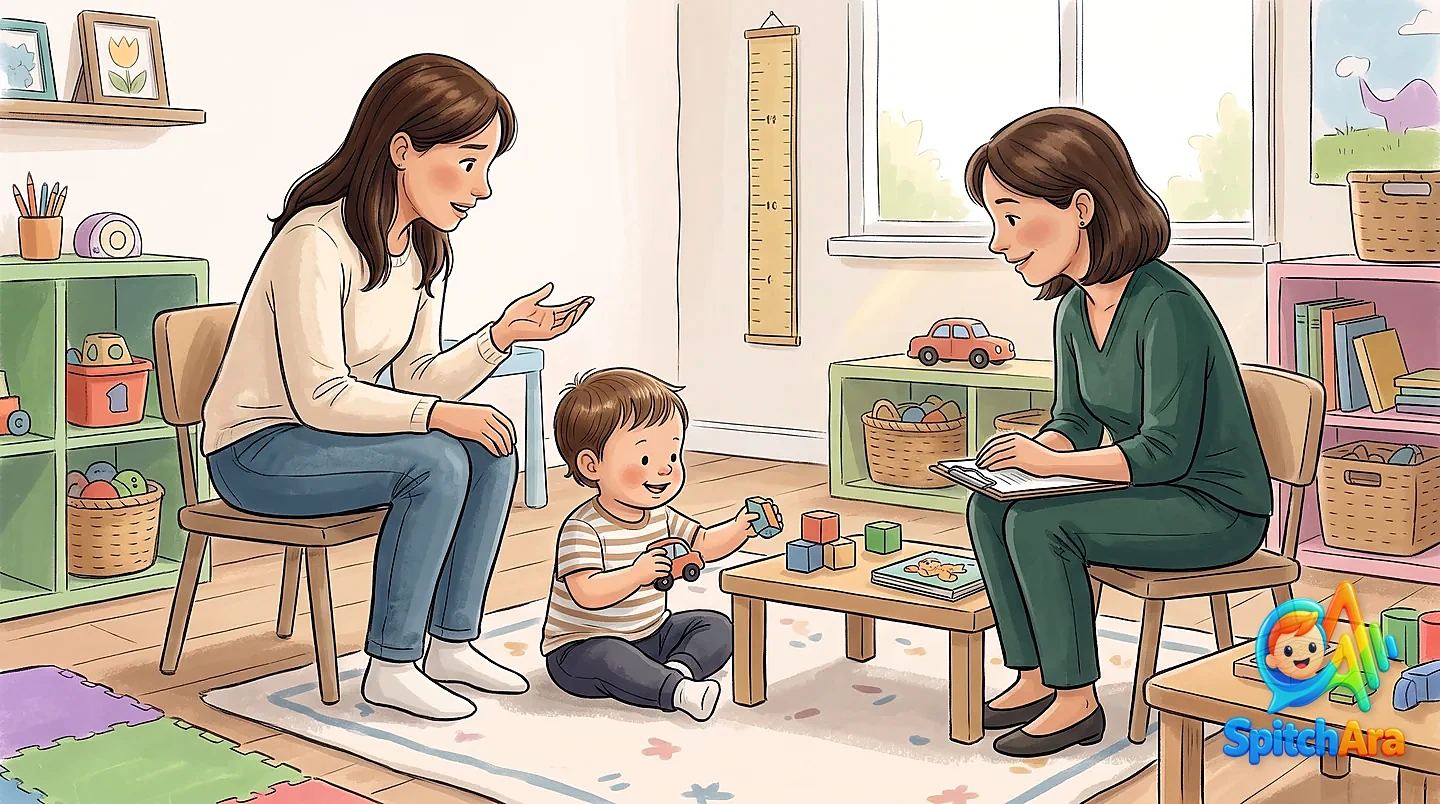
At eighteen months, a caregiver may notice a mixture of strengths and questions. A child brings a favourite book but uses few words. They follow a familiar routine but do not always respond to a request. Comparing that picture with another child's vocabulary can leave you more worried without making the next step clearer.
If you are concerned about an eighteen-month-old's communication, discuss the concern with the child's health professional. A small set of specific observations can help that conversation. You do not need to wait until every item on a checklist is missing, and you do not need to diagnose the reason yourself (American Speech-Language-Hearing Association, n.d.-b).
Use milestones to organise a question
The CDC's eighteen-month examples include trying at least three words beyond names such as “mama” and “dada,” and following a one-step direction without a gesture. The checklist is not a diagnostic test (Centers for Disease Control and Prevention, 2026). Its useful role is to help you identify what you want to discuss.
If an example does not fit your child, write down what you have actually seen. Perhaps the child follows the instruction when you point, or uses a consistent sound that family members recognise. These details should not be hidden merely because they do not fit a simple yes-or-no box.
Conversely, one successful response does not settle every concern. A child may do something once, under familiar conditions, and have difficulty elsewhere. Describe both the successful situation and the situations that remain hard so that the professional can interpret the pattern.
Notice different reasons for communicating
Start with ordinary purposes: asking for something, refusing, getting help, and sharing interest. A child who brings a cup may be requesting a drink. A child who points at a bird may be sharing a discovery. A child who pushes an object away may be declining it. Context helps you understand the difference.
For example, imagine a child handing a shoe to an adult near the door. The adult says “Outside?” and the child moves towards the door. That exchange gives useful information even without a spoken word. It does not prove a diagnosis or rule one out; it simply describes how the child communicated in that moment.
Record the child's usual methods, including gestures, sounds, signs, pictures, or words. If one signal is hard to interpret, say so. “I think this means help, but I am not always sure” is more accurate than assigning a definite meaning to every movement.
Separate the words from the surrounding clues
Everyday understanding is supported by routines, objects, and other people's actions. A child may come to the table when food appears without relying on the spoken invitation alone. That is a useful ability, but it is different from following an unfamiliar spoken instruction.
You do not need to create difficult tests. Notice naturally occurring situations instead. Did the child respond when you mentioned a familiar object that was not in view? Did they need pointing as well as speech? Was the environment noisy? Such observations help clarify what was available to support understanding.
Speech and language evaluation considers communication and general development, and may include hearing assessment (National Institute on Deafness and Other Communication Disorders, 2022). Therefore, tell the professional about hearing concerns or relevant history even if the child responds to some sounds at home (American Speech-Language-Hearing Association, n.d.-a).
Include changes over time
A list of abilities is useful, but the direction of change matters too. Are new forms of communication appearing? Are existing signals used with more people? Has the child stopped using a word, gesture, or skill that was previously established?
If there has been loss of acquired skills, raise it promptly when seeking advice. The CDC includes lost skills among the reasons to act on developmental concerns (Centers for Disease Control and Prevention, 2026). Do not begin a home exercise programme as a condition for mentioning the change.
Try to describe the timing without overstating precision. “We noticed it over the last few weeks” may be more honest than inventing an exact date. If you have an older note or recording, it may help, but a perfect archive is not required to seek care.
Prepare one page rather than a dossier
Write the child's age, the languages used regularly, the concern in one sentence, and a few examples. Include relevant hearing or health history and previous assessments. If other caregivers have noticed something different, add their observations with the setting in which they occurred.
A hypothetical summary might say: “At home she points to food and brings toys for help. She sometimes says a familiar word after us, but we rarely hear it spontaneously. At nursery, staff report that she mainly reaches for objects.” This gives the professional several questions to explore without suggesting an answer in advance.
Ask the service whether it wants videos, forms, or records before the visit. Use its secure process rather than sending identifiable recordings through an uncertain channel. The aim is to make the consultation clearer, not to collect as much private material as possible.
Support communication without adding pressure
While arranging advice, continue ordinary warm interaction. Follow an interest, describe a visible action, and respond to the child's message. If they reach for a toy, you can name it as you help. If they decline, acknowledge the refusal rather than treating it as a missed opportunity to practise a word.
Avoid repeated demonstrations for relatives or repeated checks of whether the child can say something today. Such testing may show what happens under pressure rather than how the child communicates naturally. A few comfortable exchanges can provide more useful observations.
Keep the family languages and established communication supports available. If you are unsure how to adapt an activity, bring that practical question to the appointment: “How can we make it easier for her to show us what she wants?” is more actionable than “How do we make her talk?”
Ask for a clear follow-up plan
Before leaving, clarify what the professional recommends, who will arrange it, and when you should expect the next contact. If monitoring is suggested, ask what will be monitored and which changes should prompt an earlier review.
You can also ask which observations would be most useful to collect next. This prevents the family from trying to track everything. A focused note about requests or responses may be more helpful than an exhausting daily word count.
The goal of preparing observations is not to prove that your worry is justified. It is to help the professional understand your child in everyday life. Start with what you have noticed, include the strengths as well as the difficulties, and ask for the next step in terms you can use.
References
American Speech-Language-Hearing Association. (n.d.). Childhood hearing screening [Practice Portal]. https://www.asha.org/practice-portal/professional-issues/childhood-hearing-screening/
American Speech-Language-Hearing Association. (n.d.-b). Late language emergence [Practice Portal]. https://www.asha.org/practice-portal/clinical-topics/late-language-emergence/
Centers for Disease Control and Prevention. (2026, February 16). Concerned about your child’s development? https://www.cdc.gov/act-early/families/concerned.html
Centers for Disease Control and Prevention. (2026, May 15). Milestones by 18 months. https://www.cdc.gov/act-early/milestones/18-months.html
Dowdall, N., Melendez-Torres, G. J., Murray, L., Gardner, F., Hartford, L., & Cooper, P. J. (2020). Shared picture book reading interventions for child language development: A systematic review and meta-analysis. Child Development, 91(2), e383–e399. https://doi.org/10.1111/cdev.13225
National Institute on Deafness and Other Communication Disorders. (2022, October 13). Speech and language developmental milestones. https://www.nidcd.nih.gov/health/speech-and-language
