
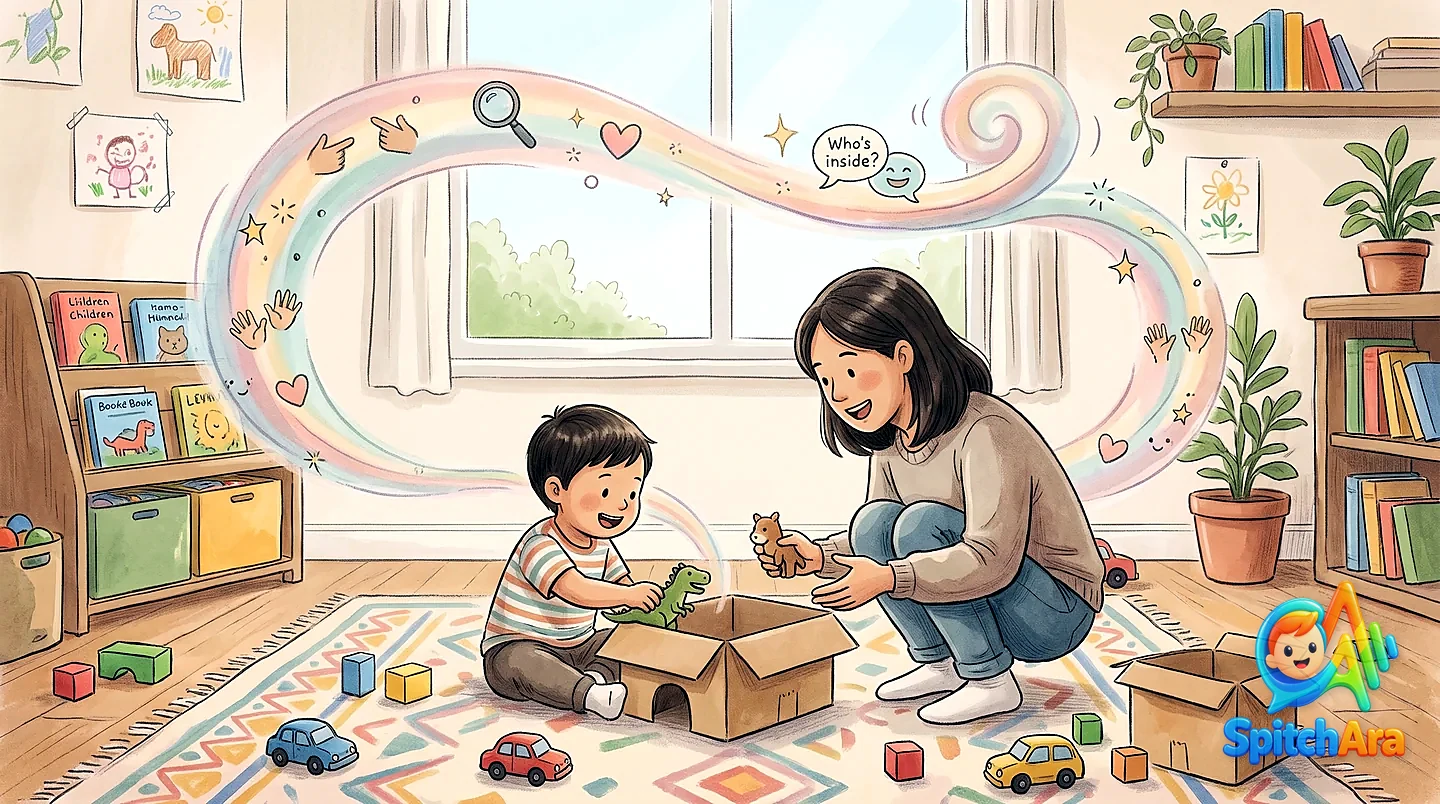
Imagine this change of plan. You have set out a pretend picnic, but your child is interested in turning the basket upside down. It is easy to think the activity has gone wrong. Another possibility is that the child has shown you where to begin. The basket, rather than the picnic, is the subject available for a shared exchange.
Following your child's lead in play means noticing their current interest and responding in a way they can recognise. It does not mean abandoning safety or never introducing an idea. It means that your contribution connects with what the child is doing instead of requiring them to leave their interest before interaction can begin.
Observe the action before naming the goal
Take a moment to see what the child repeats, examines, or changes. Are they watching movement, comparing sounds, arranging objects, or acting out an event? The answer may be different from the conventional purpose of the toy.
For a hypothetical example, a child lines up cars by size. An adult could immediately insist on driving them. Alternatively, the adult could place another car nearby and comment “This one is small.” If the child accepts the addition or moves it, that response gives the adult something to follow.
Observation does not require interpreting every action perfectly. If you are unsure, make a tentative comment or offer a small contribution and watch the response. The child's correction is useful information, not resistance to the activity.
Join in a way that leaves the child some control
You might copy an action with your own object, take a role the child offers, or comment on a visible event. Avoid taking the main object out of the child's hands to demonstrate what they should do. Joining is easier to recognise when it does not remove the child's access to the play.
If the child taps a box, you could tap another surface once and wait. If they cover a toy, you might cover a second toy. The aim is to offer a possible connection, not to imitate relentlessly when the child would prefer space.
Notice signs that your contribution is welcome. The child may repeat the action, offer an object, move closer, or change the game to include you. They may also move away or stop. Respond to that information rather than assuming that more adult involvement is always better.
Put words beside the shared event
Once you are following the same subject, a brief comment can make the connection between words and meaning clearer. “Car under” fits a car disappearing beneath a cushion. “Tall tower” fits the child's construction. The words do not need to describe every detail.
NHS guidance supports talking about everyday activities and building on children's contributions (National Health Service, 2023). In child-led play, the practical question is whether your phrase matches the event the child is attending to. A well-pronounced vocabulary list is less useful if it concerns something the child is not currently noticing.
If the child speaks, respond to the idea first. “Broken” might become “Bridge broken” while you look together. If they communicate without speech, acknowledge that message just as carefully. A gesture can lead the conversation as effectively as a spoken word.
Introduce a small idea without taking over
Following the child's lead does not prevent you from adding something. The size and timing of the addition matter. Offer one change that connects with the existing play, then see whether the child uses it.
If the child is rolling a car, a short ramp may be an interesting variation. You can place it nearby and demonstrate once with another car. If the child ignores it, return to the original game. The new idea is an invitation, not a hidden instruction that the child must discover.
This approach also helps you interpret difficulty. If the child becomes upset, the change may have been too large, too sudden, or simply unwanted. You do not need to decide immediately which explanation is correct. Reduce the demand and notice what restores comfortable participation.
Let the conversation include disagreement
A child may move your object, reject your interpretation, or choose a different sequence. Those responses can carry clear meaning. If you say “Bear sleeping” and the child makes the bear jump, you can acknowledge “Bear awake!” rather than returning it to bed.
The example matters because adult-led language practice often rewards agreement more readily than correction. Yet being able to say “not that” or show another idea is an important part of real interaction. A game becomes more reciprocal when the child's disagreement can influence it.
Keep ordinary safety boundaries clear. If a proposed action is unsafe, explain and redirect without pretending that all choices are available. Child-led does not mean that the adult stops providing care or supervision.
Adapt for access and sensory preferences
An interest may be easier to share when the materials are stable, reachable, or quieter. Think about what allows the child to participate rather than interpreting a difficulty as a lack of motivation. Follow individual professional recommendations about positioning and communication access where relevant.
If the child uses a device, pictures, or signs, make those methods available within the play. Do not reserve them only for asking an adult to start the activity. The child may need them to comment, change a rule, ask for help, or stop.
Some children prefer an adult nearby rather than directly in front of them. Others need more space or shorter exchanges. Use the child's response to adjust your position and pace. Shared interest does not require a particular eye-contact pattern.
Review your own contribution
After a short play period, consider what you did. Did you notice before instructing? Did you follow a change in the child's idea? Did your words connect with a visible event? These questions are often easier to act on than trying to decide whether the child “played correctly.”
If a clinician has suggested following the child's lead, ask them to demonstrate the difference between joining, modelling, and prompting. The terms can sound similar until you see them in a real exchange. Then discuss what feels natural in your family (American Speech-Language-Hearing Association, n.d.-b).
At the next play time, begin with the basket if that is what interests your child. There may eventually be a picnic, or there may be a game about turning and tapping. The useful starting point is the same: something the child wants to explore, and an adult willing to make their own contribution fit.
References
American Speech-Language-Hearing Association. (n.d.). Late language emergence [Practice Portal]. https://www.asha.org/practice-portal/clinical-topics/late-language-emergence/
Centers for Disease Control and Prevention. (2026a, February 16). Concerned about your child’s development? https://www.cdc.gov/act-early/families/concerned.html
National Health Service. (2023, April 26). Help your baby learn to talk. https://www.nhs.uk/baby/babys-development/play-and-learning/help-your-baby-learn-to-talk/
National Institute on Deafness and Other Communication Disorders. (2022, October 13). Speech and language developmental milestones. https://www.nidcd.nih.gov/health/speech-and-language
World Health Organization. (2022, April 27). Caregiver skills training for families of children with developmental delays or disabilities: Introduction. https://www.who.int/publications/i/item/9789240048836
