
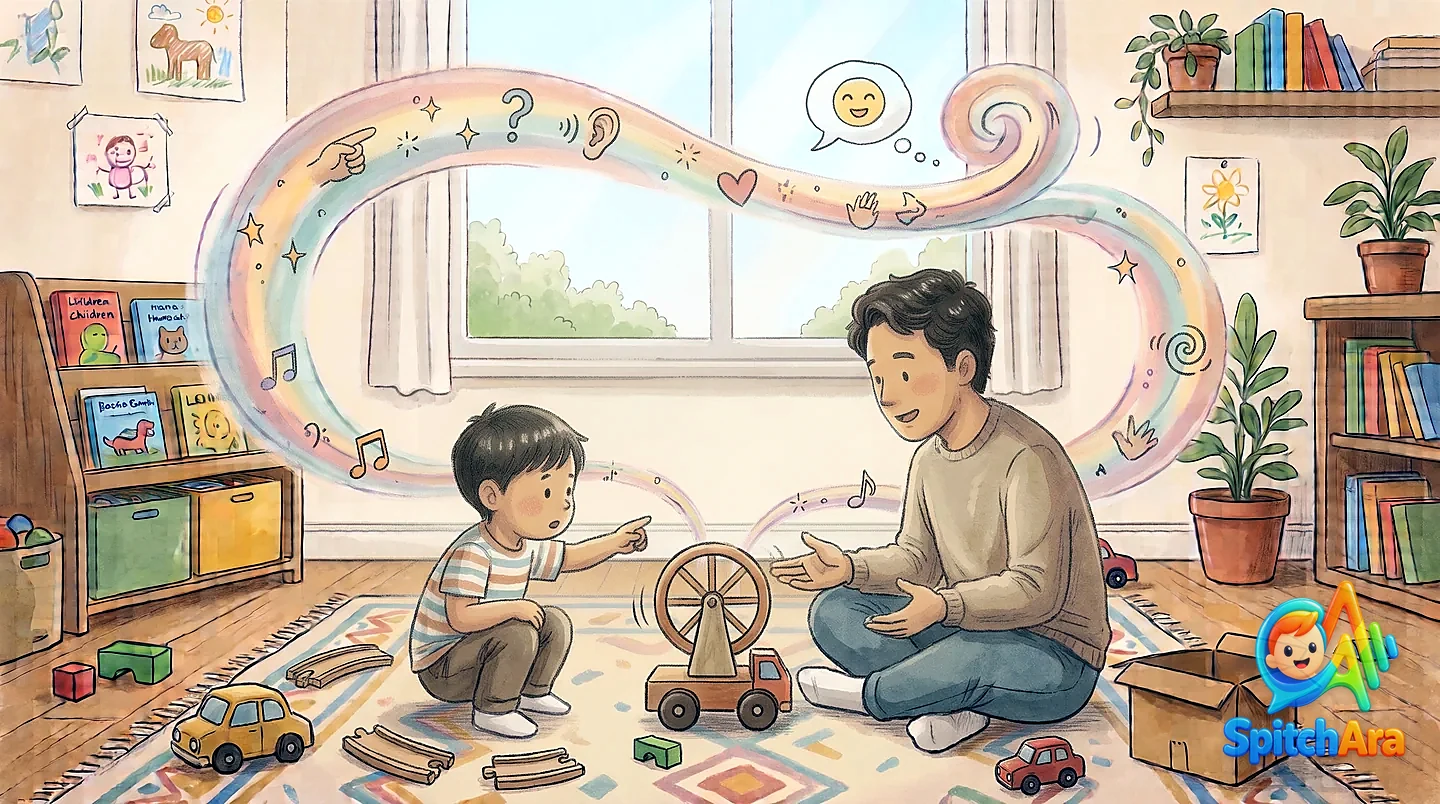
A child reaches towards a cup, pushes a plate away and brings you a shoe. Three small actions, three possible messages. Yet an adult who is waiting for spoken words may see only the missing speech and miss the communication already happening.
Noticing gestures and sounds does not mean guessing confidently at everything a child does. It means treating an action as something worth understanding, responding carefully and checking whether your interpretation fits. A child's message can matter before it becomes a word. Supporting it can sit alongside professional help for speech and language concerns.
Separate what you saw from what you think it meant
Start with the visible action. “He pushed the plate towards me” is an observation. “He wanted more food” is an interpretation. The interpretation may be right, but he could also be finished or asking for help with something on the plate.
That distinction changes your response. You might say, “More, or finished?” while showing the available options in a way the child understands. If the child pushes the plate farther away, “Finished” may be a better fit. You can remove the plate without insisting on a spoken confirmation.
When you are unsure, use tentative language: “I think you want the door open.” Then watch what happens. A child's correction, including turning away or rejecting the result, is useful communication. The goal is shared understanding, not proving that the adult's first guess was correct.
Listen for the function as well as the sound
The same sound can have different meanings in different situations. A short “ah” near the window might accompany noticing a dog. At the cupboard it might accompany a request. Rather than assigning a permanent translation, consider the setting, the child's attention and what changes after you respond.
Likewise, communication includes more than asking for objects. Children may greet, protest, seek comfort, share amusement, choose a person or draw attention to a problem. If you only notice requests, you may overlook the moments when the child is inviting you into their experience.
A useful question is, “What happened when I responded?” If your child relaxes after you turn down a sound, your response may have addressed the concern. That does not prove what every similar gesture means. It gives you one concrete example to remember and compare with future situations.
Answer the message in a form the child can use
Suppose a child brings a closed box. An adult can say, “Open the box,” while opening it. There is no need to hold the box shut until the child says “open.” The adult's words give a possible way to express the message while the response shows that the child's existing communication worked.
If the child says an early approximation, answer naturally. “Ba” while looking at a ball might receive “Your ball.” A long correction about pronunciation can interrupt the message. NHS guidance encourages responding to early words with an accurate model rather than criticizing errors (National Health Service, 2023).
A model should fit the child's meaning, not only the object. When the child points at a fallen ball, “Ball fell” adds different information from “Want ball.” The surrounding action helps you choose. If you get it wrong, adjust rather than requiring the child to follow your script.
Keep established communication tools available
Some children use pictures, signs, a communication board or a speech-generating device. These can support or replace speech according to the person's needs. There is no reason to put an established system away simply because you hope to hear a spoken word (American Speech-Language-Hearing Association, n.d.).
In practice, make the system available where communication happens. A board kept on a high shelf cannot help a child comment during play. At the same time, access is more than physical proximity. The child may need suitable symbol size, positioning, vocabulary or a different selection method. Ask the professional who supports the system to help solve these problems.
Respond to an AAC message as an actual contribution. If the child selects “stop,” pause the activity and clarify if necessary. Do not treat it as a practice selection that becomes meaningful only when the child repeats the word aloud. This is especially important for messages about discomfort, refusal and personal boundaries.
Help other people understand without speaking for the child
A familiar caregiver may understand signals that another adult misses. Share a few examples in plain language: “When she holds out the cup and looks towards the kitchen, she often wants help getting a drink. Please check with her.” The phrase “often” leaves room for the child to mean something else.
Avoid giving adults a rigid dictionary of gestures. Instead, explain how to check understanding and allow time for a response. A child should not lose the opportunity to communicate because an adult assumes the message in advance.
For preschool or visits with relatives, a brief note can include the child's usual communication methods, ways to offer choices and signs that an activity is uncomfortable. Keep personal information limited to what the other person needs. Update the note when the child's preferences or supports change.
Know what recognition cannot tell you
Recognizing communication is valuable, but it does not answer every developmental question. A child may communicate effectively with familiar gestures and still need assessment of language, speech or hearing. Conversely, a quiet period with an unfamiliar person does not establish a disorder (American Speech-Language-Hearing Association, n.d.-b).
If you have concerns, take examples to your child's health professional or a speech-language professional. Explain what the child understands, how they express different needs and whether anything has changed. If previously acquired words or other skills have been lost, seek prompt advice rather than waiting for a home activity to work (National Institute on Deafness and Other Communication Disorders, 2022).
For today, choose one moment in which you would usually ask for a word. First respond to the message that is already there. Then offer a short, useful model and let the exchange continue. This leaves space for speech while protecting the child's ability to be understood now.
References
American Speech-Language-Hearing Association. (n.d.). Augmentative and alternative communication (AAC). https://www.asha.org/practice-portal/professional-issues/augmentative-and-alternative-communication/
American Speech-Language-Hearing Association. (n.d.-b). Spoken language disorders [Practice Portal]. https://www.asha.org/practice-portal/clinical-topics/spoken-language-disorders/
Centers for Disease Control and Prevention. (2026a, February 16). Concerned about your child’s development? https://www.cdc.gov/act-early/families/concerned.html
National Health Service. (2023, April 26). Help your baby learn to talk. https://www.nhs.uk/baby/babys-development/play-and-learning/help-your-baby-learn-to-talk/
National Institute on Deafness and Other Communication Disorders. (2022, October 13). Speech and language developmental milestones. https://www.nidcd.nih.gov/health/speech-and-language
World Health Organization. (2022, April 27). Caregiver skills training for families of children with developmental delays or disabilities: Introduction. https://www.who.int/publications/i/item/9789240048836
