
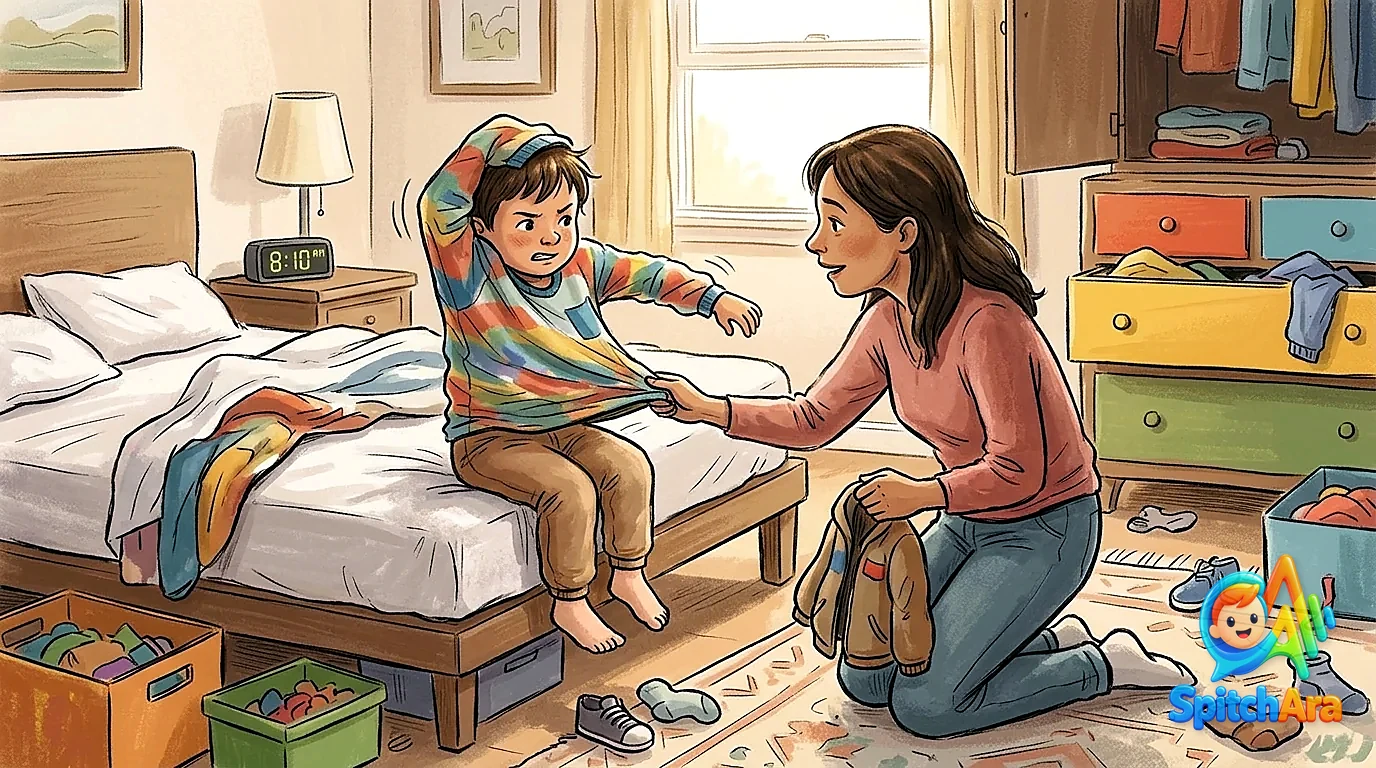
Imagine a familiar dressing-time problem. A sleeve has turned inside out. Your child pulls once, then looks towards you. You could give a string of instructions, or you could acknowledge the problem: “Sleeve stuck. Help?” Dressing offers many moments like this, when language can explain something the child is already experiencing.
However, getting dressed also involves movement, touch, temperature, and time pressure. Language during dressing needs to work with those demands. The purpose is to help a child understand and communicate within the routine, not to make clothes a reward for saying the right word.
Notice the practical problem first
Before encouraging speech, check what is making the task difficult. Is the opening hard to find? Is the fabric uncomfortable? Is the child cold, tired, or in a hurry to do something else? A child who needs help with a sleeve does not need the adult to turn the difficulty into a prolonged guessing game.
Respond to the problem and add words as you do so. “Hand through” can accompany the action. “Too tight?” might help you check a possible discomfort, provided the child has a way to answer. Do not assume that every movement means the same thing; pulling at a shirt could indicate curiosity, irritation, or an attempt to remove it.
A useful hypothetical exchange is simple. The child holds out a sock. The adult says “Sock on?” and waits briefly. The child presents a foot, and the adult helps. The child's action has answered the question. Requiring “yes” as well would add a demand that is unnecessary for understanding the message.
Use a few words that change what happens
Object names are useful, but dressing offers more than “shirt,” “shoe,” and “sock.” Words such as “on,” “off,” “inside,” “other,” “help,” and “finished” describe actions and relationships. They also give the child ways to influence the task.
Choose words that match the current event. “Other foot” is meaningful when a shoe is being offered to the wrong foot. “Zip up” belongs to the movement of the zip. In contrast, asking about colours while the child struggles to balance may pull attention away from the part that matters.
The NHS recommends using everyday routines and adding language to what children say (National Health Service, 2023). Dressing makes that practical: if a child says “off,” you might reply “Shoes off” while helping. The added word identifies the child's meaning without making the interaction a correction exercise.
Make choices small and genuine
Two suitable shirts can create a useful choice. Show them, name them briefly, and accept a response the child can give. A reach or point may be clear enough. If not, confirm what you think they selected and allow a correction.
Avoid offering choices you cannot honour. If the weather requires a coat, “Do you want your coat?” may create confusion when “no” cannot be accepted. You can instead explain “Coat on for outside” and offer a practical choice within the task, such as which sleeve comes first, when that is possible.
There is also no requirement to offer a choice at every stage. Too many questions can make a straightforward routine feel like a negotiation. A child may be content for you to choose the socks while they concentrate on standing or keeping warm. Follow the child's capacity in that moment.
Use a missing item without creating a trap
Sometimes a shoe is genuinely missing. Looking together gives the family something to discuss: “One shoe here. Where's the other?” You can describe the search, acknowledge the child's discoveries, and connect the words with visible places.
That is different from deliberately hiding an essential item until the child asks for it. A manufactured obstacle may be frustrating, particularly when the child needs to leave or already finds dressing difficult. You can create a playful search with spare toys at another time instead of adding pressure to necessary care.
For example, a child points under a chair during a real search. “Under the chair” gives language to the discovery. If the item is not there, say so and continue together. The child does not need to be correct for their contribution to be worth acknowledging.
Keep consent and bodily comfort in the conversation
Dressing happens close to the child's body. Explain what you are doing and notice signals to slow down or adjust. “I'm moving the sleeve” is more informative than an unexpected pull. Where possible, allow the child to take part in the movement at their own pace.
If your child uses a sign, picture, or device to communicate, keep that method available in a practical way. A child should not lose the means to say “stop” or “help” simply because dressing involves their hands. Follow any individual access recommendations already provided by the child's professionals (American Speech-Language-Hearing Association, n.d.-a).
When discomfort is persistent, discuss it with the appropriate professional rather than assuming it is unwillingness to cooperate. The language goal must not obscure a real care need. A routine can be adapted for communication only after the family understands what the child needs to manage it safely and comfortably.
Adapt the routine to the morning you actually have
On a quiet weekend, you might leave more room for choosing and experimenting. On a school morning, a short explanation and prompt assistance may be the better response. Both can contain useful language. The difference is how much time and energy are available.
You can also move part of the activity to a calmer moment. Sorting clean socks together or dressing a familiar toy gives access to similar words without the pressure of leaving the house. Make it optional and playful. The toy does not have to be dressed in a conventional order for the child to communicate an idea.
If several caregivers help, share what makes the routine easier. “He likes to hold the sock while I guide his foot” is specific. “Make him cooperate” is not. The first description gives another adult an action to try while respecting that the child's response may differ on another day.
Look for a useful change rather than a perfect sentence
You might notice that the child now hands you an item when help is needed, indicates which shirt they prefer, or protests in a way you understand sooner. These observations can be worth sharing with a clinician. They are not, by themselves, proof of a particular developmental outcome.
Keep a note only if it serves a purpose. “When the zip caught, she handed me the coat and said ‘help’” tells a clearer story than “Language improved.” It identifies the situation and the message, making it easier to discuss what support was useful.
Tomorrow, choose one part of dressing where your child already contributes. Respond to that contribution, add words that fit, and continue with the task. A successful exchange may end with a comfortable child and a shoe on the right foot. It does not need to end with a repeated sentence.
References
American Speech-Language-Hearing Association. (n.d.). Augmentative and alternative communication (AAC) [Practice Portal]. https://www.asha.org/practice-portal/professional-issues/augmentative-and-alternative-communication/
American Speech-Language-Hearing Association. (n.d.). Spoken language disorders [Practice Portal]. https://www.asha.org/practice-portal/clinical-topics/spoken-language-disorders/
Centers for Disease Control and Prevention. (2026a, February 16). Concerned about your child’s development? https://www.cdc.gov/act-early/families/concerned.html
National Health Service. (2023, April 26). Help your baby learn to talk. https://www.nhs.uk/baby/babys-development/play-and-learning/help-your-baby-learn-to-talk/
National Institute on Deafness and Other Communication Disorders. (2022, October 13). Speech and language developmental milestones. https://www.nidcd.nih.gov/health/speech-and-language
