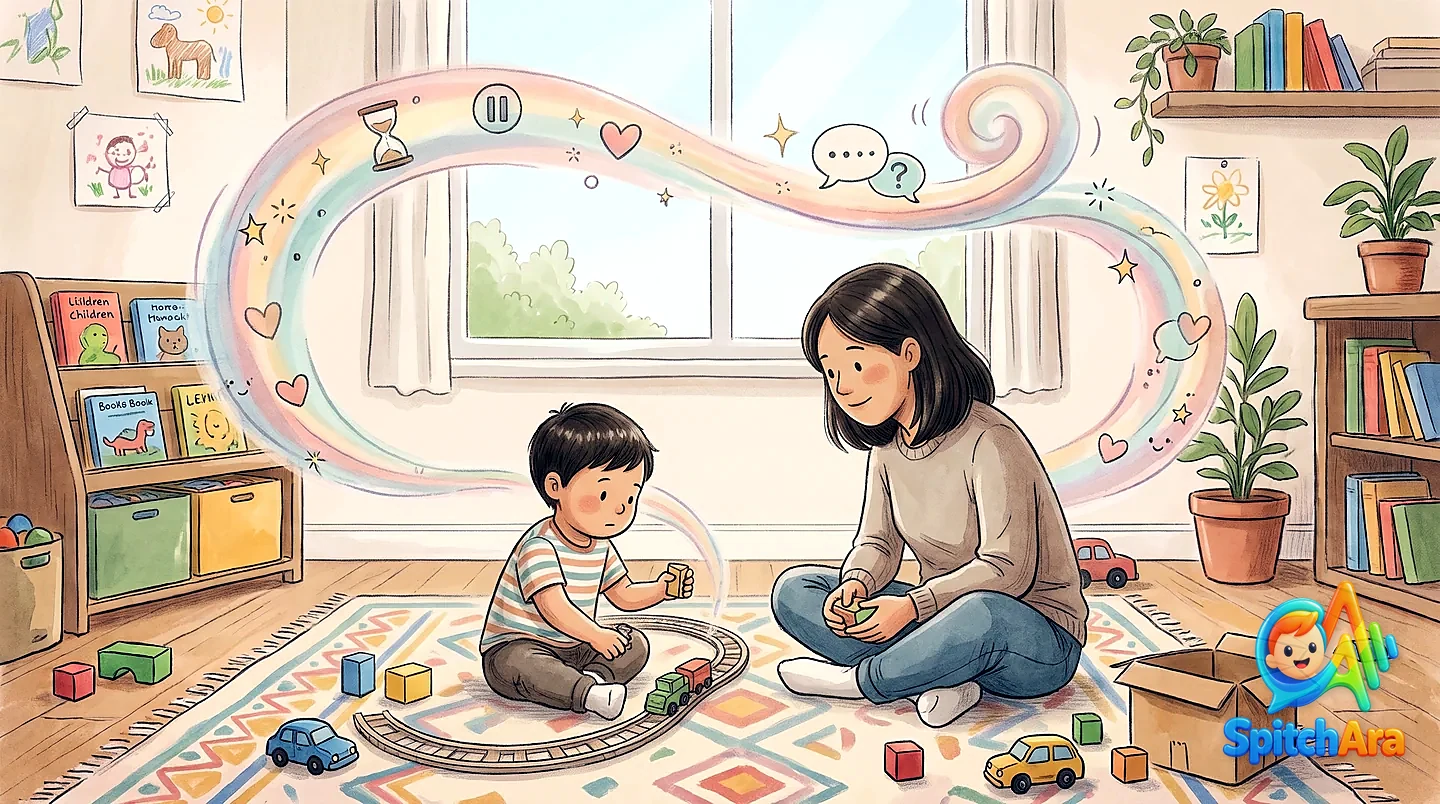
You ask a question, receive no immediate answer, and ask again in slightly different words. Then you add a gesture, another explanation, and perhaps the answer itself. It is an understandable habit, especially when you want to help. However, the extra language may arrive before the child has had a chance to decide how to respond.
Giving a child time to respond means leaving an opening while staying attentive and available. It is not silent pressure, a fixed countdown, or a rule that help must wait until a word appears. The useful pause changes according to the child, the situation, and the message they are trying to communicate.
First make the message worth answering
A pause cannot repair a question that does not make sense to the child. Before waiting, check whether your message is clear and connected with the current activity. A short comment or genuine choice may be easier to respond to than a long instruction followed by several questions.
For example, during a car game, “Again?” while showing the car can have an obvious meaning. “What do you think we should do with this vehicle next?” may introduce more language than the moment needs. The simpler message is not necessarily a better sentence in every situation, but it may fit this exchange more closely.
Ask yourself whether you really need an answer. If you are naming a passing bus, a comment may be enough. Not every adult sentence needs to create a response opportunity.
Stay visibly available during the pause
After a question or invitation, remain engaged without repeating it immediately. Your posture and attention can show that the child's contribution is welcome. Avoid staring expectantly in a way that feels like a test; different children find different kinds of attention comfortable.
The NHS advises allowing time after a question (National Health Service, 2023). In practice, that means noticing what the child does with the opening. They may prepare a word, reach for a symbol, move an object, or show that they do not want to respond.
If the child uses an established communication device, the response may involve finding vocabulary or using a particular access method. Do not fill the pause merely because speech would have been quicker. At the same time, check that the support is actually reachable and working.
Recognise a response that is not a word
A child may answer “Which one?” by reaching. They may answer “Again?” by handing you the object. They may reject an interpretation by pushing it away or using a familiar sign. If the message is clear, respond to it rather than continuing to wait for a spoken version.
Consider a hypothetical exchange. The adult holds two toy animals and asks which should go into the box. The child looks towards one, then points. The adult confirms the choice and puts that animal in. The pause has done its job because the child had a way to influence the game.
If the signal is ambiguous, check your interpretation. “I think you chose the horse” leaves room for correction. Do not present your guess as a definite answer and move on before the child can object.
Know when waiting has become withholding
Waiting is inappropriate when it delays necessary care, access to food or drink, relief from discomfort, or a clearly needed response. A child should not have to produce speech to receive help with an everyday need.
Even in play, the pause can become pressure if the adult repeatedly says “Use your words,” refuses to continue, or ignores a clear gesture. The issue is not the number of seconds. It is whether the child's communication is being accepted and whether the activity remains comfortable.
If the child becomes distressed, help and simplify. You can still model the relevant word while responding. “Help open” as you open the container gives language to the action without making a spoken request a condition.
Use fewer prompts rather than a longer silence
An adult may think the solution is to wait for an increasingly long time. Sometimes the better adjustment is to reduce the question, change the materials, or offer a clearer way to answer. A pause should be part of an accessible exchange, not a substitute for one.
For example, a child may struggle with “What do you want to play?” because the options are not visible or the question is broad. Showing two familiar activities may make the choice easier. Another child may not want either, so there must still be a way to decline.
If a clinician recommends a waiting strategy, ask them to demonstrate what to watch for and when to step in. A general instruction such as “wait longer” can be difficult to apply without understanding its purpose and limits.
Leave openings inside an activity
You do not need to ask a question to create room for a turn. After sending a car down a ramp, you might stop and see what the child does. They may bring the car back, change the ramp, or begin a different game. Each response can guide the next exchange.
A familiar song or story can also contain a natural opening, but continue if the child does not join. The pause is an invitation to participate, not a requirement to complete the adult's sentence.
During an unfamiliar or demanding task, fewer pauses may be appropriate because the child needs clear support. Adapt to the activity rather than applying the same technique throughout the day.
Notice what changes when you change your timing
You might observe that the child initiates a gesture before you ask another question, uses a device without being rushed, or corrects your first interpretation. Record one example if it helps you discuss the strategy with a professional.
Be careful about conclusions. One easier exchange does not prove that response time was the only barrier or that a developmental difficulty has resolved. It shows what happened in that situation and suggests a practical question worth exploring.
For the next interaction, try making one clear contribution and then resisting the urge to immediately add another. Watch for the child's answer in any familiar form. The purpose of the pause is to hear that answer more clearly, not to hold the moment open until the child performs the response you imagined.
References
Centers for Disease Control and Prevention. (2026a, February 16). Concerned about your child’s development? https://www.cdc.gov/act-early/families/concerned.html
National Health Service. (2023, April 26). Help your baby learn to talk. https://www.nhs.uk/baby/babys-development/play-and-learning/help-your-baby-learn-to-talk/
National Institute on Deafness and Other Communication Disorders. (2022, October 13). Speech and language developmental milestones. https://www.nidcd.nih.gov/health/speech-and-language
Roberts, M. Y., Curtis, P. R., Sone, B. J., & Hampton, L. H. (2019). Association of parent training with child language development: A systematic review and meta-analysis. JAMA Pediatrics, 173(7), 671–680. https://doi.org/10.1001/jamapediatrics.2019.1197
World Health Organization. (2022, April 27). Caregiver skills training for families of children with developmental delays or disabilities: Introduction. https://www.who.int/publications/i/item/9789240048836
