
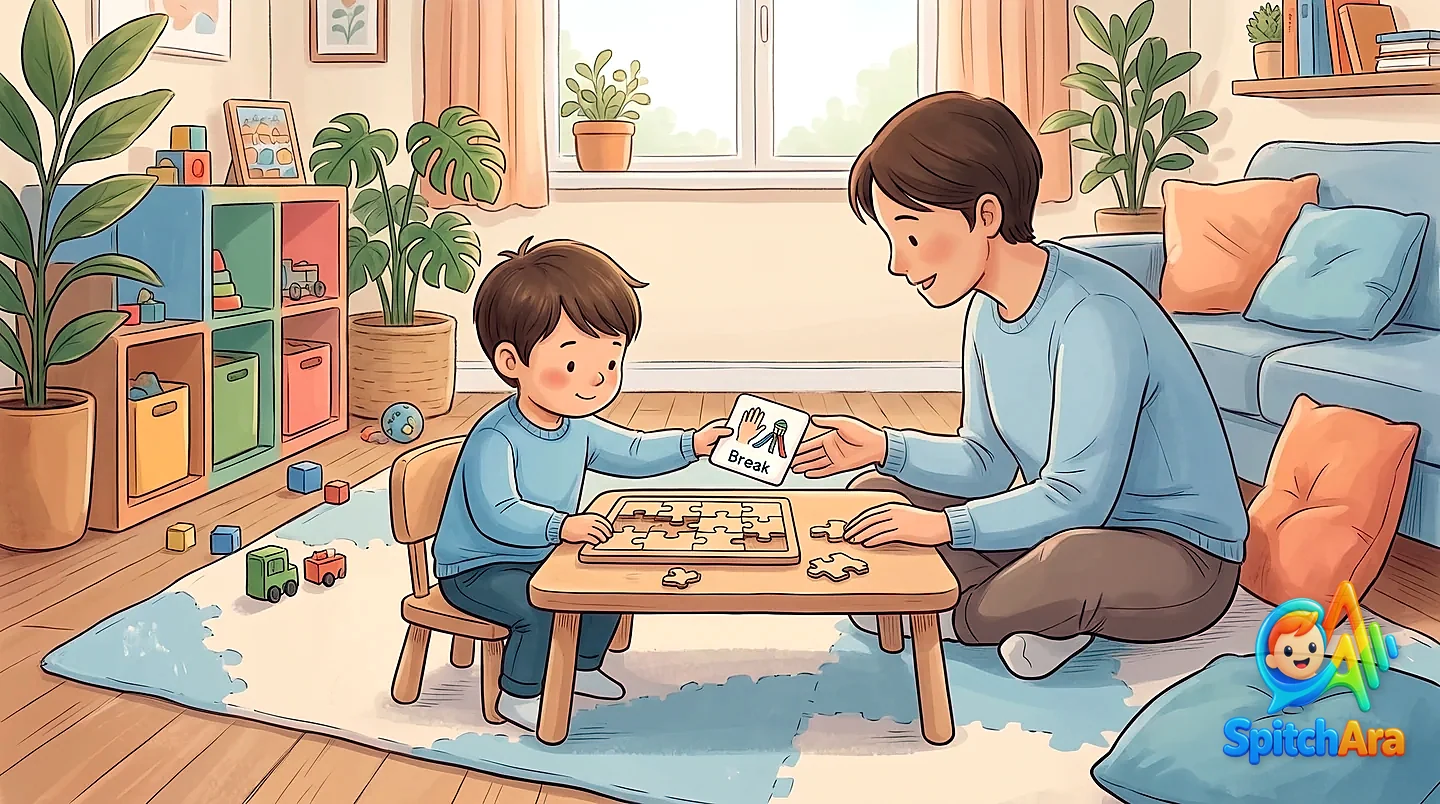
A puzzle piece will not fit. The child pushes it away, the adult encourages another try, and the child becomes upset. The missing step may not be another demonstration. It may be a reliable way to say, “Help,” “Stop,” or “I need a break,” and an adult who responds.
These messages are useful only when they change what happens. A child does not have to pronounce them clearly, select a perfect symbol or remain calm enough to perform a taught sequence before discomfort is taken seriously. The aim is to make communication more accessible before a difficult moment becomes overwhelming.
Decide what each message should do
Adults sometimes teach a word without agreeing on the response. If “break” means stopping to one caregiver and “finish three more turns” to another, the child receives conflicting information. Begin by discussing what the messages mean in the routines where they are needed.
“Help” might lead to opening a container, demonstrating a step or doing a task together. “Stop” might end an optional activity or pause touch. “Break” might mean a quieter place or a short rest, with the next step explained when the child is ready. These responses should fit the actual need, not a fixed script.
Some boundaries cannot be removed immediately, such as necessary safety actions. Even then, acknowledge the message and explain what you can change. “You want me to stop. I need to keep you safe here. We can move away from the noise.” Receiving a response is different from having every request granted, a distinction reflected in communication-rights guidance (National Joint Committee for the Communication Needs of Persons With Severe Disabilities, n.d.).
Accept the signals already in use
Before introducing new words or symbols, notice how the child currently asks for assistance or relief. They may bring an object, move your hand towards it, push something away, turn aside or select a familiar message. These signals are starting points, not errors that must be replaced before adults respond.
You can model a clearer message while acting on the existing signal. If the child hands you a difficult lid, say “Help with the lid” and help. If they push a loud toy away, stop it and say, “Stop the sound.” The model is connected to an understandable result.
Avoid deliberately creating distress to generate practice opportunities. There are enough ordinary moments when assistance is genuinely needed. A child should not have to become frustrated repeatedly so that adults can rehearse a communication target.
Make the method available where it matters
The child may use speech, a sign, a picture, a button or another AAC method. Selection should consider movement, vision, hearing, language understanding and the environments in which the message is needed. Ask the child's communication professional to help establish an accessible approach (American Speech-Language-Hearing Association, n.d.).
A “break” card stored in a drawer cannot help at the noisy table. A message buried in an unfamiliar device menu may be too difficult to find during distress. Practise access in calm, ordinary situations and ask for adjustments when the system is not workable.
Keep alternative forms available. A child who can say “stop” when calm may use a gesture when overwhelmed. The adult should respond to the meaning rather than insist on the form used during practice.
Model your own need for assistance
You can make these words ordinary by using them yourself. During a simple shared task, “I need help holding this” shows that asking for help is part of participation. “I'm taking a short break” can explain a pause without presenting it as failure.
Keep the example genuine and proportionate. There is no need to pretend to be helpless or create a dramatic problem. The purpose is to show that messages have a place in everyday life and are not reserved for moments when a child is already struggling.
When the child responds, acknowledge the contribution naturally. “That helped me hold it steady” describes the result. Excessive praise or celebration can make a small practical exchange feel like another performance.
Respond before adding a lesson
In a difficult moment, use fewer words and attend to safety and comfort. If a child clearly signals “stop,” continuing to explain how to say it more politely can make the interaction less safe and less understandable. Language teaching can wait until the immediate need has been addressed.
Later, when everyone is settled, you can review what happened in a simple way: “The sound was too much. You showed stop, and I turned it off.” This connects the signal with the response without demanding that the child relive the event or provide an explanation they cannot yet give.
If distress is frequent, intense or new, seek appropriate professional advice. Communication support may be part of the response, but it should not obscure pain, illness, sensory difficulties or other needs that require attention.
Help other people respond consistently
Share a short description with relatives, preschool staff or other caregivers. Include how the child expresses each message, what adults should do and where the communication support is kept. Explain uncertainties honestly: a particular movement may mean “stop” in one context but something different elsewhere.
Ask adults to report situations in which the message was difficult to honour. That information can help the team adapt the environment or clarify boundaries. Consistency is not rigidly doing the same thing in every situation; it is making the child's communication reliably meaningful.
Look for earlier and easier communication
A useful change might be the child handing over a difficult object before becoming upset, or an adult noticing a refusal sooner. These outcomes matter even if no new spoken word appears. Record the situation and response rather than counting only how often a target word was produced.
For the next routine, choose one message that would make participation easier. Make it accessible, model it naturally and agree on a response. The strongest evidence that the message is useful is that the child can influence what happens without having to struggle to be heard.
References
American Speech-Language-Hearing Association. (n.d.). Augmentative and alternative communication (AAC). https://www.asha.org/practice-portal/professional-issues/augmentative-and-alternative-communication/
American Speech-Language-Hearing Association. (n.d.). Spoken language disorders [Practice Portal]. https://www.asha.org/practice-portal/clinical-topics/spoken-language-disorders/
Centers for Disease Control and Prevention. (2026a, February 16). Concerned about your child’s development? https://www.cdc.gov/act-early/families/concerned.html
National Health Service. (2023, April 26). Help your baby learn to talk. https://www.nhs.uk/baby/babys-development/play-and-learning/help-your-baby-learn-to-talk/
National Joint Committee for the Communication Needs of Persons With Severe Disabilities. (n.d.). Communication bill of rights (3rd ed.). American Speech-Language-Hearing Association. https://www.asha.org/njc/communication-bill-of-rights/
Roberts, M. Y., Curtis, P. R., Sone, B. J., & Hampton, L. H. (2019). Association of parent training with child language development: A systematic review and meta-analysis. JAMA Pediatrics, 173(7), 671–680. https://doi.org/10.1001/jamapediatrics.2019.1197
