
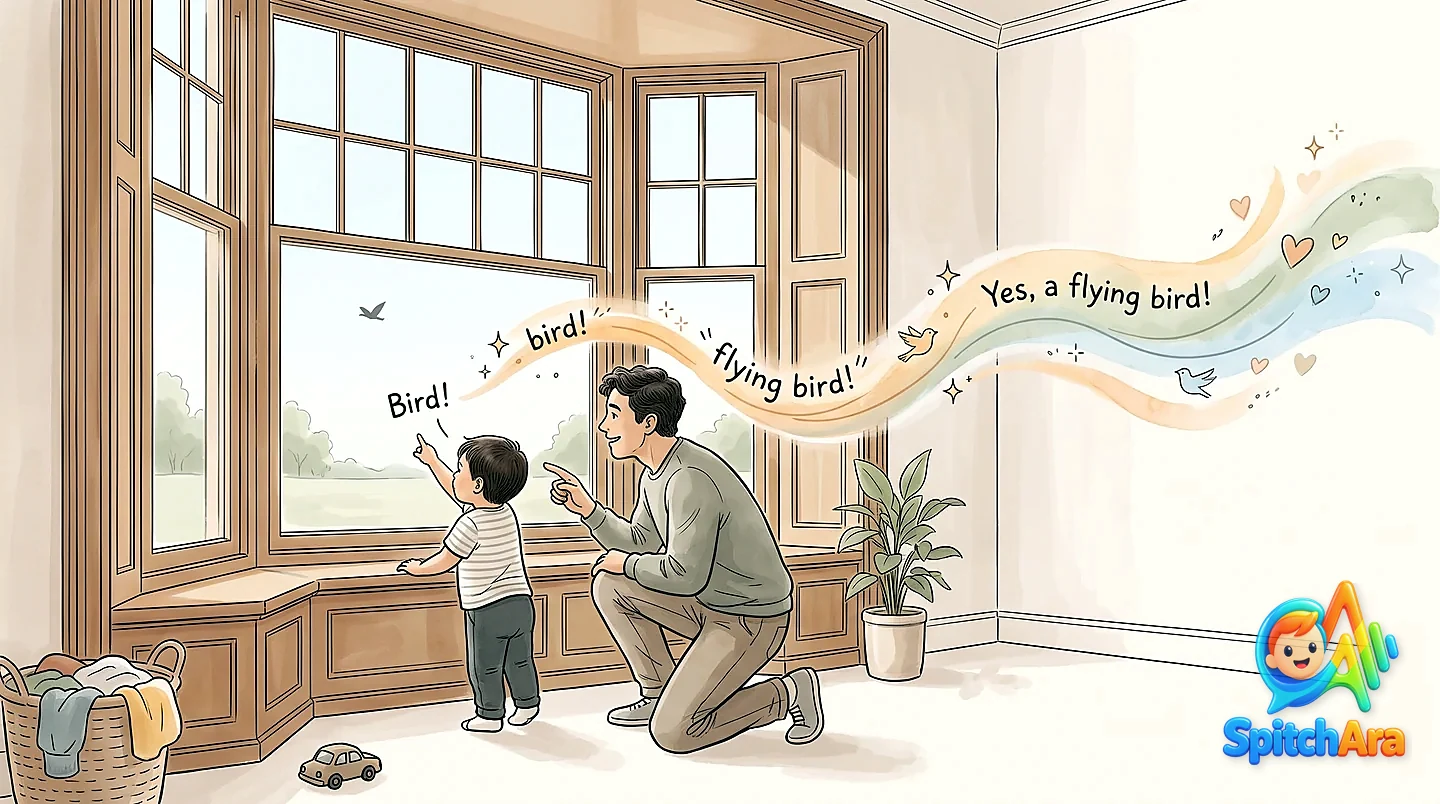
Your child points outside and says, “Dog.” You could answer, “Yes, the dog is running.” You could also ask, “Can you say dog running?” The two responses contain similar words, but they create different conversations. The first shares the child's topic. The second asks for a performance.
Adding a little language to a child's message is often called an expansion. The idea is to preserve the meaning and offer a slightly fuller version, without requiring the child to copy it. Done naturally, it sounds like an interested response. Done mechanically, it can interrupt the very conversation it is meant to support.
Find the meaning before adding words
One word can serve several purposes. “Dog” may mean “Look at that dog,” “I want the toy dog,” or “The dog frightened me.” If you automatically turn it into “Big dog” every time, you may miss the child's intention.
Look at the situation and respond accordingly. A child who points towards a dog entering the room might hear, “The dog's here.” A child who steps back may need, “You're moving away,” followed by space and support. A child holding out a toy dog might be inviting you to join a game. In each case, understanding the message matters more than adding a particular number of words.
You can check when unsure: “The dog outside?” Pause and allow the child to confirm or redirect. An expansion is not a declaration that the adult knows exactly what the child meant. It remains part of a conversation in which either person may need clarification.
Add one useful piece of meaning
The easiest expansion is often a small addition: “Car” becomes “Car's stuck,” or “Mummy” becomes “Mummy's coming.” You might add an action, a location or a missing grammatical part, depending on the message. There is no requirement to turn every short contribution into a long sentence.
NHS guidance suggests responding to children's early phrases with a slightly fuller sentence (National Health Service, 2023). The practical value is that the child hears language connected to their own idea. It is not a rule that a caregiver must correct every phrase or that longer responses are always better.
Consider “Sock off.” “Yes, your sock's off” acknowledges the event and offers a grammatical model. By contrast, “You must say, ‘I have taken my sock off’” changes the focus to accuracy and introduces a much more demanding sentence. The simpler response leaves room for the child to continue.
Keep the conversation moving
After expanding, respond to what the child wants to do. If they say “Door” while trying to leave, “Open the door” should lead to an appropriate response, not another round of requests to speak. If leaving is not possible, explain the boundary simply and offer a meaningful next step.
For example, imagine a child says “Outside” during heavy rain. An adult might respond, “You want to go outside. It's raining hard. Let's look from here.” The child's message has been understood even though the request cannot be granted immediately. Acknowledging communication does not mean agreeing to every request.
Sometimes no expansion is needed. A laugh, “Yes,” or a shared look at the object may be the most natural response. If every child contribution triggers a language lesson, the rhythm becomes predictable and tiring. Use expansions when they add something helpful, then let ordinary interaction fill the rest.
Distinguish an expansion from a pronunciation correction
A child may use a word that is hard to understand. If the intended meaning is clear, you can respond with an accurate model while continuing the topic. If it is unclear, say so kindly: “I didn't understand. Can you show me?” Offer the child's familiar communication tools rather than guessing repeatedly.
Avoid turning a conversation into instructions about where to put the tongue or how to form a sound unless that is part of an individualized plan taught by a qualified professional. Speech sounds and language formulation are different areas of assessment, and a general home article cannot select exercises for a specific child (National Institute on Deafness and Other Communication Disorders, 2022).
This distinction also helps with frustration. A child who has successfully conveyed “car stuck” should not lose that success because one sound was unclear. Solve the stuck-car problem first. If speech clarity remains a concern across situations, bring examples to the professional separately.
Make the model fit the language being spoken
Expansions depend on the grammar of the language, not on English word order. In a multilingual family, use a natural version of the child's meaning in the language of that exchange. Do not force a direct translation of an English phrase if it sounds awkward or changes the emphasis.
A child may also combine words from different languages. Rather than treating the mixture as misbehaviour, respond to the message and provide a natural model you can use comfortably. Learning more than one language does not cause developmental language disorder, although a child can have language difficulties in a multilingual setting and still need support (National Institute on Deafness and Other Communication Disorders, 2023).
If you are unsure how to support several languages, ask a professional how the assessment and home plan will include them. A useful plan should allow the people who care for the child to communicate naturally, not require every interaction to become translation practice.
Notice what changes in the interaction
The immediate question is not whether the child repeats your longer sentence. Notice whether the exchange continues, whether the child adds information and whether both people seem comfortable. A child who brings another toy into the story may be contributing more meaning without repeating any of your words.
You might record a hypothetical example like this: “He said ‘baby sleep.’ I said ‘The baby's sleeping.’ He put the blanket over the doll.” The note shows how the conversation and play fitted together. It does not claim that one expansion caused a developmental change.
For your next routine, choose a single place to listen closely. At snack time, during play or while putting shoes away, respond to one message with a small, meaningful addition. Then carry on. The most useful expansion is one that helps the child feel understood while offering language they can hear in context.
References
Centers for Disease Control and Prevention. (2026, February 16). Concerned about your child’s development? https://www.cdc.gov/act-early/families/concerned.html
National Health Service. (2023, April 26). Help your baby learn to talk. https://www.nhs.uk/baby/babys-development/play-and-learning/help-your-baby-learn-to-talk/
National Institute on Deafness and Other Communication Disorders. (2022, October 13). Speech and language developmental milestones. https://www.nidcd.nih.gov/health/speech-and-language
National Institute on Deafness and Other Communication Disorders. (2023, May 8). Developmental language disorder. https://www.nidcd.nih.gov/health/developmental-language-disorder
Petrie, A., Mayr, R., Zhao, F., & Montanari, S. (2023). Parent-child interaction during storybook reading: Wordless narrative books versus books with text. Journal of Child Language, 50(1), 104–131. https://doi.org/10.1017/S0305000921000763
Roberts, M. Y., Curtis, P. R., Sone, B. J., & Hampton, L. H. (2019). Association of parent training with child language development: A systematic review and meta-analysis. JAMA Pediatrics, 173(7), 671–680. https://doi.org/10.1001/jamapediatrics.2019.1197
