
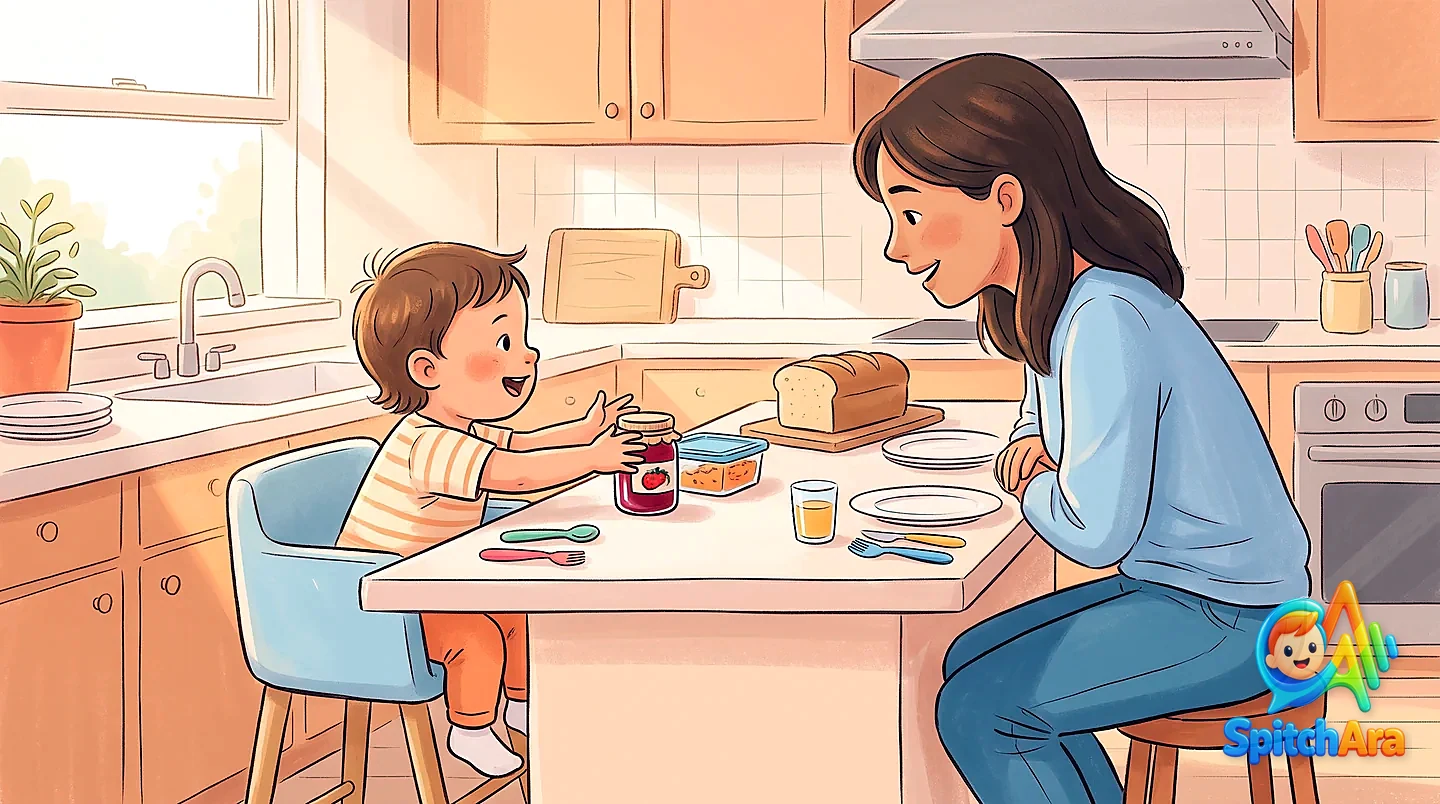
“Car.” Your child points under the chair, and you understand that something needs retrieving. The next useful phrase might be “car stuck,” “get car,” or “car under,” depending on what the child wants to say. A two-word combination has a purpose when it carries that extra meaning.
Families often ask how to move from single words to short phrases. The starting point is the child's message, not a demand to make it longer. You can model simple combinations during everyday routines while continuing to accept gestures, single words and other established ways of communicating. If you are concerned about language development, seek advice alongside these ordinary interactions (American Speech-Language-Hearing Association, n.d.-b).
Think about relationships between words
Two words placed next to each other are not automatically a useful new sentence. A memorized label or repeated phrase may function differently from a child combining words to express a changing idea. Rather than testing this distinction at home, notice examples you can describe to a professional.
Useful relationships appear throughout daily life: a person doing an action, an object in a place, something changing or a preference being expressed. “Daddy coming,” “cup here,” “door open” and “not that” each communicate a different relationship. The exact form will vary with the language spoken and the child's existing skills.
This gives you a more practical goal than practising a fixed list. You are looking for chances to connect meanings the child already cares about. If the child is watching the dog run, “dog running” is relevant. If they are frightened by it, “dog away” may be the more important message.
Offer a model without making access conditional
Suppose a child holds out a closed box and says “Open.” You can respond, “Open box,” or “I'll open it,” while helping. The child hears the extra information and their request still works. You do not need to keep the box shut until they produce two words.
NHS guidance recommends adding a little language to children's early phrases and keeping everyday instructions manageable (National Health Service, 2023). In practice, that means making your response relevant and understandable. It does not mean a child must repeat an adult's phrase before receiving help, food, comfort or access to an established communication tool.
If you already have a home plan from a speech-language professional, ask how these examples fit its goals. Some children may need different kinds of support, including AAC or work on understanding. A general activity should not override an individualized recommendation.
Use the changing parts of a familiar routine
Getting dressed offers more than clothing names. A sleeve can be “too tight,” a sock can be “all wet,” and a jacket can be “Daddy's coat.” Meal preparation offers “more rice,” “cup full” or “my spoon.” Choose language that describes the actual moment rather than narrating a prepared script over it.
For example, imagine a child notices two shoes by the door. The adult says, “Your shoe,” as the child picks one up, then “My shoe” while taking another. Later, when a shoe is missing, “Where's your shoe?” arises naturally. The relationship changes within a familiar situation, so the words have something concrete to refer to.
You can also follow a child's unexpected idea. If a spoon becomes a pretend microphone, the useful phrase may be “sing song,” not “silver spoon.” Staying with the child's intention keeps the activity conversational and avoids turning every household object into a naming exercise.
Keep a comfortable pause after the model
Once you have spoken, leave space. Your child might say a word, point, act on the situation or introduce a different idea. Respond to that contribution. A pause is valuable when it gives the child room, not when it becomes silent pressure to repeat.
If the child appears confused, simplify the situation before adding more language. Show the object you mean or offer a smaller choice. If they are tired or upset, attend to that need. Communication demands that are manageable during calm play may not be manageable during a difficult transition.
Avoid comparing one child's pace with a sibling's or a video online. A short clip cannot show the child's history, support or circumstances. Assessment considers more than phrase length, including how a child understands and uses language across situations (National Institute on Deafness and Other Communication Disorders, 2022).
Include AAC and the child's home languages
Combining meanings can happen through speech, signs or symbols. A child might point to a person and select “go” on a device. Whether and how to expand such a message depends on their system and access. Ask the professional supporting AAC to show you appropriate models rather than rearranging the system on your own.
Keep the communication method available even when speech begins to emerge. AAC can complement speech and should be selected around the person's communication needs (American Speech-Language-Hearing Association, n.d.). The arrival of a spoken phrase does not mean the child no longer needs another way to express themselves when tired, overwhelmed or speaking with unfamiliar people.
In multilingual homes, use natural phrases rather than translating English word by word. Different languages express relationships differently. A professional should consider those differences when discussing what counts as a meaningful combination and how to support it.
Bring real examples to the next conversation
You do not need to write down every phrase. A few examples with context are more informative: “At the window, she said ‘Daddy home’ before he entered,” or “He repeated ‘blue car’ after me while holding the car.” Both are useful observations, but they describe different situations.
Also record what the child communicates without speech, what they understand and whether participation has become easier. These details prevent the conversation from narrowing to a single milestone or word count.
If words or other established skills have been lost, seek prompt professional advice. If your concern is persistent but less sudden, arrange a discussion rather than waiting indefinitely for two-word phrases to appear. Meanwhile, choose one ordinary routine, offer language that fits, and let the child's meaning guide the next turn.
References
American Speech-Language-Hearing Association. (n.d.). Augmentative and alternative communication (AAC). https://www.asha.org/practice-portal/professional-issues/augmentative-and-alternative-communication/
American Speech-Language-Hearing Association. (n.d.). Spoken language disorders [Practice Portal]. https://www.asha.org/practice-portal/clinical-topics/spoken-language-disorders/
Centers for Disease Control and Prevention. (2026, February 16). Concerned about your child’s development? https://www.cdc.gov/act-early/families/concerned.html
National Health Service. (2023, April 26). Help your baby learn to talk. https://www.nhs.uk/baby/babys-development/play-and-learning/help-your-baby-learn-to-talk/
National Institute on Deafness and Other Communication Disorders. (2022, October 13). Speech and language developmental milestones. https://www.nidcd.nih.gov/health/speech-and-language
World Health Organization. (2022, April 27). Caregiver skills training for families of children with developmental delays or disabilities: Introduction. https://www.who.int/publications/i/item/9789240048836
