
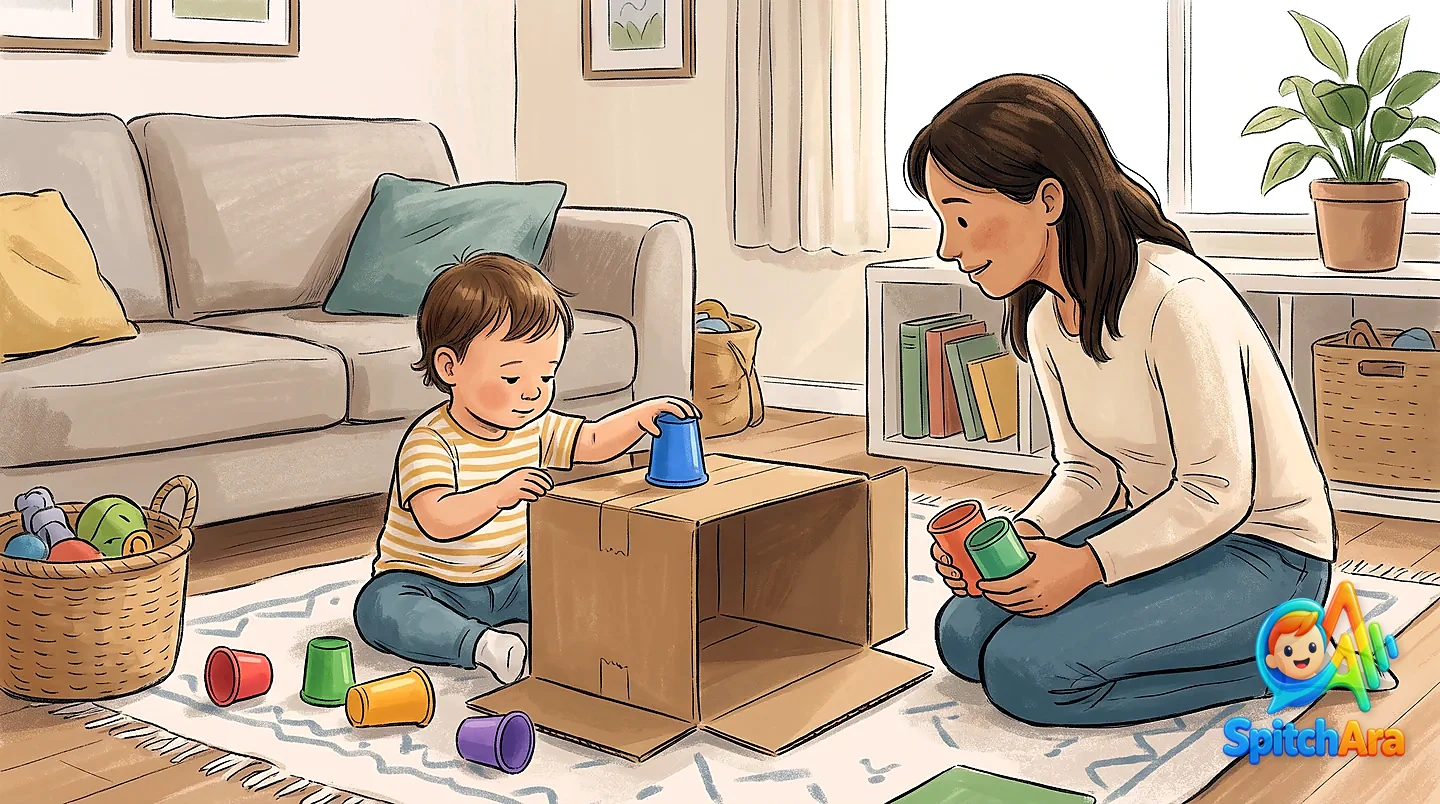
A cardboard box can become a garage, a drum, a bed for a toy, or simply a box that opens and closes. Its usefulness for communication comes from what a child wants to do with it and how another person joins in. Expensive materials do not create that connection automatically.
You can build language play with household items by choosing a safe, familiar object and noticing the child's idea before adding your own. The suggestions below are flexible examples, not a treatment programme. Keep supervision and the child's individual access needs in mind, and avoid small parts, sharp edges, unsafe containers, or objects that are unsuitable for mouthing.
Start with one object rather than a collection
Too many materials can make it difficult to notice what the child is actually doing. Begin with something simple, such as a sturdy box and a large familiar toy. If the child places the toy inside, you can describe “In the box.” If they sit beside the box and tap it, the subject may be the sound instead.
Allow the object to have the meaning the child gives it. A box does not have to become the pretend shop the adult planned. You can share the child's action first and introduce a small idea later if they are interested.
For instance, the child might open and shut the lid. The adult opens another flap and says “Open.” When the child shuts it, the adult responds “Closed.” The exchange follows a visible change, so the words have a clear reference. It does not require the child to name the box or follow a series of instructions.
A container can create several kinds of message
Putting a toy into a container offers more than the words “in” and “out.” A child may ask for help, reject an item, show surprise, invite another turn, or decide that the game is finished. Notice the purpose of the message rather than steering every exchange towards requesting “more.”
Imagine that a child hands you an empty bowl after putting all the toys elsewhere. “All gone” acknowledges the result. If the child brings another toy, you might say “One more.” If they walk away, the activity may be over. Your language changes because the child's contribution changes.
Do not use a difficult lid to withhold a wanted object until speech appears. If the child needs help, provide it while offering a phrase such as “Help open.” That keeps communication useful. A barrier designed to extract a word can make the same materials frustrating.
Fabric can make a shared game without a fixed script
A suitable cloth can cover a familiar toy, become a blanket, or be moved through the air. Choose a use that is safe for the child and does not cover their face or interfere with breathing. The adult can narrate a small action and see whether the child wants to continue.
A toy might be “sleeping,” then “awake.” A child may pull the cloth away, put it back, or bring another toy. Each action changes the story. If your child enjoys only the covering and uncovering, there is no need to insist on a more elaborate pretend sequence.
You can also offer a meaningful choice: “Bear under or car under?” when both options are available. Accept the child's response in its usual form. The choice serves the game; it should not become an additional test before the child can play.
Use everyday sounds with a reason
Tapping a safe container with a suitable object can create a rhythm to share. You might copy the child's pattern once, pause, and see what they do. If the child dislikes the sound, stop or choose a quieter activity. Loudness is not evidence that an activity is more engaging.
The language can stay simple: “Tap,” “Quiet,” “Again,” or “Stop,” depending on what happens. The important part is that the word has a consequence. When the child signals “stop,” stopping demonstrates that you understood.
General NHS guidance includes everyday conversation and building on children's contributions (National Health Service, 2023). A household game applies that principle through an ordinary shared event. It should not be presented as proof that a particular object produces a measurable language gain.
Add one useful detail to the child's contribution
If the child says “box,” you might reply “Big box” when size matters, or “Box open” when the lid has moved. The added detail should explain the current idea. There is little value in adding several descriptive words simply to make the adult's sentence longer.
If the child points, signs, or uses a communication aid, respond to that contribution with the same attention. A spoken model can accompany your response without replacing the child's method. Keep familiar supports available during the game rather than putting them aside because the activity is meant to encourage speech.
Suppose a child selects “help” on a device while looking at a toy caught under the box. The adult says “Help with the car” and retrieves it. The child's message has worked. Requiring the child to repeat the spoken phrase would introduce a new condition after the communication was already understood.
Adapt the materials instead of insisting on one way to play
A child who cannot easily grasp a small object may need larger materials, a stable surface, or another access method. A child who finds movement uncomfortable may prefer a game where objects remain within reach. Use existing professional advice about positioning and access when relevant.
You can adjust the adult's role too. Rather than repeatedly directing the child's hands, demonstrate with your own object or place the materials where the child can choose. If the game still feels difficult, change it. The goal is an exchange the child can influence, not completion of a prescribed sequence.
Sometimes the best adaptation is fewer words. If the child is concentrating on a movement, wait until it is complete before adding a comment. If the adult talks over every action, the child may have little space to contribute.
Finish when the interaction has finished
A child may signal the end by moving away, putting materials aside, or using a familiar message. Acknowledge it and close the activity. There is no requirement to complete another turn to make the play count.
Afterwards, you can note what made the exchange easier. Did a stable box help? Did a quieter sound work better? Did the child initiate more when you copied their action? These observations may help you choose the next game or discuss access with a clinician.
Begin next time with one object and one genuine interest. Follow the action, add language that fits, and let the child affect what happens. That is the part of household play worth keeping, even when the box never becomes the elaborate activity you first imagined.
References
Centers for Disease Control and Prevention. (2026, February 16). Concerned about your child’s development? https://www.cdc.gov/act-early/families/concerned.html
Dowdall, N., Melendez-Torres, G. J., Murray, L., Gardner, F., Hartford, L., & Cooper, P. J. (2020). Shared picture book reading interventions for child language development: A systematic review and meta-analysis. Child Development, 91(2), e383–e399. https://doi.org/10.1111/cdev.13225
National Health Service. (2023, April 26). Help your baby learn to talk. https://www.nhs.uk/baby/babys-development/play-and-learning/help-your-baby-learn-to-talk/
National Institute on Deafness and Other Communication Disorders. (2022, October 13). Speech and language developmental milestones. https://www.nidcd.nih.gov/health/speech-and-language
Roberts, M. Y., Curtis, P. R., Sone, B. J., & Hampton, L. H. (2019). Association of parent training with child language development: A systematic review and meta-analysis. JAMA Pediatrics, 173(7), 671–680. https://doi.org/10.1001/jamapediatrics.2019.1197
World Health Organization. (2022, April 27). Caregiver skills training for families of children with developmental delays or disabilities: Introduction. https://www.who.int/publications/i/item/9789240048836
