
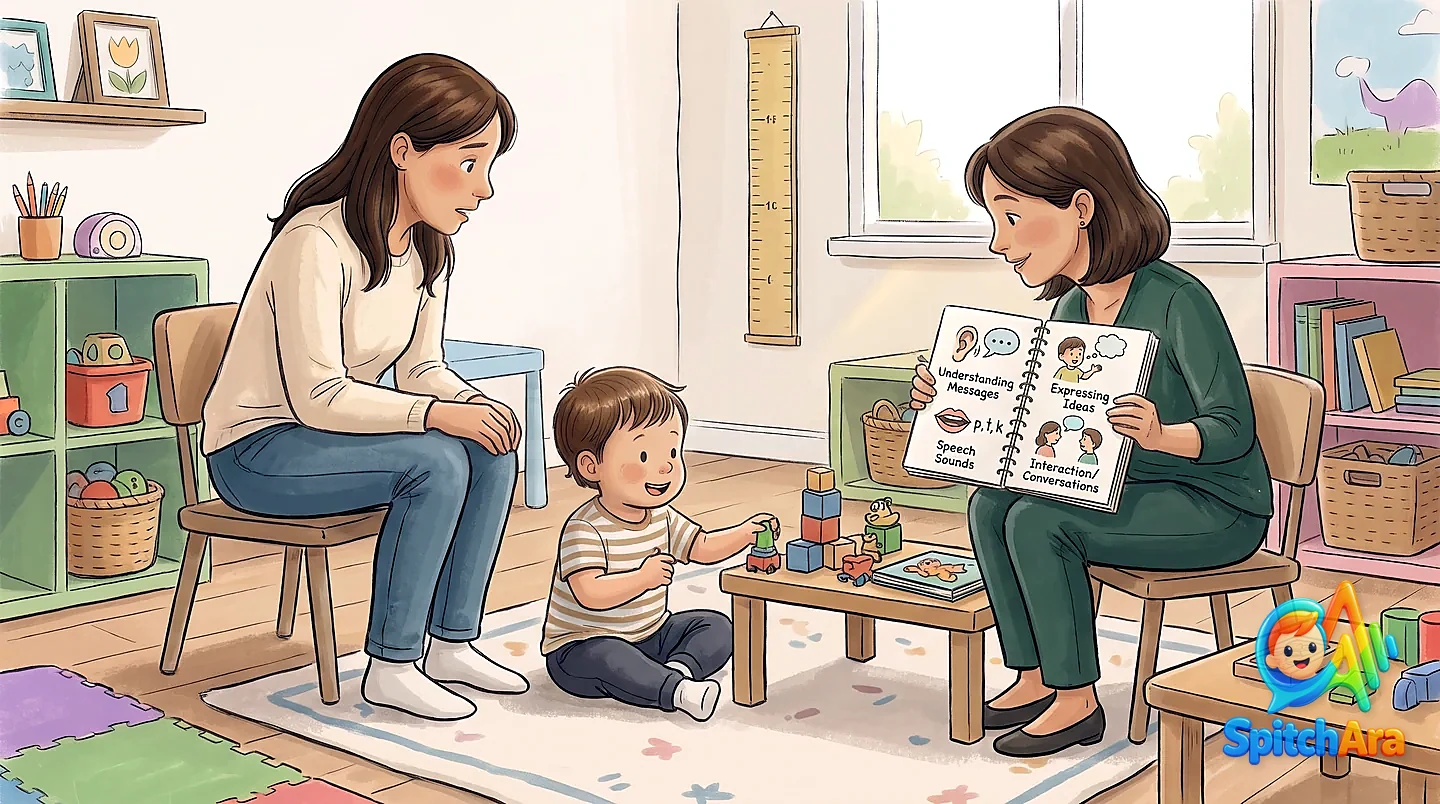
One person says “late talker,” another says “speech delay,” and a third mentions “language disorder.” A parent searching for help can come away with several labels and very little clarity about what should happen next. The terms overlap in everyday conversation, but they do not always mean the same thing in a professional assessment.
The useful starting point is to describe the difficulty: understanding messages, expressing ideas, producing speech sounds, or taking part in an exchange. A label should clarify that picture, not replace it. If your child is struggling, ask a qualified professional what the term means in your child's case and which evidence supports it.
Why speech and language are different questions
Speech refers to how spoken sounds are produced. Language concerns how meaning is understood and expressed. A child can have a clear voice and pronounce familiar words accurately while finding it difficult to understand sentences. Another child can have many ideas and words but be difficult for new listeners to understand.
For a hypothetical example, imagine two children both described as “not talking much.” One follows a familiar conversation and uses gestures to explain a complex game but produces very few spoken words. The other uses several memorised phrases but struggles when an instruction changes. Those observations do not diagnose either child. They show why a broad description needs closer assessment.
When talking to a professional, give the actual example before the label. “She brings me the cup, but I am unsure whether she understands when I ask for it without pointing” is easier to investigate than “She has a speech problem.” The label can come after the clinician has understood the situation.
What professionals mean by late language emergence
ASHA uses late language emergence for delayed language onset in young children without other diagnosed disabilities or delays in other developmental areas. The profile can involve expression alone or both understanding and expression (American Speech-Language-Hearing Association, n.d.). That is more specific than the casual phrase “a child who talks late.”
It also explains why hearing and wider development may enter the assessment. A professional is considering whether the description fits and whether another explanation or additional need should be investigated. Asking those questions does not mean that a particular diagnosis has already been decided.
If you hear “late talker,” ask whether it is being used descriptively or as part of a defined assessment conclusion. Then ask what was checked and what remains uncertain. A familiar-sounding term should not leave the family without a plan.
“Late bloomer” describes something known afterwards
Families often hope to know whether a child will catch up without additional support. The difficulty is that “late bloomer” is a retrospective description: it refers to a child whose development later catches up. It cannot reliably be assigned simply because the child seems bright or another relative spoke late.
Research helps identify patterns, but it does not provide a personal forecast from a few observations. Fisher's review included 20 samples with 2,134 children and found that early receptive language was among the predictors of later expressive-language outcomes (Fisher, 2017). A predictor across groups does not tell a family exactly what will happen to one child.
The practical implication is to ask about understanding as well as spoken vocabulary. It is not to calculate a prognosis at the kitchen table. A child's support plan can respond to current needs while professionals continue to monitor development over time.
When developmental language disorder is discussed
Developmental language disorder, or DLD, involves persistent difficulties learning, understanding, and using language that are not explained by certain other conditions. It can affect more than the number of words a child says, including later conversation, reading, and writing (National Institute on Deafness and Other Communication Disorders, 2023) (American Speech-Language-Hearing Association, n.d.-b).
However, every child who begins speaking later does not automatically have DLD. Nor can a parent distinguish all possible explanations by comparing a list of symptoms online. The assessment must consider the child's history, current skills, context, and appropriate measures.
If a professional raises DLD, ask for an explanation in everyday terms. Which parts of language are difficult? How does that affect play, learning, or family interaction? What support is recommended now? Understanding the practical meaning is more useful than memorising the abbreviation.
Use the child's whole language experience
A child who uses several languages may have different opportunities and vocabulary in each. Therefore, a list collected only in one setting can be incomplete. Tell the clinician who uses each language and which situations are easiest or hardest.
Do not assume that changing the family to one language will resolve a language difficulty. Multilingualism does not cause DLD (National Institute on Deafness and Other Communication Disorders, 2023). Instead, ask how the assessment will distinguish differences related to language experience from difficulties that need support.
You might bring examples that do not translate neatly. A child may use a short family expression to request a familiar game. Explain what it means and how it is used. The professional needs the communicative function, not just an English word count.
Ask what a test result does and does not show
An assessment score can be informative, but it is not a complete portrait of a child. Ask which task produced the score, whether the measure fits the child's language and access needs, and how the clinician has combined it with observation and caregiver information.
If the child was tired, unfamiliar with the materials, or unable to use a usual support, mention it. That does not invalidate every finding automatically. It gives the clinician context for interpreting the result and deciding whether another approach is needed.
Likewise, ask about strengths. Knowing that a child communicates well through gesture or understands a familiar sequence may help shape support. Strengths and difficulties can coexist; one does not have to cancel the other.
Leave with a plan rather than a vocabulary lesson
Before the conversation ends, ask the professional to complete this sentence in plain language: “For your child, the main concern is…” Then clarify the next action, the reason for it, and the review arrangements. If the term is provisional, ask what additional information would make it clearer.
At home, continue responding to the child's current communication and use the strategies demonstrated for their needs. Avoid repeatedly testing whether they can now perform the milestone linked to the label. The purpose of support is meaningful communication, not proving that the child fits a category.
The terminology becomes useful when it leads to better questions. What does my child understand? How do they express a message? What makes participation easier? Which assessment or support comes next? Those questions keep the child visible behind the words used to describe them.
References
American Speech-Language-Hearing Association. (n.d.). Late language emergence. https://www.asha.org/practice-portal/clinical-topics/late-language-emergence/
American Speech-Language-Hearing Association. (n.d.-a). Augmentative and alternative communication (AAC). https://www.asha.org/practice-portal/professional-issues/augmentative-and-alternative-communication/
American Speech-Language-Hearing Association. (n.d.-b). Spoken language disorders [Practice Portal]. https://www.asha.org/practice-portal/clinical-topics/spoken-language-disorders/
Fisher, E. L. (2017). A systematic review and meta-analysis of predictors of expressive-language outcomes among late talkers. Journal of Speech, Language, and Hearing Research, 60(10), 2935–2948. https://doi.org/10.1044/2017_JSLHR-L-16-0310
National Institute on Deafness and Other Communication Disorders. (2022, October 13). Speech and language developmental milestones. https://www.nidcd.nih.gov/health/speech-and-language
National Institute on Deafness and Other Communication Disorders. (2023, May 8). Developmental language disorder. https://www.nidcd.nih.gov/health/developmental-language-disorder
