
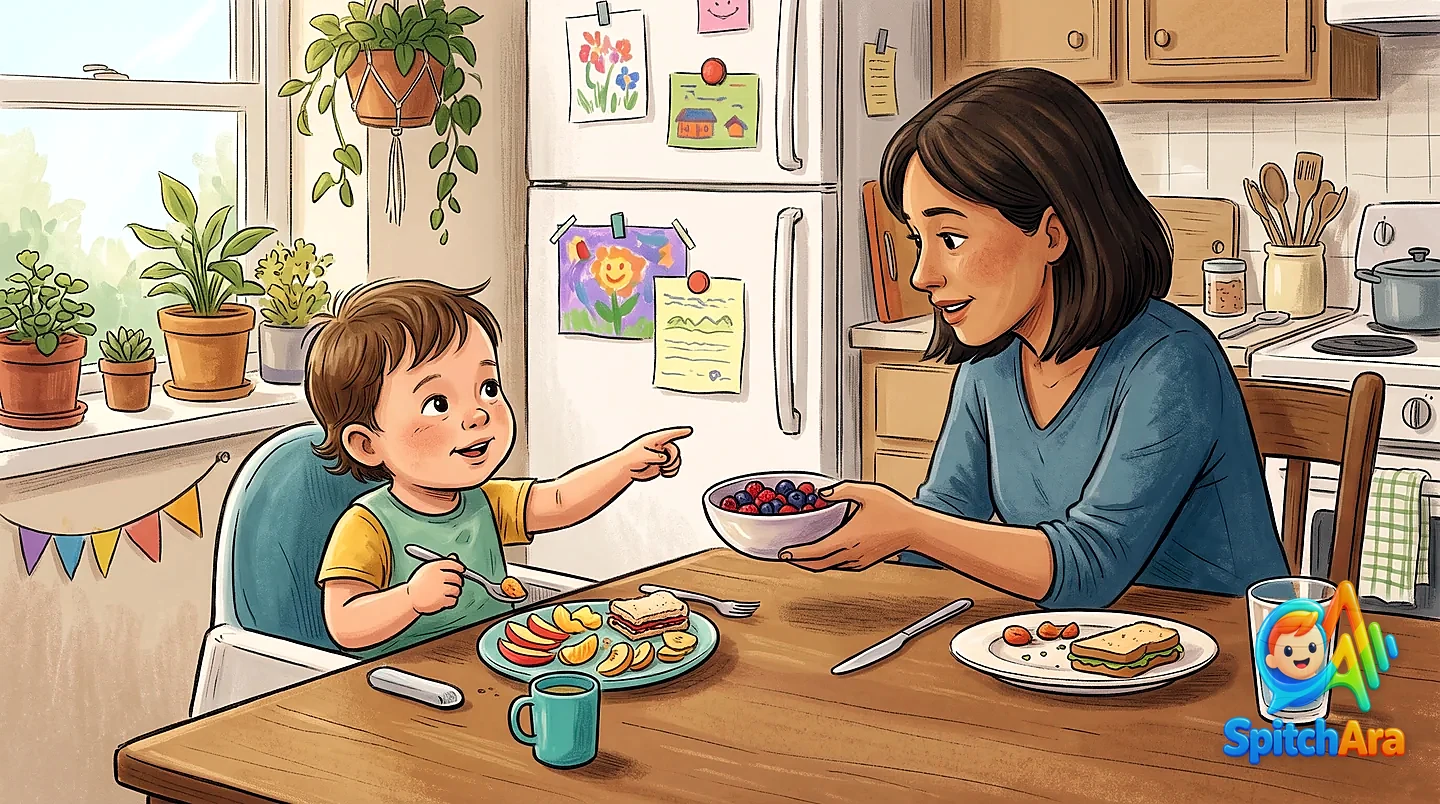
Imagine a child pushing a bowl a little further across the table. An adult might read it as a request for more, a sign of being finished, or simple play. Before adding another instruction, it helps to find out what the child is trying to tell you. “Finished?” accompanied by an open hand leaves room for the child to confirm, correct, or show something else.
Mealtime conversation works best when eating remains comfortable and the child's signals have a real effect. You can offer words, choices, and shared observations without asking for speech before a child gets food or drink. The aim is an exchange around the meal, not a speaking test delivered between mouthfuls.
Begin with the meal your child already manages
Use foods, textures, utensils, and seating that are already suitable for your child. A communication activity is not a reason to introduce a difficult food or change a feeding plan. Likewise, if coughing, pain, choking, or persistent difficulty eating is a concern, that needs discussion with the relevant health professional rather than a language exercise.
With that foundation in place, look at how the table is arranged. Can the child see what they might choose? Can they reach their usual communication support? Does somebody move the cup before the child has time to indicate it? A small practical adjustment may make the child's message easier to notice.
For example, place two familiar cups where both are visible and name the options once. If the child reaches towards the yellow one, pass it over and say “Yellow cup.” You have linked the words with a meaningful choice. Repeating the question until the child speaks would change a successful exchange into an unnecessary demand.
Offer choices that have real answers
A genuine choice includes the possibility that neither option is wanted. “Apple or banana?” is not a genuine question if the adult has already decided that the child must eat the apple. You can instead describe what is available: “Apple is here. Banana is here.” Then follow the child's response within the family's ordinary meal arrangements.
At another moment, the choice might concern how something happens rather than what is eaten. “Big spoon or little spoon?” and “Here or there?” can be useful when both options are practical. Avoid creating extra choices merely to make the child communicate. A hungry child may want an uncomplicated meal.
The NHS includes offering choices among its everyday language ideas (National Health Service, 2023). The value of the choice comes from its meaning in the moment. Therefore, select an option that matters to this child rather than trying to work through a vocabulary list at the table.
Make room for comments as well as requests
Meals can become dominated by “more,” “please,” and the names of foods. Yet children also have reasons to notice, protest, joke, and share. A pea rolls across the plate. Somebody's soup steams. A sibling arrives wearing a paper hat. These events give the family something to talk about without manufacturing a communication challenge.
Suppose a child watches a spoon fall. You could say “Spoon down,” pick it up, and see whether they want to comment. If the child laughs, you can acknowledge the surprise rather than immediately asking “What fell?” A question with an obvious answer may be less useful than responding to the child's actual reaction.
Similarly, a child who points towards a parent entering the room might be sharing news. “Dad's here” fits that message. “Do you want Dad to feed you?” introduces an assumption. When you are not sure, a short description and a pause often leave more room for clarification than a long chain of questions.
Respond when the message comes without speech
Some children point or reach; others use signs, pictures, a communication device, or a combination. Communication supports need to remain accessible during ordinary family life, and the right access method depends on the individual (Communication Health Support Association, 2026). At a meal, that may mean keeping a device protected but reachable rather than putting it away until eating is over.
If a child selects a symbol for “finished,” respond to that message. You can say the word aloud while following the usual plan for ending the meal. There is no need to demand that the child say it as well. If the signal is unclear, acknowledge your uncertainty: “I think you mean finished. Is that right?” Then offer a way to correct you that the child can use.
Family members sometimes worry that accepting a gesture means losing a chance to encourage speech. In practice, you can provide a spoken model and honour the gesture at the same time. “Water” as you pour is still language input. It also shows that the child's communication reaches another person.
Let one word grow into a useful exchange
If your child says “hot,” you can respond “Soup is hot” and address the temperature. If they say “more,” you might reply “More rice” while serving it. The addition should clarify the child's message, not correct them in a way that interrupts the meal.
Be especially careful when the child is chewing, tired, or already managing several demands. Conversation can wait. An adult does not need to comment on every movement for a meal to contain language. A quiet, relaxed stretch of eating may be exactly what the family needs.
Here is a hypothetical exchange: the child points to the jug; the adult says “Water?” and begins pouring; the child pushes the cup forward; the adult says “More water” and stops when the child withdraws the cup. Several meaningful turns have occurred, although the child may not have spoken. The adult's job was to interpret carefully and respond, not to convert every turn into a word-count opportunity.
Include the people and languages at your table
Choose familiar expressions that family members actually use. If one caregiver naturally speaks another language, that language can belong at the table too. There is no need to translate every spoonful or require the child to answer in the same language as the question.
It can help to agree on how the family recognises a few important messages, such as “stop,” “help,” or “finished.” This is especially useful when a grandparent, sibling, or another caregiver joins the meal. Share the child's signal without presenting one person's interpretation as infallible. “He often pushes the plate away when finished; please check with him” leaves room for context.
Choose one thing to notice at the next meal
You might notice how your child chooses, how they decline, or how they draw your attention to something interesting. If keeping a note helps, record one example in plain language: “At lunch, she moved the cup towards the jug. I offered water and she nodded.” Such a note describes an exchange without claiming a developmental score.
Afterwards, consider whether your response helped the child get their message across. Did you allow a correction? Was the communication support reachable? Did a choice make the meal easier, or did it add pressure? Use the answer to adjust the next meal. The most useful change may be remarkably small: listening to the signal before adding another question.
References
Centers for Disease Control and Prevention. (2026, February 16). Concerned about your child’s development? https://www.cdc.gov/act-early/families/concerned.html
Communication Health Support Association. (2026, May 8). Augmentative and alternative communication (AAC). https://helpingyoucommunicate.org/article/augmentative-and-alternative-communication-aac
Dowdall, N., Melendez-Torres, G. J., Murray, L., Gardner, F., Hartford, L., & Cooper, P. J. (2020). Shared picture book reading interventions for child language development: A systematic review and meta-analysis. Child Development, 91(2), e383–e399. https://doi.org/10.1111/cdev.13225
National Health Service. (2023, April 26). Help your baby learn to talk. https://www.nhs.uk/baby/babys-development/play-and-learning/help-your-baby-learn-to-talk/
National Institute on Deafness and Other Communication Disorders. (2022, October 13). Speech and language developmental milestones. https://www.nidcd.nih.gov/health/speech-and-language
Petrie, A., Mayr, R., Zhao, F., & Montanari, S. (2023). Parent-child interaction during storybook reading: Wordless narrative books versus books with text. Journal of Child Language, 50(1), 104–131. https://doi.org/10.1017/S0305000921000763
