
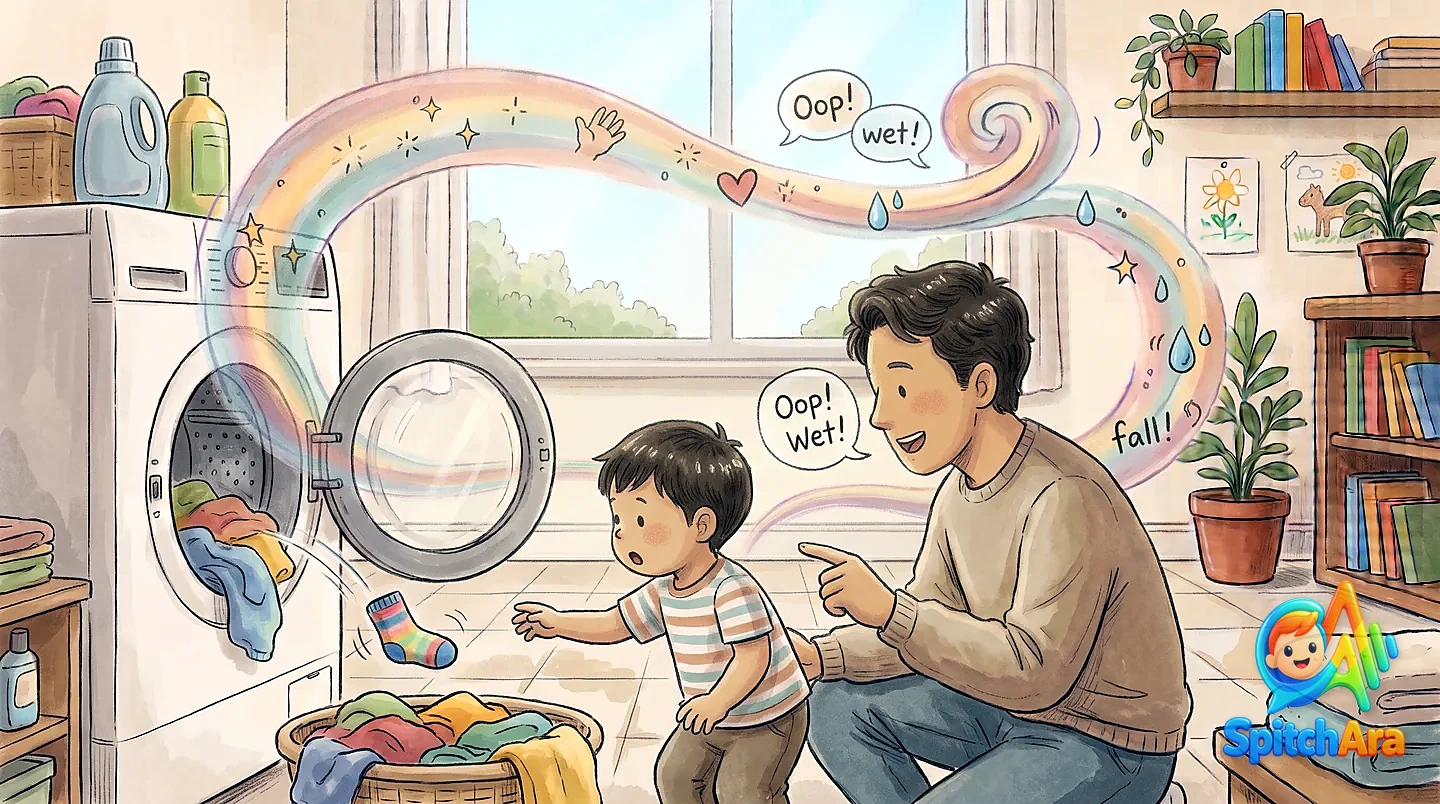
The washing machine finishes, and your child points at the door. You say, “Open,” as you release it. A moment later, a wet sock falls out. “Sock fell,” you add. There is no flashcard and no request to repeat, but the words have a clear place in what is happening.
Modelling a first word means offering language that fits a shared moment. It is different from asking the child to prove they know a word. The adult provides a useful example, responds to the child's existing communication and keeps the interaction moving. Which words are useful will depend on the child's interests, access and everyday life.
Begin with a reason to communicate
Before choosing a word, notice what your child is trying to do. They might want a lid opened, enjoy a sound, reject a toy or invite someone closer. Those situations suggest language more naturally than a list of supposedly essential first words.
For example, “help” makes sense when a child brings a shoe they cannot manage. Say it while helping, rather than waiting for the child to say it before you respond. “Stop” makes sense when an activity is unwelcome. Honour the child's signal and model the word as the activity stops. A model becomes meaningful because something understandable happens around it.
This also broadens the child's available messages. If all your chosen words are object names, consider actions, people, locations and preferences. A child needs ways to share an idea and refuse something, not merely to name what an adult holds up.
Keep the language small enough to follow
Short language can be easier to connect with a moment, but it need not sound unnatural. “Open the lid” may fit better than repeatedly saying “Open, open, open.” When the child is attending to a toy moving down a ramp, “Down it goes” offers a clear phrase with a visible event.
Adjust your language to the child and the situation. If you are explaining a complicated task, adding more words may not make it clearer. Show the relevant object, reduce competing activity and give one piece of information at a time. On the other hand, do not limit every conversation to single words if the child comfortably follows more.
NHS advice encourages everyday conversation, meaningful repetition and a little expansion of children's early contributions (National Health Service, 2023). These are broad principles. They do not specify a universal word list or establish how many times an individual child must hear a word before using it.
Repeat through real life rather than drills
A useful word can appear in different ordinary moments. “Open” may accompany a box, a curtain or the front door. Each occurrence gives the word a context. You do not need to manufacture a series of locked containers or interrupt the child's activity to create repetitions.
Consider a hypothetical morning. A child brings a snack container, and the caregiver says, “Open the box,” while helping. Later, the child notices someone at the door; “Open the door” accompanies welcoming them. The language recurs because the meaning recurs. There is no hidden tally the child must satisfy.
Variation also reveals meaning. Opening and closing, going and stopping, putting something in and taking it out offer contrasts within an activity. Keep these contrasts natural. If the child clearly wants to stop, do not continue simply to model the word again.
Leave room for the child's own turn
After offering a model, pause comfortably. A child may respond with a gesture, sound, word or movement towards the activity. Treat that response as part of the exchange. If nothing happens, continue or simplify rather than escalating into “Say it” repeatedly.
A pause is not a fixed number of seconds and should not become uncomfortable withholding. A child using an AAC system may need time to find a message. Another child may prefer to show rather than say. Your response should fit the accessible method already available.
If the child makes an approximation, answer the meaning. When “bo” clearly refers to a boat, “The boat's floating” keeps the topic alive. You can provide an accurate spoken example without turning the moment into a correction. A speech-language professional can advise separately if speech production itself is a concern.
Use the family's real language
Words matter because people use them together. Choose the language you can use naturally with your child, including familiar terms for relatives, food or household routines. A polished phrase in a language you rarely speak may offer less useful interaction than an ordinary phrase shared throughout the day.
If several languages are used at home, the same situation may involve different words with different people. Do not assume that this causes a developmental language disorder. NIDCD states that learning multiple languages does not cause DLD (National Institute on Deafness and Other Communication Disorders, 2023). Concerns should be assessed in the context of all the child's languages.
For AAC users, discuss how the system represents those languages and family words. Speech and AAC can be available together. Removing a communication system to encourage a spoken first word can leave the child with fewer ways to participate (American Speech-Language-Hearing Association, n.d.).
Check your own side of the exchange
If modelling starts to feel tiring, ask what has become difficult. Are you trying to narrate every second? Are you offering words unrelated to the child's attention? Has a pleasant activity become a performance? Often the useful adjustment is to say less and respond more carefully.
Choose one routine and one kind of message to notice. During getting dressed, for instance, pay attention to requests for help and signals that something is uncomfortable. You may model “help,” “off” or “too tight” as appropriate. The routine still has to meet the child's practical needs; language practice should not delay care.
At the end of the day, remember one exchange rather than counting every word you offered. “She brought me the shoe and waited while I helped” describes communication in context. If you are concerned about progress, take such examples to a professional. Modelling can support everyday connection, but it should not become a reason to postpone assessment or a measure of whether a caregiver has tried hard enough (American Speech-Language-Hearing Association, n.d.-b).
References
American Speech-Language-Hearing Association. (n.d.). Augmentative and alternative communication (AAC). https://www.asha.org/practice-portal/professional-issues/augmentative-and-alternative-communication/
American Speech-Language-Hearing Association. (n.d.). Late language emergence [Practice Portal]. https://www.asha.org/practice-portal/clinical-topics/late-language-emergence/
American Speech-Language-Hearing Association. (n.d.). Spoken language disorders [Practice Portal]. https://www.asha.org/practice-portal/clinical-topics/spoken-language-disorders/
Centers for Disease Control and Prevention. (2026, February 16). Concerned about your child’s development? https://www.cdc.gov/act-early/families/concerned.html
National Health Service. (2023, April 26). Help your baby learn to talk. https://www.nhs.uk/baby/babys-development/play-and-learning/help-your-baby-learn-to-talk/
National Institute on Deafness and Other Communication Disorders. (2023, May 8). Developmental language disorder. https://www.nidcd.nih.gov/health/developmental-language-disorder
