
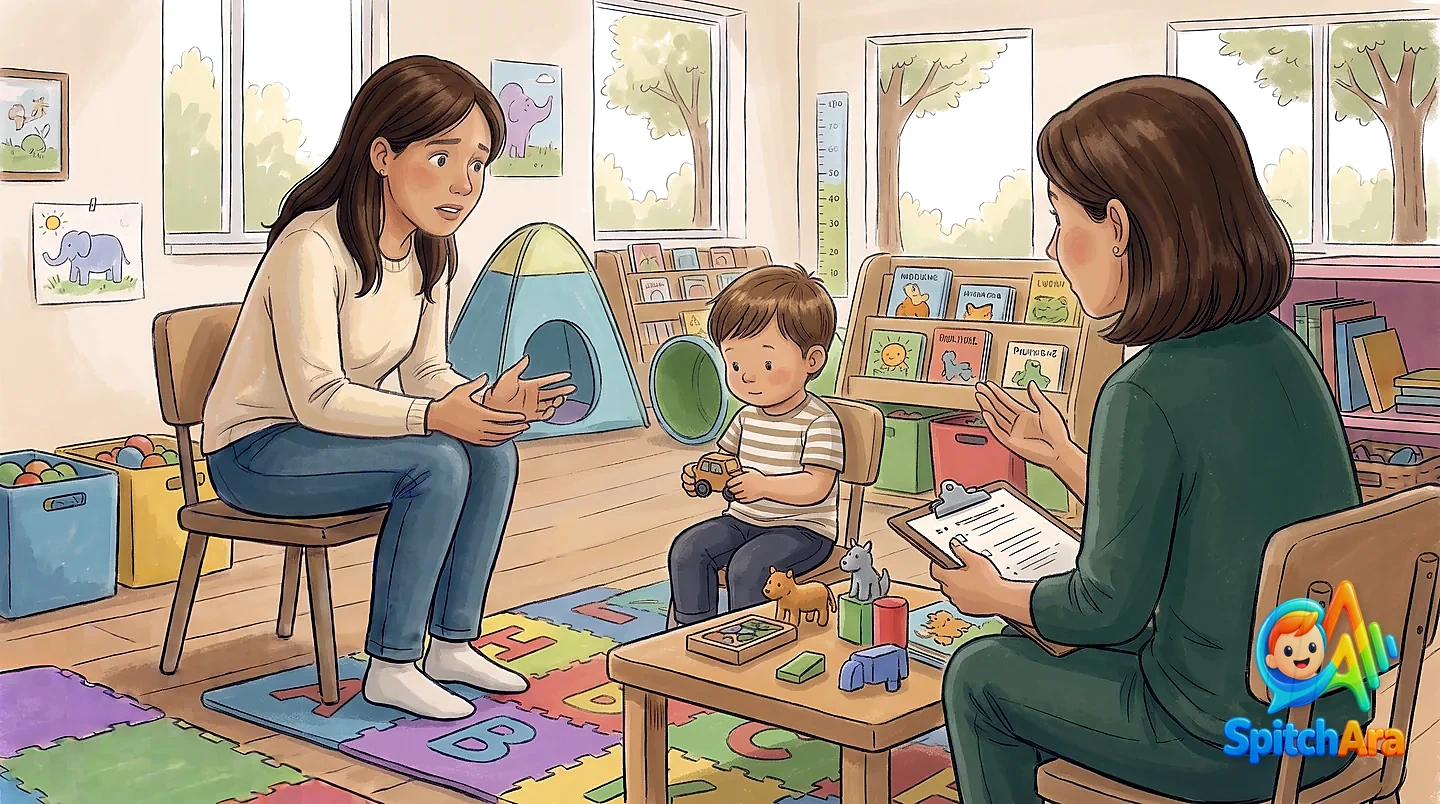
A child used to say a familiar word and now rarely says it. Perhaps a gesture has disappeared too, or a skill that once seemed easy has become difficult. It can be tempting to search for an explanation before contacting anyone, especially when friends suggest that children simply go through phases.
If your child has stopped using words or other established skills, contact their health professional promptly and describe the change. The CDC includes loss of previously acquired skills among reasons to act on developmental concerns (Centers for Disease Control and Prevention, 2026). You do not need to complete a period of home practice before raising it.
Describe the change as precisely as you can
Start with what the child previously did and what you see now. “She used ‘up’ most days to ask to be carried, but we have not heard it recently” is more specific than “Her speech is worse.” Mention whether the word was spontaneous, prompted, or part of a familiar song or repeated phrase.
Then add the timeframe as honestly as possible. You may know the exact week, or only that the change became noticeable over the last month. Do not create a precise date because a form asks for one. An approximate history can still be useful when clearly labelled.
Include other changes you have noticed, such as a difference in gestures, play, understanding, movement, response to sound, or participation. You are not trying to assemble a diagnosis. You are giving the professional enough information to decide what assessment and timing are appropriate (National Institute on Deafness and Other Communication Disorders, 2022).
Separate a missing demonstration from a wider loss
A child may decline to say a word when asked but use it at another time. Another child may have stopped using it across situations. These are different observations, so explain the distinction if you can.
For a hypothetical example, a child will not name the family dog for visitors but still calls the dog during play. That is not the same account as a child who no longer uses several familiar words at home or elsewhere. Neither situation should be interpreted from a single staged performance.
Avoid repeatedly testing to resolve the uncertainty. Repetition can make it harder to observe ordinary behaviour and can become stressful for the child. Instead, notice what happens naturally and tell the professional which parts of the history remain unclear.
Make contact before the record is perfect
You can call with a short description: “I am concerned because my child has stopped using skills they previously used. I would like advice on how soon they should be assessed.” Give the child's age and explain any additional change the service asks about.
If you already have an appointment some distance away, contact the service and report the new information. Ask whether the timing should change. Do not assume that being on a waiting list means a new concern cannot be discussed.
If the child is acutely unwell or there is a sudden serious change, use urgent local medical care rather than waiting for a routine speech appointment. The appropriate service depends on the immediate situation and where you live. A blog cannot assess that urgency from a description alone.
Bring examples that show the before and after
An older recording or note may help explain what the child previously did, but it is not required. A caregiver's account is worth discussing even without video proof. If you have recordings, ask the service how to share them securely and whether they are useful.
Keep the examples short and relevant. A clip showing a familiar word in ordinary use may be more helpful than several minutes of repeated requests to perform it. Explain who was present, which language was used, and what prompted the exchange.
You can also ask other regular caregivers what they have noticed. Record differences rather than forcing agreement. “Nursery still hears this word, but we rarely hear it at home” is important context. It may help the professional understand when the change occurs.
Keep the child's current communication working
While seeking advice, continue responding to the ways your child can communicate now. A gesture, picture, sign, sound, or device may still convey a clear message. Do not remove that method to encourage the return of speech.
If the child reaches towards a wanted object, acknowledge the message and help as appropriate. You can offer a short spoken phrase without making repetition a condition. The child needs a reliable way to be understood during uncertainty, not an additional obstacle to everyday needs.
Familiar, comfortable interaction may be easier than a new intensive practice routine. Follow the child's interests and tolerance. If an activity becomes distressing, stop and discuss the difficulty with the relevant professional. More practice is not automatically the right response to a change whose cause has not been assessed.
Ask what the assessment will consider
When you meet the professional, ask which areas need to be checked and whether other referrals are appropriate. The answer should follow the child's history and current presentation, not a diagnosis selected from an online checklist (American Speech-Language-Hearing Association, n.d.-a).
You may want to clarify how hearing, language, general development, or other health concerns will be considered. If several services are involved, ask who will coordinate the information and whether you need to send reports between them (American Speech-Language-Hearing Association, n.d.-b).
At the end of the conversation, distinguish what is known from what remains uncertain. A preliminary explanation may change after further assessment. It is reasonable to ask, “What would make you reconsider this explanation?” and “What should we do if another skill changes?”
Give the family a practical follow-up plan
Write down the recommended next step, the person responsible for arranging it, and how to make contact if you do not hear back. If monitoring is part of the plan, ask what to record and when the review will occur.
Also discuss the family's immediate communication needs. Perhaps the child needs an easier way to request help, or nursery needs guidance on responding to a new difficulty. Support for everyday participation can be considered while the wider questions are being investigated.
You do not have to choose between staying calm and taking the change seriously. Promptly reporting the loss, describing it accurately, and keeping communication accessible are practical actions. They allow the next decisions to be based on professional assessment rather than reassurance or fear alone.
References
American Speech-Language-Hearing Association. (n.d.-a). Late language emergence [Practice Portal]. https://www.asha.org/practice-portal/clinical-topics/late-language-emergence/
American Speech-Language-Hearing Association. (n.d.-b). Spoken language disorders [Practice Portal]. https://www.asha.org/practice-portal/clinical-topics/spoken-language-disorders/
Centers for Disease Control and Prevention. (2026, February 16). Concerned about your child’s development? https://www.cdc.gov/act-early/families/concerned.html
Centers for Disease Control and Prevention. (2026, May 15). Milestones by 2 years. https://www.cdc.gov/act-early/milestones/2-years.html
National Institute on Deafness and Other Communication Disorders. (2022, October 13). Speech and language developmental milestones. https://www.nidcd.nih.gov/health/speech-and-language
Roberts, M. Y., Curtis, P. R., Sone, B. J., & Hampton, L. H. (2019). Association of parent training with child language development: A systematic review and meta-analysis. JAMA Pediatrics, 173(7), 671–680. https://doi.org/10.1001/jamapediatrics.2019.1197
