
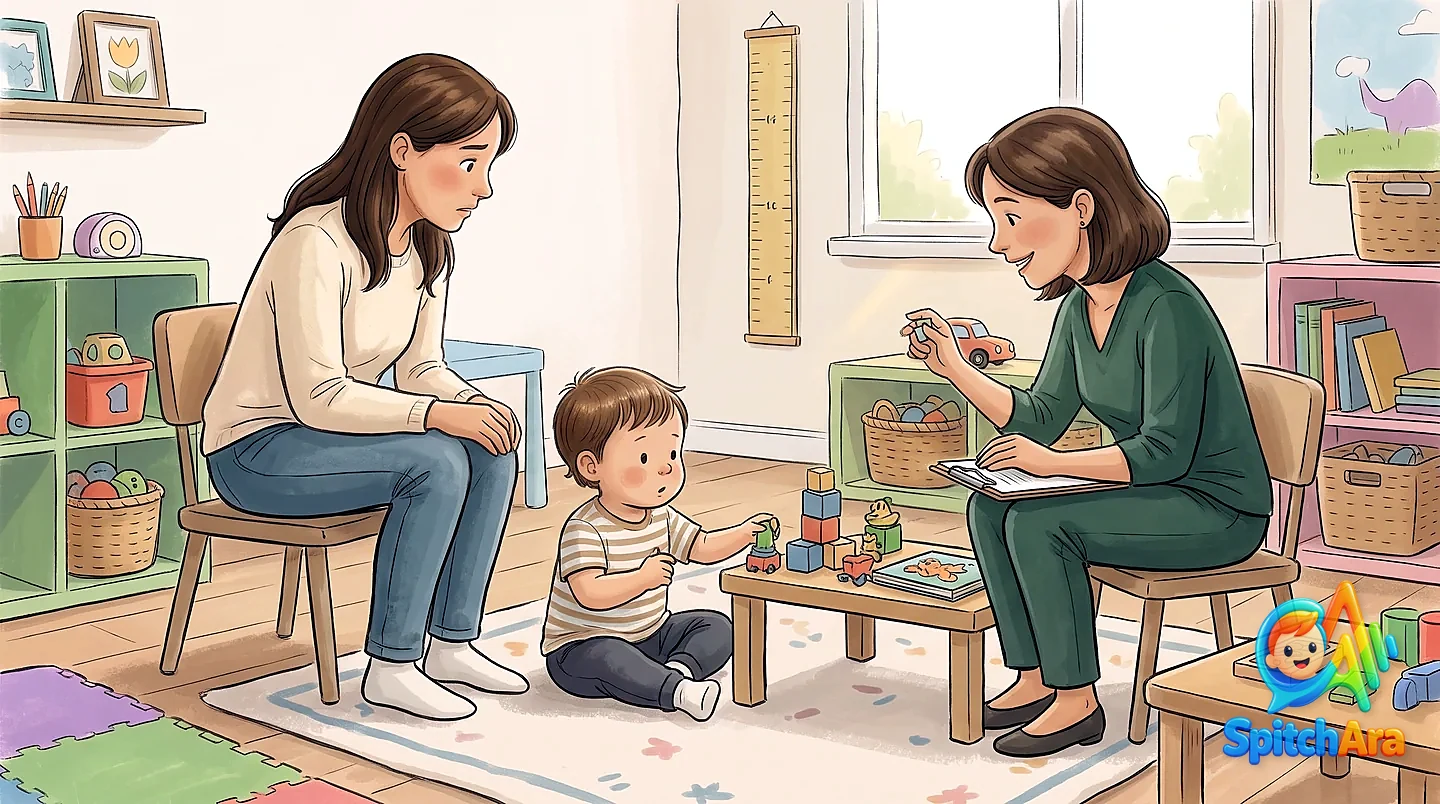
A three-year-old may know exactly which game they want but struggle to explain it to somebody outside the family. They may use familiar words at home and become quiet in a new room. When a child uses few words, the most helpful question is not whether a relative was also a late talker. It is what the child needs to communicate now and which assessment will clarify that need.
Arrange professional advice if you are concerned about your three-year-old's speech or language. Preparing a few examples can make the evaluation more useful, but preparation should not delay it. You do not need a complete vocabulary inventory or a convincing performance from your child before asking for help (American Speech-Language-Hearing Association, n.d.-a).
Describe what is difficult in daily life
“Few words” can mean several things. The child may have a small spoken vocabulary, use mostly repeated phrases, speak unclearly, or find it difficult to combine ideas. These descriptions lead to different questions, so give the professional examples rather than relying on one label.
Consider a hypothetical child who says “juice” but cannot easily explain that the wrong cup has been offered. The difficulty is not just naming a drink. It concerns correcting another person and making a preference understood. Another child may use long phrases that familiar adults understand but new listeners do not. Their assessment needs may be different.
Write down where communication works and where it breaks down. Meals, play with siblings, nursery, and unfamiliar places can reveal different parts of the picture. Include what helps, such as a familiar routine, a gesture, a picture, or extra time.
Use age guidance without diagnosing from a checklist
The CDC's three-year examples include brief back-and-forth conversation and speech that other people understand most of the time. These are monitoring prompts, not a substitute for a validated screening or full evaluation (Centers for Disease Control and Prevention, 2026).
If your child does not show an example, describe the closest situation you have observed. Perhaps they respond through gestures or use a familiar phrase to continue a game. That information belongs in the assessment even when it does not match the checklist wording.
Likewise, do not use one achieved milestone to dismiss another concern. A child may be very capable in play while still needing support to understand instructions or express a message. An evaluation should recognise strengths and difficulties together.
Bring the child's languages into the picture
List the languages your child hears and uses, who uses them, and in which settings. A child may know words for family routines in one language and nursery activities in another. An assessment based only on the clinic language can miss important context.
Learning several languages does not cause developmental language disorder (National Institute on Deafness and Other Communication Disorders, 2023). Therefore, do not remove a home language as a substitute for investigating a concern. Ask how the assessment will consider the child's experience in every relevant language and whether an interpreter is needed.
You can bring a few examples with simple explanations of their meanings. The purpose is not to translate an entire home life for the clinician. It is to make sure that words, gestures, and difficulties are interpreted in the setting where they occur.
Prepare records that answer useful questions
Relevant records may include previous assessments, hearing information, developmental history, and nursery observations. Ask the service what it needs. A concise set of documents is often easier to discuss than a large unsorted folder.
If you keep a communication note, include the event, the child's contribution, and the other person's response. For example: “During a puzzle, he handed his sister a piece and said ‘there.’ She placed it in the wrong space; he moved it and said ‘no, there.’” This shows a meaningful exchange with a correction.
When recording a difficult moment, avoid interpreting motives. “She moved away when asked three questions” is an observation. “She refuses to communicate” is an assumption that may hide the effects of fatigue, understanding, sensory demands, or the unfamiliar situation.
Ask what the evaluation is designed to answer
Before or during the visit, ask which areas will be considered. Understanding language, expressing ideas, producing speech sounds, hearing, and communication participation are related but not identical. Knowing the purpose of the assessment helps you understand the result.
The NIDCD describes language assessment as drawing on observation, caregiver information, and appropriate tests (National Institute on Deafness and Other Communication Disorders, 2023). A single task may therefore be one piece of the evaluation rather than the whole answer. Ask how the clinician combines information from the session with what happens at home or nursery.
Also mention anything that may affect participation: unfamiliar adults, difficulty sitting, movement needs, access to communication aids, or a language mismatch. These are practical assessment considerations. They should not be treated as reasons to make the child perform without support.
Keep the appointment manageable for the child
Explain the visit in simple, truthful terms suited to your child. You might say that you will meet somebody, play with some materials, and talk together. Avoid promising that there will be no unfamiliar tasks if you do not know the appointment structure.
Bring usual supports and ask about breaks, snacks, comfort items, or positioning where appropriate. If the child communicates differently from home, tell the clinician rather than repeatedly prompting a demonstration. A caregiver can add context without taking over every turn.
The professional may need to see how the child responds independently, but should explain what support is appropriate and why. Ask when you are unsure. You are providing essential knowledge of the child, not sitting an examination of your parenting.
Turn the findings into an understandable plan
At the end, ask for the main findings in plain language. What can the child do comfortably? What is difficult? Which conclusions are firm, and which need more information? If a diagnostic term is used, ask what it means for everyday support rather than leaving with the label alone.
Then clarify the next action. It might involve further assessment, therapy, a hearing check, coordination with nursery, or a planned review. Ask who arranges each step and how to follow up if you do not hear back (National Institute on Deafness and Other Communication Disorders, 2022).
For home support, request a demonstration that fits your child's current communication. One well-understood adjustment is more useful than a long list you cannot apply. Continue accepting the child's existing ways of expressing needs and ideas while the plan develops. The purpose of evaluation is to make communication more accessible, not to measure the child's worth by how many words appear in a clinic room.
References
American Speech-Language-Hearing Association. (n.d.). Spoken language disorders [Practice Portal]. https://www.asha.org/practice-portal/clinical-topics/spoken-language-disorders/
American Speech-Language-Hearing Association. (n.d.-a). Late language emergence [Practice Portal]. https://www.asha.org/practice-portal/clinical-topics/late-language-emergence/
Centers for Disease Control and Prevention. (2026, February 16). Concerned about your child’s development? https://www.cdc.gov/act-early/families/concerned.html
Centers for Disease Control and Prevention. (2026, May 15). Milestones by 3 years. https://www.cdc.gov/act-early/milestones/3-years.html
National Institute on Deafness and Other Communication Disorders. (2022, October 13). Speech and language developmental milestones. https://www.nidcd.nih.gov/health/speech-and-language
National Institute on Deafness and Other Communication Disorders. (2023, May 8). Developmental language disorder. https://www.nidcd.nih.gov/health/developmental-language-disorder
