
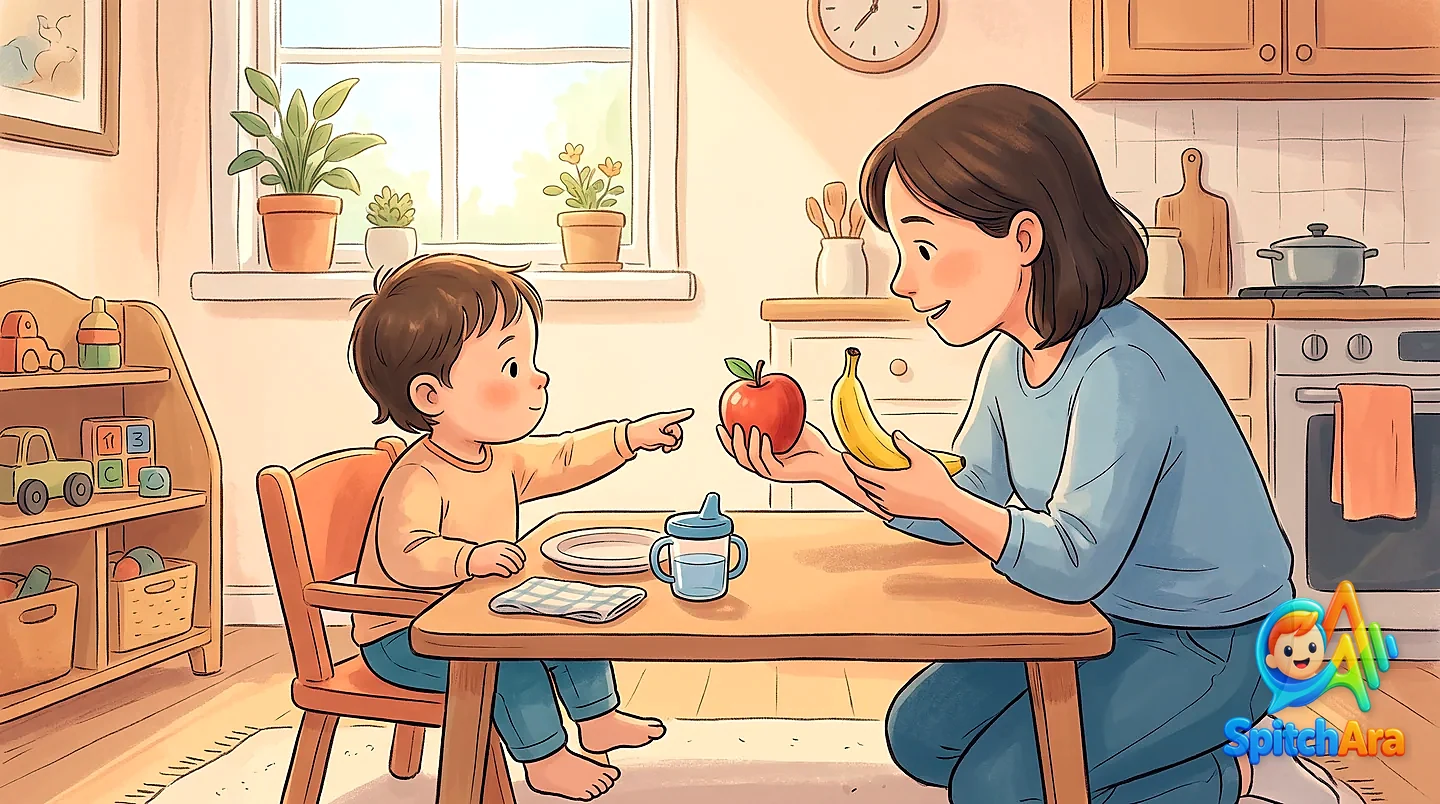
“Blue cup or yellow cup?” sounds like a small question. For a child, however, it can be a real opportunity to affect what happens next. That opportunity disappears if the adult ignores the answer, rejects a gesture or keeps asking until a preferred word is spoken.
A meaningful choice has options the child can understand, a way to answer and an adult willing to act on the answer. Offering choices can fit naturally into daily life, but it should not turn every routine into a language test. The purpose is participation as well as practice.
Offer a choice only when there is one
Begin with decisions that are genuinely flexible. A child might choose between two suitable cups, which book to look at or where to place a toy. If an option is unavailable, unsafe or unacceptable to the adult, do not present it as an equal possibility.
For example, asking “Do you want to leave?” when departure is unavoidable creates a false choice. A clearer message is, “We are leaving now. Shoes first or coat first?” provided both sequences are practical. The adult explains the boundary while preserving a decision the child can actually make.
This distinction also reduces confusion. A child who has learned that their answer changes nothing may have little reason to respond. The solution is not a more exciting reward for speaking. It is to make the decision honest and understandable.
Make the options visible and manageable
Present two familiar objects if spoken options alone are difficult to follow. Hold them where the child can see or otherwise access them, without moving them so quickly that tracking becomes the task. For some children, pictures, written words or an established AAC system will be more suitable than the objects themselves.
The number of options should fit the child and situation. Two is a practical starting point, not a developmental rule. A child may comfortably choose from more; another may need the options presented separately. Access needs, vision, movement and familiarity all affect how a choice can be expressed.
NHS guidance includes everyday choices among ways to support early language experiences (National Health Service, 2023). That recommendation does not mean a caregiver must demand a spoken label. The decision remains meaningful when the child points, looks towards an option in an established way, signs or uses AAC.
Wait without turning the pause into a demand
Ask once, then give the child time. Repeating the question rapidly, adding new alternatives and moving the objects around can make the decision harder. A quiet pause allows the child to process the options and respond in their own way.
If the child reaches for an object, acknowledge the choice and provide it when appropriate: “The blue cup.” You have supplied a language model without making speech a condition. If the reach is unclear, check gently rather than deciding that the child failed to answer.
An AAC user may need extra time to locate a message or use a selection method. Keep the system available and follow the access approach agreed with the child's professional. Do not assume that a slow response means the child has no preference.
Leave room for neither and something else
A two-option question can accidentally trap a child between things they do not want. If the child pushes both away, turns from the activity or uses “no,” recognize that response. You can say, “Neither cup,” and consider what is possible next.
There will be situations where neither option is not immediately feasible. Explain simply: “We need a coat because it is cold. This one or that one?” If distress continues, look for the underlying difficulty rather than repeating the choice indefinitely. The issue may be texture, fit, timing or leaving a preferred activity.
Communication rights include meaningful choice and refusal, alongside receiving a response even when the requested outcome cannot be provided (National Joint Committee for the Communication Needs of Persons With Severe Disabilities, n.d.). In family life, this means taking the message seriously while explaining practical limits.
Use choices for more than obtaining objects
Choices can concern an action, a person or the course of a shared activity. “Shall the car go through the tunnel or around it?” lets a child influence play. “This page or the next one?” can give them control during a book. These exchanges may be more interesting than repeatedly choosing between snacks.
However, do not make the child choose every detail. Constant decisions can be tiring, especially when the child is already managing a difficult routine. Sometimes a simple explanation and supportive help are more useful than another question.
Consider a hypothetical mealtime. The child chooses a cup, then points to a spoon already on the table. The adult gives the spoon without requiring another formal choice. Communication has already succeeded. Turning that moment into “Spoon or fork? Say spoon” would add a demand without adding useful information.
Share the approach with other caregivers
Consistency means adults understand the child's response methods and respect the same basic decisions. It does not require everyone to repeat identical phrases. A grandparent can offer a choice naturally in a home language while following the same principle of accepting an accessible answer.
Describe specific signals and uncertainties: “She usually points to choose, but please check if the objects are close together.” Avoid a rigid rule that every glance means yes. A child deserves the chance to correct an adult's interpretation.
If choices repeatedly become confusing or frustrating, ask a speech-language professional to observe an ordinary example. The question may involve comprehension, access, vocabulary or the way the options are presented. More repetition is not always the answer (Centers for Disease Control and Prevention, 2026).
Notice whether the choice changed anything
After a routine, ask yourself whether the child could influence the outcome. Did you honour the selection? Was there a way to reject both options? Did your language help or interrupt? These questions evaluate the interaction rather than score the child.
Start with one genuine decision today. Show the options clearly, allow an accessible response and act on it. The most important outcome is not a perfectly pronounced word. It is a child experiencing that their communication can shape a real part of the day.
References
Centers for Disease Control and Prevention. (2026, February 16). Concerned about your child’s development? https://www.cdc.gov/act-early/families/concerned.html
Dowdall, N., Melendez-Torres, G. J., Murray, L., Gardner, F., Hartford, L., & Cooper, P. J. (2020). Shared picture book reading interventions for child language development: A systematic review and meta-analysis. Child Development, 91(2), e383–e399. https://doi.org/10.1111/cdev.13225
National Health Service. (2023, April 26). Help your baby learn to talk. https://www.nhs.uk/baby/babys-development/play-and-learning/help-your-baby-learn-to-talk/
National Institute on Deafness and Other Communication Disorders. (2022, October 13). Speech and language developmental milestones. https://www.nidcd.nih.gov/health/speech-and-language
National Joint Committee for the Communication Needs of Persons With Severe Disabilities. (n.d.). Communication bill of rights (3rd ed.). American Speech-Language-Hearing Association. https://www.asha.org/njc/communication-bill-of-rights/
Roberts, M. Y., Curtis, P. R., Sone, B. J., & Hampton, L. H. (2019). Association of parent training with child language development: A systematic review and meta-analysis. JAMA Pediatrics, 173(7), 671–680. https://doi.org/10.1001/jamapediatrics.2019.1197
