
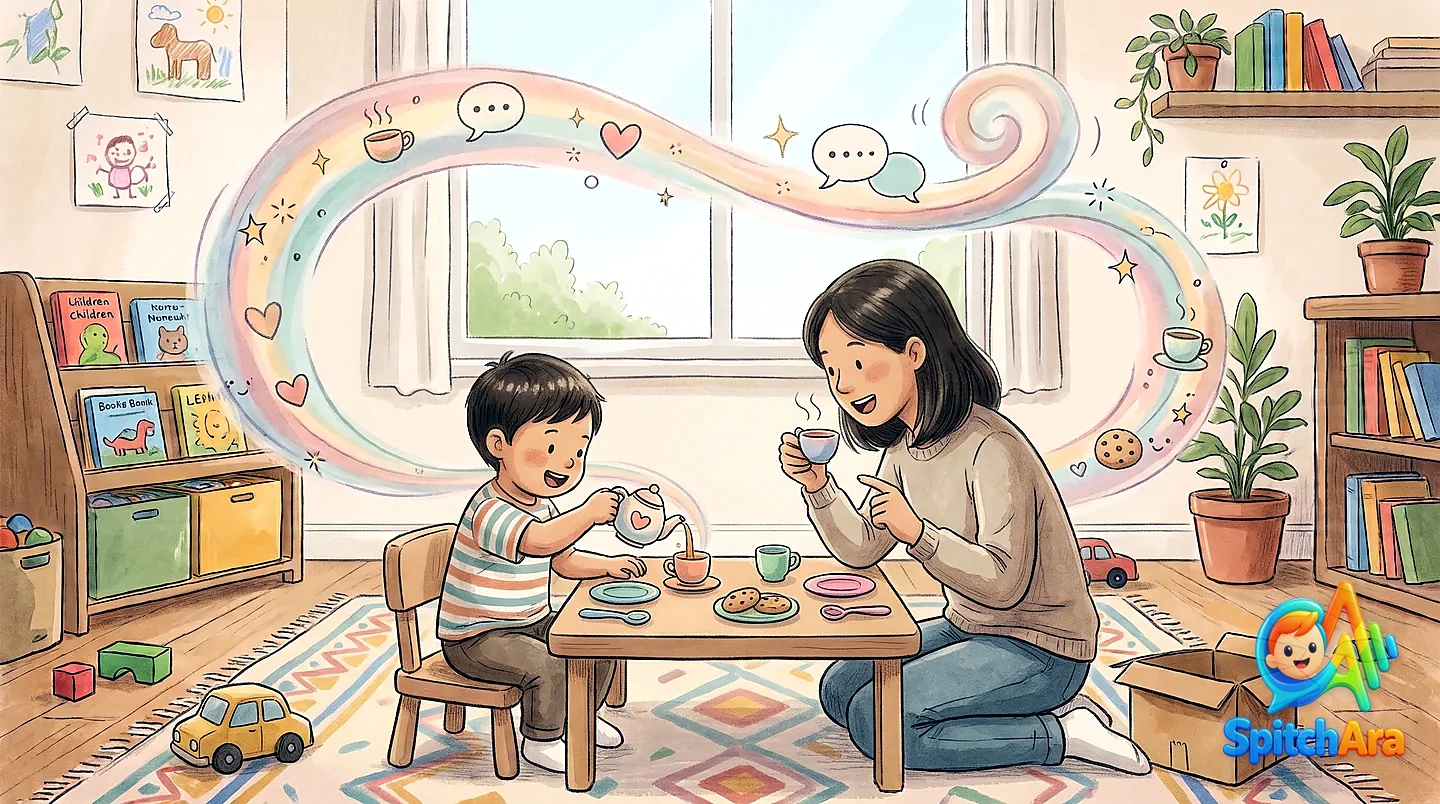
A toy bear receives a spoonful from an empty bowl. A car sleeps under a cloth. A block becomes a telephone for one moment and a tower piece the next. Pretend play can be wonderfully ordinary, and it does not need an elaborate set or a convincing performance to give people something to communicate about.
For pretend play that supports communication, begin with an action the child recognises and enjoys. Join the meaning they are creating, add a small amount of language, and let their response affect the story. If pretend play is not comfortable or interesting for your child, other forms of shared interaction are valid starting points.
Start with a familiar action
Everyday events provide possible ideas: feeding, sleeping, travelling, washing, or greeting somebody. Choose an action the child has reason to recognise rather than one that requires a long explanation. A toy does not have to look realistic if both people understand the idea.
The CDC includes simple pretend actions among its suggestions for young children (Centers for Disease Control and Prevention, 2026). That guidance does not mean a parent should turn a pretend scenario into a diagnostic test. The activity is an opportunity to share meaning, while concerns about play or communication belong in a broader professional discussion.
Suppose your child puts a cloth over a toy. You can say “Bear sleeping” and place another toy nearby. If the child wakes the bear, follow the change. The scene can develop through the child's decisions rather than a sequence the adult insists on completing.
Give the child a role that has an effect
A child may choose which toy receives food, decide where the car goes, or indicate that a character needs help. Their contribution should change what happens. If the adult always returns to the planned story, the child's ideas may become decorative rather than meaningful.
For a hypothetical picnic game, the adult offers two toy plates. The child gives one to the bear and places the other on the floor. “Bear's plate here” acknowledges the first choice. The adult can then ask or comment about the second without immediately correcting its location.
If the child does something unexpected, check the meaning. Perhaps the plate is a steering wheel now. Shared pretend play can involve negotiation, and the adult does not need to know the child's idea before the exchange begins.
Use words that explain the event
Action words and short phrases often fit a pretend scene naturally: “Bear hungry,” “Car stuck,” “Baby awake,” or “More soup.” Choose language that matches the child's contribution rather than adding a long narrative over it.
The NHS suggests building on a child's words in everyday interaction (National Health Service, 2023). In pretend play, “sleep” might become “Bear sleeping” while you acknowledge the child's action. The expansion adds a useful detail without requiring the child to repeat it.
If the child communicates through gesture, signs, pictures, or a device, those messages can direct the story too. A selection for “stop” may end an action; “different” may change the character. Keep the child's usual communication support available rather than treating the game as a speech-only activity.
Introduce one change and see whether it is welcome
Once a familiar action is comfortable, you might offer a small variation. The bear's spoon could be missing, the car could need a bridge, or another character could arrive. These are optional story ideas, not a required progression.
Keep the variation gentle and reversible. Do not create a frustrating obstacle with an essential object merely to provoke a request. If the child is upset, restore the simpler scene. A communication opportunity loses its value when the child has no comfortable way to participate.
You can also let the child introduce the variation. If they put the bear in the car, the story may now be about a journey. Follow that idea before suggesting your own. The most useful language often appears when both people are trying to understand what happens next.
Avoid confusing imitation with imagination
A child may copy an adult's action, but copying is not the only form of participation. They may watch, reject an idea, change an object, or offer a completely different sequence. Describe what happens rather than deciding that play counts only when the child reproduces your example.
Likewise, a repeated favourite scene is not automatically a problem to correct. It may be familiar and enjoyable. You can join it and leave room for a small change without demanding novelty every time.
If you are concerned about the child's play or development, bring concrete examples to a qualified professional. A short blog activity cannot determine whether a child's play pattern has clinical significance. It can help you notice what the child enjoys and how interaction works around it (Centers for Disease Control and Prevention, 2026a).
Make materials accessible and manageable
Choose objects that are safe for the child's age and individual needs. Large, stable materials may be easier for some children to use than tiny pretend-food pieces. A tray or accessible surface may help keep the scene within reach.
The child does not have to manipulate every object to lead the play. They might choose a character while an adult moves it, or use a familiar signal to decide when an action happens. The important question is whether they have a clear way to contribute.
If several children join, keep the roles understandable. One sibling may enjoy narrating the whole story, leaving little room for another child's message. Slow the exchange and respond to each contribution without asking a sibling to act as a therapist.
Let the story finish naturally
The child may end the game by putting a toy away, changing activity, or using a familiar signal. Acknowledge the ending. There is no need to complete a final sentence or perform a tidy story conclusion before moving on.
Afterwards, notice one meaningful exchange. Perhaps the child corrected where the bear should sit, asked for help with the car, or invited another person into the scene. These details can be useful to share with a clinician or another caregiver without turning the play into a score.
At the next opportunity, begin with one familiar action and a small amount of language. Let the child decide whether the bear eats, sleeps, travels, or becomes part of something entirely different. The pretend world becomes useful for communication when both people are allowed to shape it.
References
Centers for Disease Control and Prevention. (2026, February 16). Concerned about your child’s development? https://www.cdc.gov/act-early/families/concerned.html
Centers for Disease Control and Prevention. (2026, May 15). Milestones by 18 months. https://www.cdc.gov/act-early/milestones/18-months.html
National Health Service. (2023, April 26). Help your baby learn to talk. https://www.nhs.uk/baby/babys-development/play-and-learning/help-your-baby-learn-to-talk/
National Institute on Deafness and Other Communication Disorders. (2022, October 13). Speech and language developmental milestones. https://www.nidcd.nih.gov/health/speech-and-language
Petrie, A., Mayr, R., Zhao, F., & Montanari, S. (2023). Parent-child interaction during storybook reading: Wordless narrative books versus books with text. Journal of Child Language, 50(1), 104–131. https://doi.org/10.1017/S0305000921000763
World Health Organization. (2022, April 27). Caregiver skills training for families of children with developmental delays or disabilities: Introduction. https://www.who.int/publications/i/item/9789240048836
