
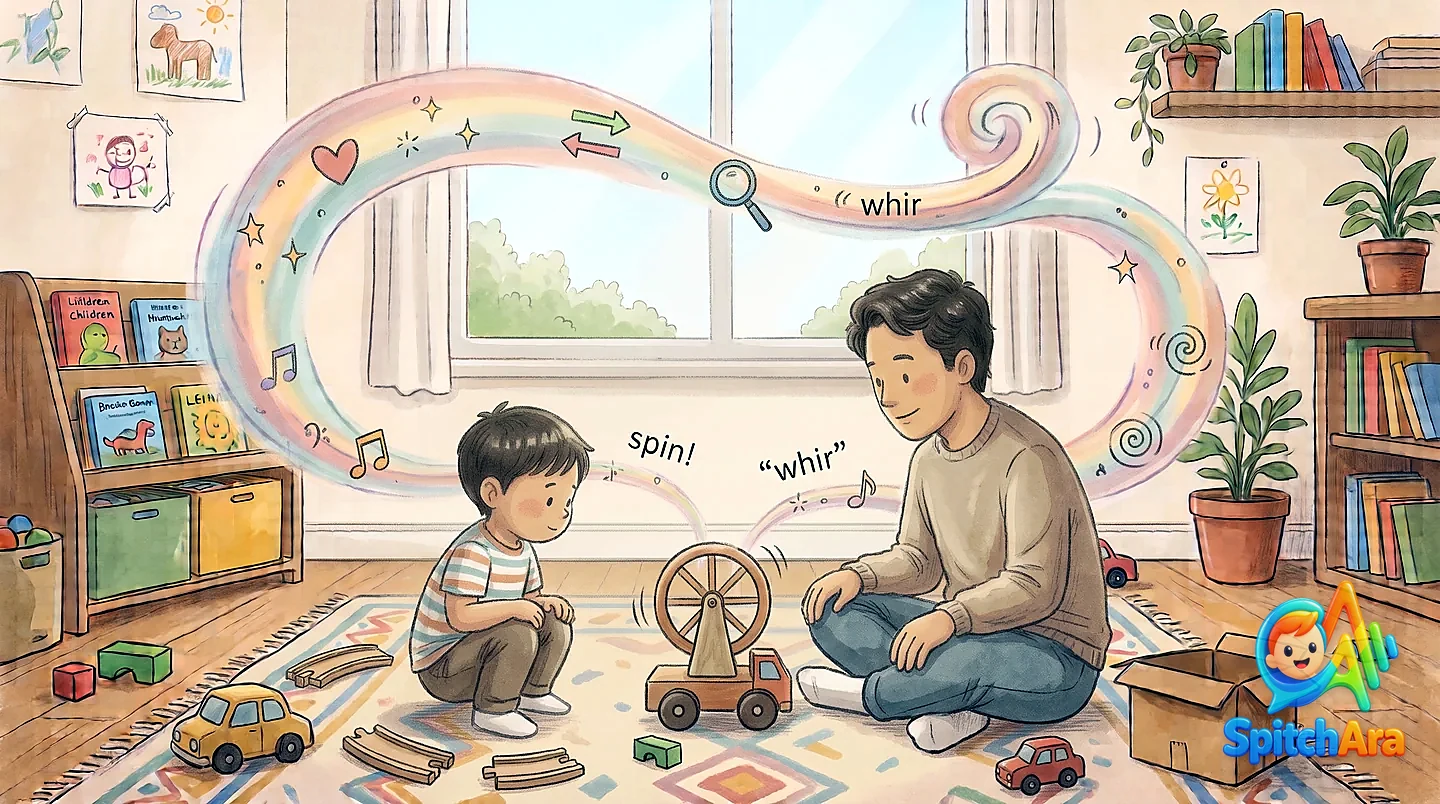
Your child places a toy beside you, then watches its wheels rather than your face. You comment on the turning wheel, and the child turns it again. There is something shared in that exchange even though nobody has looked directly into anyone's eyes.
Shared attention is about connecting around an interest or event. Eye contact can be one part of an interaction, but it should not be made the price of joining play. For some children, looking at an object while listening or moving nearby is a more comfortable way to participate. Your task is to notice the connection and make it easier to sustain.
Look for a response that relates to the moment
The phrase “paying attention” can mean several things. A child may be looking at a toy without sharing it with anyone. Another child may be looking away while responding to a familiar adult's comment. A single gaze direction does not explain the whole exchange.
Instead, consider what happened before and after the child's action. Did they bring an object towards you, repeat something after you reacted, pause for you to continue, or show pleasure when you joined? These observations can help you describe an interaction without assuming that every movement carries a deliberate message.
The American Speech-Language-Hearing Association describes shared attention in autistic people as potentially involving shared objects or activities rather than eye contact (American Speech-Language-Hearing Association, n.d.). This matters because a narrow focus on looking at faces can obscure meaningful participation. It does not mean that all children share attention in the same way, or that an observation at home replaces assessment.
Enter the child's activity without taking it over
Begin close enough to notice, but not so close that your presence interrupts. If the child is sorting blocks, you might sort a few beside them. If they watch a moving shadow, you might notice the same shadow and offer a short comment. Joining does not require changing the activity into conventional pretend play.
For instance, imagine a child repeatedly opens and closes a toy door. An adult sits nearby and says, “Open,” when it opens. The child pauses with the door halfway closed. Rather than filling the pause with questions, the adult waits. The child opens it again, and the adult smiles and responds. Whether this becomes an exchange depends on what the child does next, not on the adult declaring that it has become one.
If the child moves away or blocks your involvement, respect that boundary. You can stay available and try later. A shared activity requires room for a person to decline sharing as well as to accept it.
Use your position to make participation easier
Side-by-side seating may let both people see the same object without requiring the child to keep shifting attention between a face and a toy. Other children prefer an adult opposite them or a little farther away. Try a comfortable arrangement and notice whether it changes the ease of the exchange.
The environment matters too. Background audio, bright light or a crowded surface may compete with the activity. Removing one distraction can be more helpful than repeatedly saying the child's name. However, do not strip the space of familiar supports that help the child feel settled.
Think about physical access as part of attention. If a toy is hard to reach or the child is working to maintain an uncomfortable posture, participation may demand more effort than it appears to. An occupational therapist, physiotherapist or speech-language professional may help when positioning or access is a persistent concern.
Comment before adding another question
Questions are useful when you genuinely need information. During play, however, repeated questions with answers the adult already knows can turn a shared interest into a quiz. “What colour?” “How many?” “What's that?” may leave little room for the child to introduce a thought.
Try a comment that relates to the visible event: “The tower's leaning,” or “That wheel is stuck.” Then notice whether the child responds. A comment gives language without creating an obligation to answer. NHS advice similarly places everyday talk and shared experiences at the centre of early language opportunities (National Health Service, 2023).
If a question is helpful, keep it real. “Where shall this one go?” is meaningful when the child can choose the destination. Accept their established way of answering, including a gesture or AAC message. The value lies in the child's influence over the activity, not in the form the adult hoped the response would take.
When there is no obvious response
An unanswered comment does not tell you whether the child failed to hear, did not understand, was absorbed, felt uncomfortable or simply had nothing to add. Avoid escalating immediately into louder speech, repeated commands or physical prompting. Pause, observe and consider whether the activity still suits the moment.
You can simplify your contribution: fewer words, a slower pace or one object instead of several. You can also stop talking briefly and remain available. If the child returns an object to you later, treat that as a new opportunity rather than a delayed response they owe you.
Persistent concerns deserve a broader conversation with a professional. Bring examples of what makes interaction easier and harder, including familiar settings where the child communicates well. A professional can consider communication alongside hearing, language, sensory and developmental information. A demand for eye contact is not a substitute for that understanding.
Notice the influence each person has
A useful home note might read: “She rolled the car towards my hand. When I rolled it back, she laughed and sent it again.” The note describes a sequence rather than a judgment such as “poor attention” or “good eye contact.” It also shows how the adult's response contributed.
Try comparing your own approach across two occasions. Did fewer questions give the child more room? Did sitting beside them reduce interruptions? These are practical observations to discuss, not an experiment proving why a child behaves in a certain way.
For the next play period, choose one shared interest and leave room for the child to change the course of it. A glance may occur, but it need not become the target. The more useful question is whether both people can notice, respond and influence what happens together.
References
American Speech-Language-Hearing Association. (n.d.). Autism and autism spectrum disorder. https://www.asha.org/practice-portal/clinical-topics/autism/
American Speech-Language-Hearing Association. (n.d.). Spoken language disorders [Practice Portal]. https://www.asha.org/practice-portal/clinical-topics/spoken-language-disorders/
Centers for Disease Control and Prevention. (2026a, February 16). Concerned about your child’s development? https://www.cdc.gov/act-early/families/concerned.html
Dowdall, N., Melendez-Torres, G. J., Murray, L., Gardner, F., Hartford, L., & Cooper, P. J. (2020). Shared picture book reading interventions for child language development: A systematic review and meta-analysis. Child Development, 91(2), e383–e399. https://doi.org/10.1111/cdev.13225
National Health Service. (2023, April 26). Help your baby learn to talk. https://www.nhs.uk/baby/babys-development/play-and-learning/help-your-baby-learn-to-talk/
World Health Organization. (2022, April 27). Caregiver skills training for families of children with developmental delays or disabilities: Introduction. https://www.who.int/publications/i/item/9789240048836
