
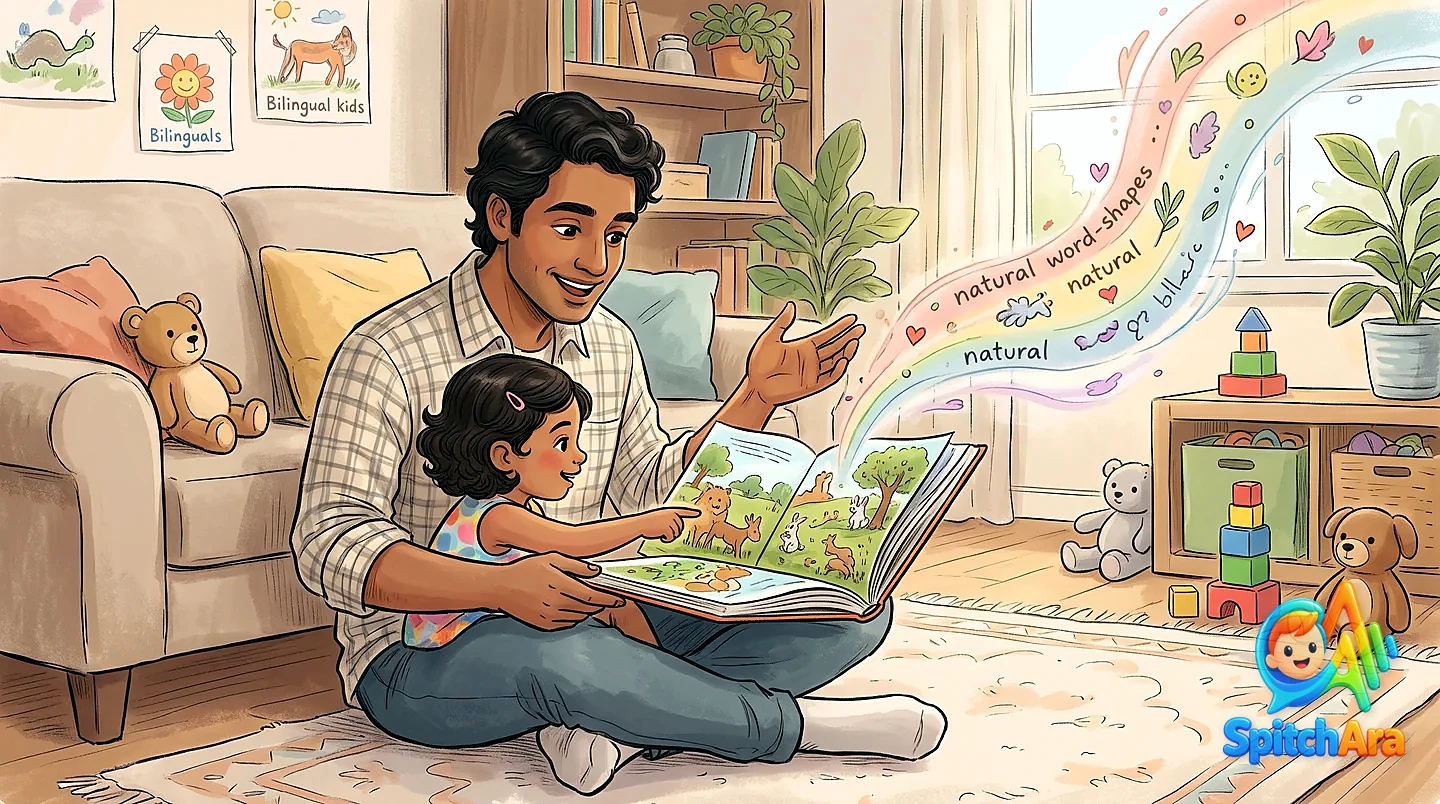
The book is printed in one language, but the story sounds warmer in the language you use with your child. You may know the right expression for the character's surprise without knowing an exact translation of the sentence on the page. That does not prevent a meaningful shared reading experience.
Reading together in two languages can begin with the pictures, the child's interest, and the language you can use comfortably. You do not need to translate every line twice or ask the child to name each object in both languages. The goal is a shared conversation around a story, with room for the child's own contribution.
Choose a book that gives you something to discuss
Look for pictures or events your child wants to revisit. A bus arriving, a lost shoe, or a character searching for a friend can provide a clear subject. The best choice for a particular evening may be a familiar book rather than one selected to teach a new set of words.
You can begin on the page the child chooses. If they point to a cat under a table, follow that detail. “The cat is hiding” in your familiar language may create a more natural exchange than translating a long printed passage about another part of the scene.
A wordless book can be useful because it leaves the wording open, but it is not required. Any suitable picture book can become a conversation. The printed text is one resource, not a rule that every adult must deliver in exactly the same way.
Let the languages serve the relationship
One caregiver may tell the story in one language and another use a different language later. Both can respond to the same character and events. The child is not required to reproduce the story identically for each person.
Current family guidance encourages using the languages in which caregivers are comfortable and sharing books in those languages (Communication Health Support Association, 2026). In practice, that can mean using familiar expressions, sound effects, or a family phrase that captures the event better than a literal translation (American Speech-Language-Hearing Association, n.d.-a).
Suppose a child uses the nursery-language name for an animal while the adult is telling the story in the home language. Respond to the meaning. You can naturally include the home-language word in your reply without demanding that the child correct their contribution before the story continues.
Replace some questions with observations
“What is that?” has a place when you genuinely want to know what the child is noticing. However, repeated naming questions can make the book feel like an assessment. A comment often gives more room for a response.
Try describing something that changes: “The hat fell,” “She cannot find the shoe,” or “The dog is still sleeping.” Then pause. The child may point, laugh, make a sound, use a sign, or say something you did not expect. Follow that contribution instead of returning immediately to the answer you had planned.
For a hypothetical example, an adult says that a character looks worried. The child points to the open door. “You think she is looking outside” connects the child's idea with the story. There is no need to decide whether the child has named an emotion correctly before accepting the contribution.
Add meaning without demanding repetition
If the child says one word, you can add a small detail that fits the picture. “Bus” might become “Bus leaving.” If the child uses a gesture, you can put words to the idea while acknowledging that the gesture already communicated something.
The same purpose can be expressed differently in different languages. Do not force an expansion into the grammatical shape of English if that sounds unnatural in the home language. Keep the message clear and close to what the child was trying to express.
You can also connect the story to a real event. A picture of a market might remind the child of a recent trip. If that becomes the conversation, follow it briefly. Returning to the family's experience can make the book more meaningful than completing every page in order.
Understand what book-sharing research supports
A review of 19 randomized trials involving 2,594 participants found small effects on children's language from interventions that trained caregivers in picture-book sharing (Dowdall et al., 2020). The finding concerns supported interventions, not a guarantee that buying a particular book produces the same result.
For a family, the useful question is therefore how the adult and child share the book. If professional support is available, ask for a demonstration of how to follow the child's interest, respond to their contribution, and adjust the language. A technique is easier to use when you have seen it with your child rather than only read a list of instructions.
The research should not turn reading into another obligation measured by perfect minutes or completed pages. A child who is uncomfortable, tired, or uninterested needs an adjustment. The quality of the exchange cannot be inferred from how long the book remains open.
Make access part of the reading plan
Think about how the child can see, reach, turn, point, or select. A stable surface may help. Another child may prefer the adult to hold the book while they use a communication support. Follow the child's established access methods rather than insisting on one posture.
If the child uses a device or pictures, make relevant communication available without reducing the story to a small naming board. They may want to comment, ask, refuse, or choose another page. An individualized system should support more than answering adult questions.
Some children participate while moving or return for short moments. You can keep the book available and respond when they rejoin. Sitting still for the entire story is not the only way to share it.
Plan a small exchange for the next reading
Choose one familiar page and one thing to notice. You might comment on an action, connect it to the child's day, or leave space after a predictable event. Use the language that lets you respond naturally.
Afterwards, ask yourself whether the child had a way to influence the reading. Could they choose a page, change the topic, reject an interpretation, or finish? Those possibilities make the exchange a conversation rather than a demonstration of vocabulary in two languages.
The book does not need two complete translations to belong in a multilingual home. It needs people who can share its meaning. Begin with the picture your child cares about, and let the words follow the relationship already there.
References
American Speech-Language-Hearing Association. (n.d.-a). Multilingual service delivery in audiology and speech-language pathology [Practice Portal]. https://www.asha.org/practice-portal/professional-issues/multilingual-service-delivery/
Centers for Disease Control and Prevention. (2026a, February 16). Concerned about your child’s development? https://www.cdc.gov/act-early/families/concerned.html
Communication Health Support Association. (2026, May 1). Learning more than one language. https://helpingyoucommunicate.org/article/learning-more-than-one-language
Dowdall, N., Melendez-Torres, G. J., Murray, L., Gardner, F., Hartford, L., & Cooper, P. J. (2020). Shared picture book reading interventions for child language development: A systematic review and meta-analysis. Child Development, 91(2), e383–e399. https://doi.org/10.1111/cdev.13225
National Institute on Deafness and Other Communication Disorders. (2023, May 8). Developmental language disorder. https://www.nidcd.nih.gov/health/developmental-language-disorder
Petrie, A., Mayr, R., Zhao, F., & Montanari, S. (2023). Parent-child interaction during storybook reading: Wordless narrative books versus books with text. Journal of Child Language, 50(1), 104–131. https://doi.org/10.1017/S0305000921000763
