
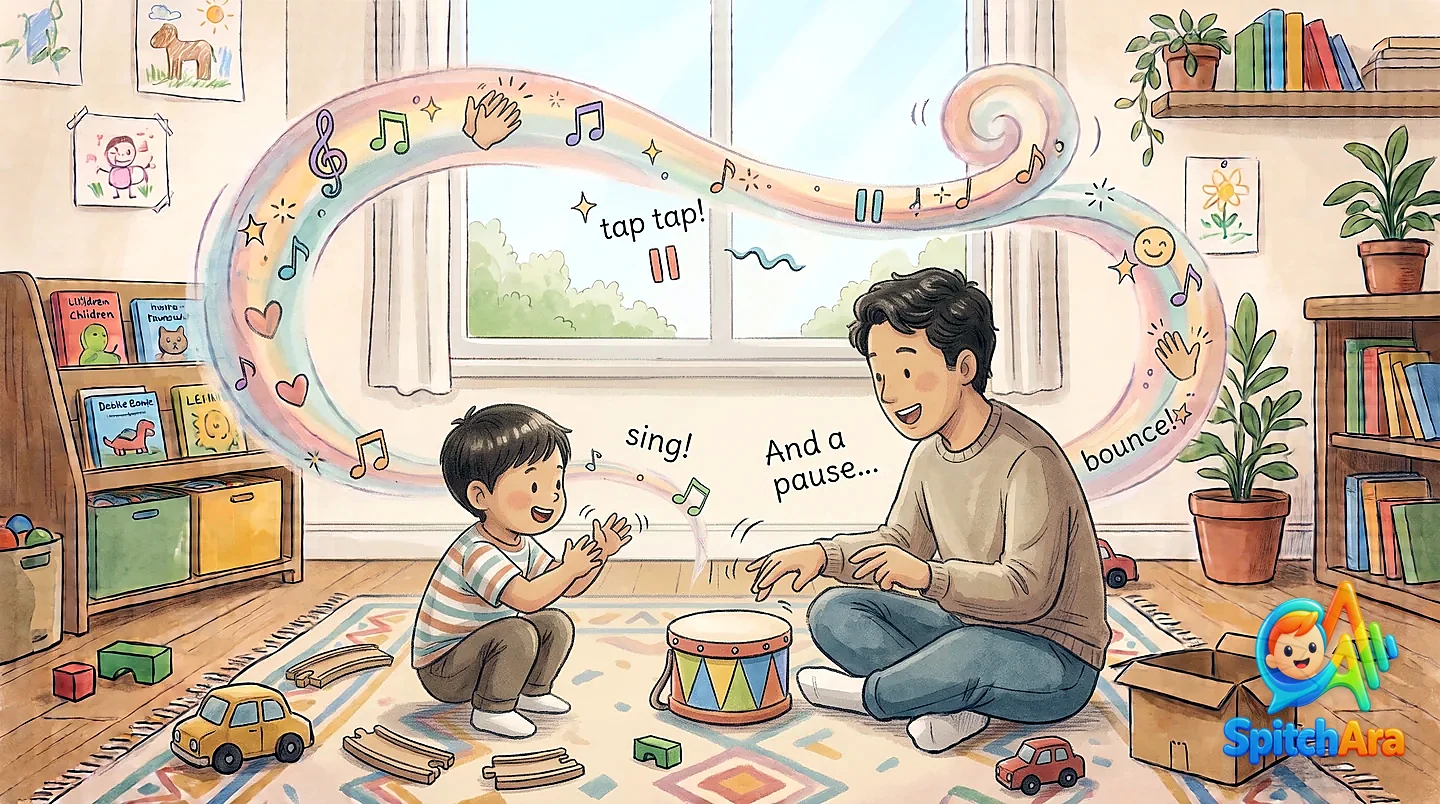
A familiar song reaches the line your child loves. You slow down, and a small hand moves before any word arrives. That movement may be the child's way of joining in. If you wait only for the missing lyric, you can overlook a contribution that is already there.
Songs can create enjoyable opportunities for shared attention, movement and anticipation. They do not need to become singing tests. The useful pause leaves space for a response while allowing the song to continue comfortably, whether the child responds with a sound, a gesture, an AAC message or no visible response at all.
Choose a song the family actually enjoys
Start with something familiar to the child and comfortable for you. It might be a short family song, a simple rhyme or a tune invented around an everyday action. Familiarity gives both people a shared starting point, whereas constantly introducing new material can leave the child trying to work out what the adult expects.
A song in a home language can be especially meaningful because other caregivers can join it naturally. You do not need to replace it with English to make the activity count. Think about the words, the movement and the memories attached to it. Those details help the song belong to your family rather than to a programme.
NHS guidance includes songs and action rhymes among everyday ways to support early language experiences (National Health Service, 2023). This is a recommendation for interaction, not evidence that a specific playlist, frequency or musical style will make a child speak. A child who dislikes singing can have equally worthwhile exchanges through books, play or routine conversation.
Find a comfortable volume and pace
Before experimenting with pauses, notice the child's reaction to the sound itself. Some children enjoy a lively voice; others prefer quiet humming or spoken rhythm. Reduce volume, remove background audio or move farther away if the child seems uncomfortable. Do not assume that louder or more animated is more engaging.
Movement also needs to be optional. If a rhyme usually involves clapping hands, you can clap your own hands and allow the child to watch. You can offer an alternative movement without guiding their body through it. Participation should not depend on tolerating touch or performing an action in a particular way.
A slower pace may make room for a child's response, but slow does not have to mean exaggerated. Imagine talking to another person rather than demonstrating to an audience. A natural voice, a familiar rhythm and a little space often make the exchange easier to follow.
Pause at a moment that makes sense
Choose an obvious point in a familiar sequence, such as before a repeated action or at the end of a short line. Pause briefly with an open, relaxed manner. You are offering a turn, not silently demanding the right answer.
For example, in an invented rolling song, an adult might sing, “The little ball goes...” and pause before rolling the ball. The child could reach, say “go,” look towards the ball or select a familiar symbol. The adult can respond and roll it. If no response comes, the adult can finish the line and continue. The song does not need to stop until the child performs.
This distinction becomes clearer over several turns. If the child starts to anticipate the moment and seems pleased, the pause may be useful. If the child becomes tense, turns away or repeatedly tries to restart the song, your pause may be interrupting the enjoyment. Shorten it or stop using it. The child's response should shape the activity.
Treat different contributions as part of the song
A child may contribute only the final vowel, repeat a rhythm, move a foot or show the picture associated with a favourite verse. Respond to what you can reasonably understand. You might say, “You chose the animal verse,” or simply sing it again. There is no need to announce every contribution as an achievement.
Be careful, however, about assigning meaning to every movement. If you are unsure whether the child is asking for another verse or reaching for a toy, offer a simple clarification. “Song again, or the ball?” Present options the child can access and accept a rejection of both.
For a child who uses AAC, singing should not mean putting the system aside. Messages such as “again,” “different,” “stop,” and names of favourite songs can make musical play more self-directed. A speech-language professional can help select and model accessible vocabulary within the child's broader communication system (American Speech-Language-Hearing Association, n.d.).
Carry a useful word back into ordinary life
Sometimes a child readily uses a sound in a song but not elsewhere. Rather than repeatedly testing whether the word transfers, notice a meaningful opportunity. If “go” occurs during a rolling rhyme, you might later say “go” when the child chooses to push a toy. The connection is the action, not a demand to demonstrate learning.
Likewise, a song about washing hands can accompany the real routine, provided it does not delay care or make washing stressful. A short phrase may be enough. You do not have to sing through every task, and a familiar routine does not need a soundtrack to be communicative.
Avoid treating a remembered lyric as proof of broad language understanding. Repeating a phrase, understanding it and using it flexibly are related questions but not identical ones. If you are preparing for an assessment, describe when the phrase occurs and what the child seems to mean. That context is more useful than saying only, “He knows all the words.” (American Speech-Language-Hearing Association, n.d.-b)
End before the invitation becomes pressure
Adults sometimes repeat a successful moment until it stops being enjoyable. One clear exchange can be enough. If your child asks to continue, continue within comfortable limits; if they leave, let the activity end. A response should not create an obligation to keep responding.
Afterwards, you might note, “She raised her hand during the pause, so I repeated the verse. She then pointed to the book and we changed activities.” That record recognizes both joining and leaving as communication.
Choose one small adjustment for next time: a quieter voice, a shorter pause, a favourite home-language song or a way to request a different verse. The aim is a shared experience in which your child can influence the rhythm, not a perfect performance.
References
American Speech-Language-Hearing Association. (n.d.). Augmentative and alternative communication (AAC). https://www.asha.org/practice-portal/professional-issues/augmentative-and-alternative-communication/
American Speech-Language-Hearing Association. (n.d.-b). Spoken language disorders [Practice Portal]. https://www.asha.org/practice-portal/clinical-topics/spoken-language-disorders/
Centers for Disease Control and Prevention. (2026a, February 16). Concerned about your child’s development? https://www.cdc.gov/act-early/families/concerned.html
National Health Service. (2023, April 26). Help your baby learn to talk. https://www.nhs.uk/baby/babys-development/play-and-learning/help-your-baby-learn-to-talk/
Petrie, A., Mayr, R., Zhao, F., & Montanari, S. (2023). Parent-child interaction during storybook reading: Wordless narrative books versus books with text. Journal of Child Language, 50(1), 104–131. https://doi.org/10.1017/S0305000921000763
Roberts, M. Y., Curtis, P. R., Sone, B. J., & Hampton, L. H. (2019). Association of parent training with child language development: A systematic review and meta-analysis. JAMA Pediatrics, 173(7), 671–680. https://doi.org/10.1001/jamapediatrics.2019.1197
