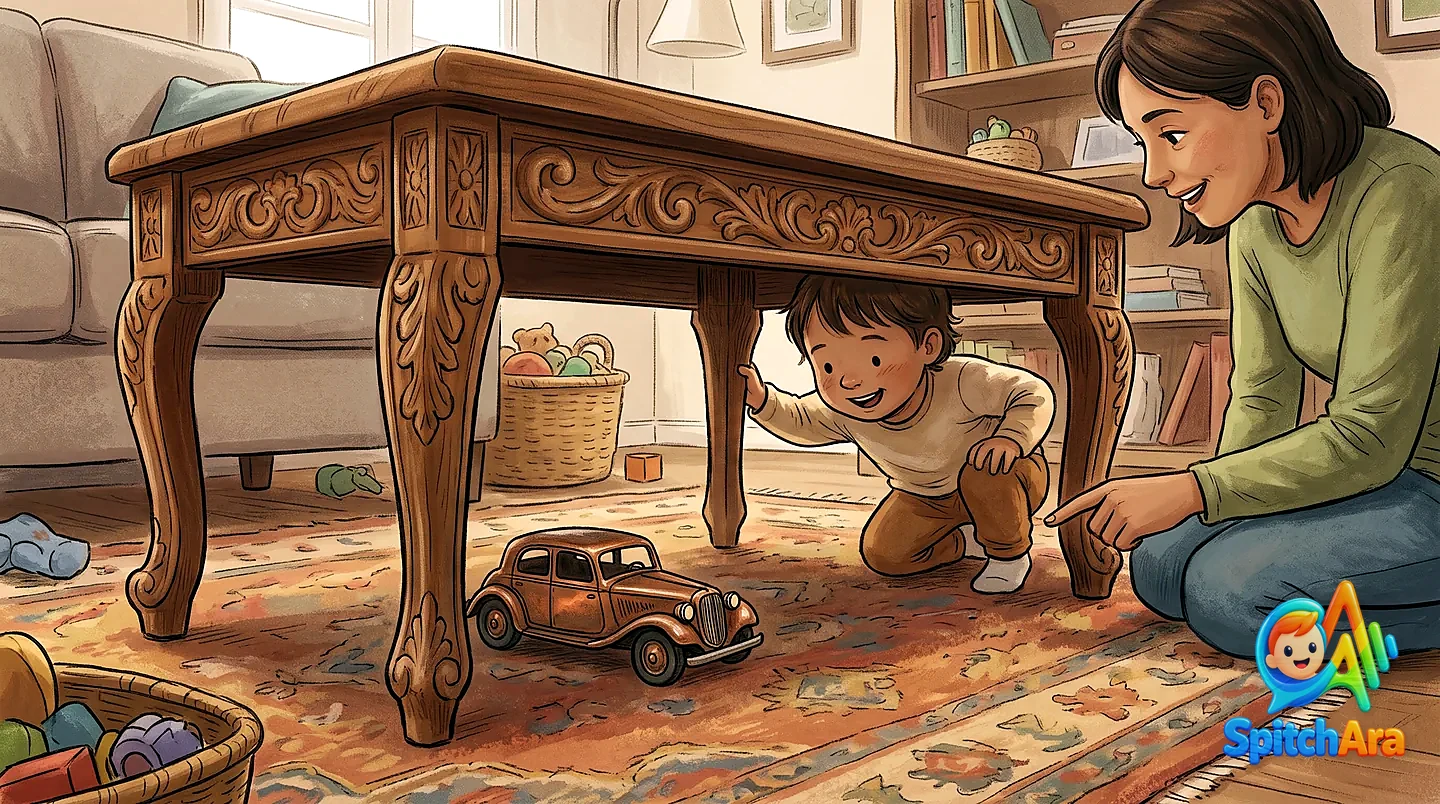
Picture this everyday moment. The toy car has disappeared under the chair. Your child reaches towards it, looks back at you, and makes a small sound. There is already a conversation here, even if nobody has said a recognisable word. You can respond to the message, help retrieve the car, and add a short phrase such as “Car stuck.” The child has something to communicate because something matters to them.
That is a useful starting point for speech and language activities at home. You do not need to recreate a therapy room or spend the day asking your child to repeat words. Instead, choose a few ordinary moments in which you can notice, respond, and make language easier to connect with what is happening. These ideas support everyday interaction; they do not replace an assessment when you have concerns.
Start with a reason to communicate
A word on a flashcard can be difficult to connect with daily life. A word used while a shoe refuses to go on has an immediate purpose. “Stuck,” “help,” and “off” describe the problem the child is experiencing. The same principle works when a tower falls, somebody arrives at the door, or the family searches for a favourite cup.
Watch for the moment before deciding what to say. If your child is examining the wheels, a comment about the car's colour may miss their interest. “Round and round” follows what they are noticing. If they then push the car away, the subject may have changed. You can move with it rather than returning them to the vocabulary you had planned.
Consider a hypothetical clean-up game. A child puts a spoon into a box, takes it out, and repeats the action. The adult joins with another spoon and says “In” as it drops. After a few turns, the child holds out the box. That invitation is worth answering, whether it comes through a movement, a sound, a sign, or speech. The exchange is more informative than the number of times “in” was repeated.
Make your contribution easy to follow
You can keep your usual warm voice while making the message shorter. Instead of “Would you like me to put the little red car at the very top of the ramp again?”, try “Car up?” while showing the ramp. Short does not mean expressionless. Your timing, gesture, and interest help the child connect the words with the action.
Then leave room for a response. The response might be a push, a look towards the ramp, a sound, or a refusal. Waiting is useful only while it remains an invitation. If the child becomes distressed or needs help, respond rather than withholding the object until a particular word appears.
The NHS recommends talking during ordinary care, sharing pictures, and building on children's words (National Health Service, 2023). You can apply that advice flexibly. A child who says “car” might hear “Car goes.” Another child who uses a picture to request a turn might hear the same phrase while you acknowledge the picture. Choose language that fits this exchange, not an imagined race towards longer sentences.
Three routines with different conversational possibilities
At breakfast, offer a choice you can honour. You might show two cups and ask “Blue cup or yellow cup?” If the child reaches for one, name it as you pass it over. There is no need to request a spoken answer as an additional payment. Later, a dropped spoon gives you a chance to comment, and a pushed-away plate may mean “finished.” A meal contains more than requesting food.
During dressing, the interesting event might be a missing sock. Hold up the sock you have and say “One sock.” Look together for its partner. If the child finds it, respond to their discovery: “There it is!” The language belongs to a shared task. On a rushed morning, however, complete the task without stretching it into a lesson. A good activity must still work for the family doing it.
With a picture book, begin on the page the child chooses. A finger on a dog can become “Dog sleeping.” If the child turns back, return with them. You can revisit one picture several times without needing to finish the book. Reading together is not a performance of every printed word, and the child does not have to sit in one prescribed position to take part.
These routines invite different messages. Breakfast offers choices and refusals; dressing creates problems to solve; books offer things to notice and remember. Trying several kinds of exchange helps you avoid turning every interaction into “Say more.”
What research adds to these everyday ideas
Research on parent training supports taking caregivers seriously as communication partners. A review of 76 studies involving 5,848 participants found an association between parent training and children's communication-related outcomes (Roberts et al., 2019). The studies differed, so the result does not mean that any particular home game guarantees a particular improvement.
The practical distinction is between receiving a list of activities and learning how to use an approach. If a clinician recommends a strategy, ask to see it with your child. Try it while the clinician watches, then discuss what felt natural and what did not. Perhaps the suggested pause was too long, the materials were difficult to access, or the example did not fit your home language. Those details affect whether advice can become part of real life.
Research also gives you a reason to ask better questions about a programme. What exactly is the caregiver taught? How is it adapted? What outcome is being measured? A collection of attractive activities is not automatically equivalent to the interventions studied in a paper.
Notice participation rather than demanding a performance
After an activity, write one concrete observation if it would be useful. For example: “During car play, she handed me the ramp after the car fell. I put it back and said ‘Again?’ She pushed the car.” This records the situation, the child's contribution, and your response. “Good session” does not show those details.
Keep the distinction between observation and interpretation visible. “He looked at the door after I mentioned Grandma” is an observation. “He understands every sentence” is a much larger conclusion. If you are unsure what a signal meant, record the uncertainty rather than making the note sound more definite.
You can also notice your own behaviour. Did you ask many questions before allowing a turn? Did the child communicate more comfortably when you sat beside them? Did a sibling answer before the child had an opportunity? These are practical adjustments to discuss, not evidence that you caused a difficulty.
When a home activity is not enough
If you are concerned about understanding, speech, hearing, or communication more broadly, seek professional advice. A speech-language evaluation may include a hearing assessment because hearing can affect language development (National Institute on Deafness and Other Communication Disorders, 2022). Bring examples from ordinary life rather than waiting until you can make the child demonstrate something on demand.
A clinician may recommend specific goals or additional assessment. Ask how the suggested home activities relate to those goals and what would prompt a change in the plan. Home support should make access to care easier, not become a condition you must complete before asking for help.
For today, choose one familiar routine and one change in your own response. You might comment instead of asking a question, accept a gesture sooner, or follow the child's chosen page. Keep the change small enough to notice. The purpose is a more useful exchange with your child, and that begins with responding to the message already there.
References
Centers for Disease Control and Prevention. (2026a, February 16). Concerned about your child’s development? https://www.cdc.gov/act-early/families/concerned.html
Dowdall, N., Melendez-Torres, G. J., Murray, L., Gardner, F., Hartford, L., & Cooper, P. J. (2020). Shared picture book reading interventions for child language development: A systematic review and meta-analysis. Child Development, 91(2), e383–e399. https://doi.org/10.1111/cdev.13225
National Health Service. (2023, April 26). Help your baby learn to talk. https://www.nhs.uk/baby/babys-development/play-and-learning/help-your-baby-learn-to-talk/
National Institute on Deafness and Other Communication Disorders. (2022, October 13). Speech and language developmental milestones. https://www.nidcd.nih.gov/health/speech-and-language
Petrie, A., Mayr, R., Zhao, F., & Montanari, S. (2023). Parent-child interaction during storybook reading: Wordless narrative books versus books with text. Journal of Child Language, 50(1), 104–131. https://doi.org/10.1017/S0305000921000763
Roberts, M. Y., Curtis, P. R., Sone, B. J., & Hampton, L. H. (2019). Association of parent training with child language development: A systematic review and meta-analysis. JAMA Pediatrics, 173(7), 671–680. https://doi.org/10.1001/jamapediatrics.2019.1197
