
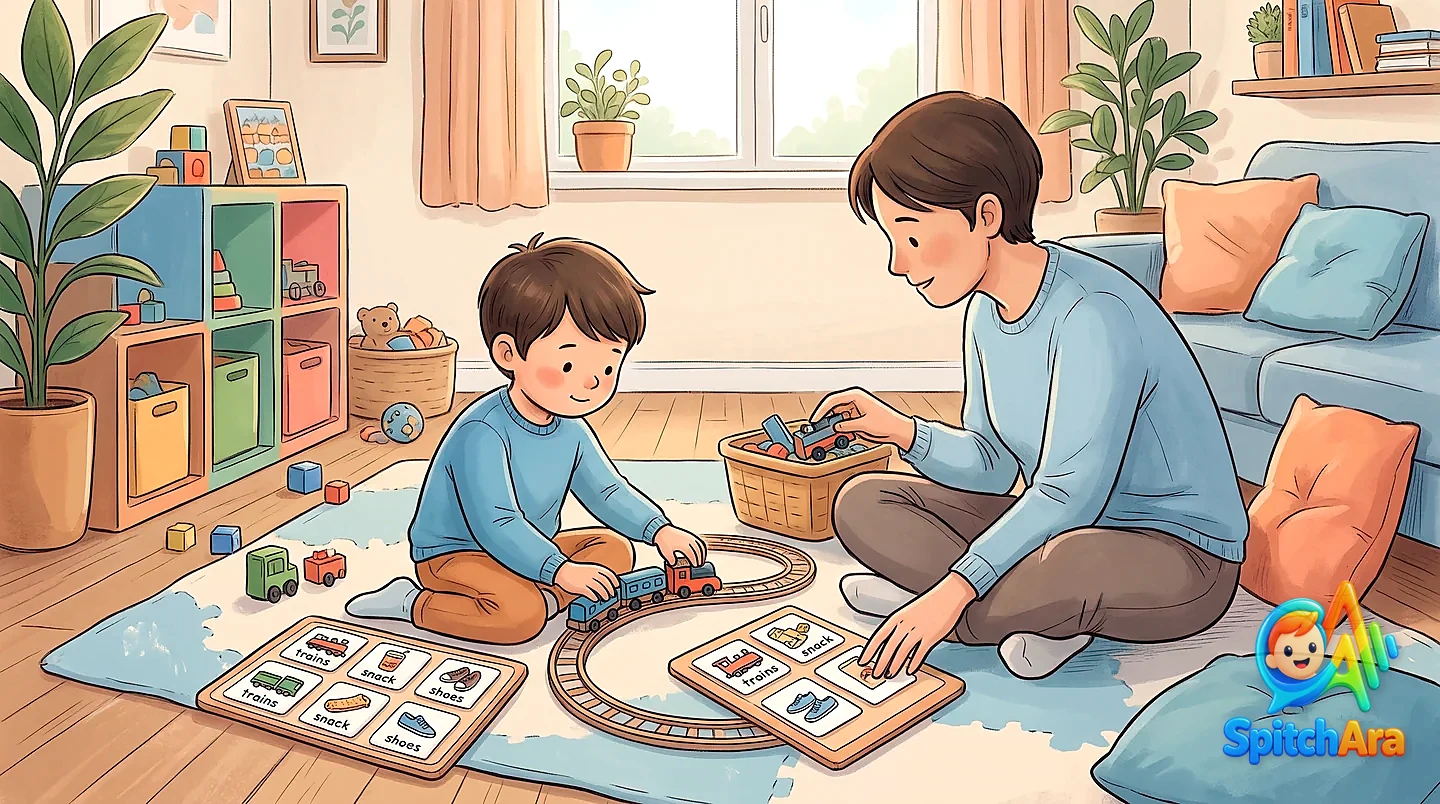
An autistic child may invite you into play by bringing a favourite object, repeating a familiar phrase, moving beside you or selecting a message on a device. These invitations do not always look like the exchanges adults expect. The starting point is to notice how this child connects, rather than decide in advance what connection must look like.
Support at home should help the child express meaning, understand what is happening and participate comfortably. Speech may be one part of that support, but it is not the only valid outcome. A useful plan makes room for the child's interests, sensory experience, communication methods and right to decline.
Begin with a daily situation that matters
Choose one moment that is either enjoyable or unnecessarily difficult. Perhaps your child loves lining up vehicles but struggles to tell someone when a vehicle is missing. Perhaps getting ready to leave becomes confusing because nobody knows how to explain a change of plan. These situations give support a practical purpose.
Describe the problem in observable terms. “He needs a way to tell us which toy is missing” is clearer than “He must communicate more.” It also makes it easier to consider different solutions: a spoken word, pointing, a photograph, an AAC message or a combination.
A child's communication profile can be uneven and can vary with context. ASHA's autism guidance therefore considers multiple forms and purposes of communication, rather than spoken vocabulary alone (American Speech-Language-Hearing Association, n.d.). At home, keep that wider view while asking professionals to help with assessment and planning.
Join an interest without turning it into a lesson immediately
Watch what the child enjoys about an activity. If the wheels matter more than pretending to drive, start with the wheels. You might sit nearby, notice the motion and make one relevant comment. The child can then accept your involvement, ignore it or ask for space.
Imagine a child arranging toy animals in a row. An adult places an animal near the row and waits. If the child moves it into position, the adult might say, “Beside the horse.” If the child removes it, the adult can take that as a reason to step back. Joining means responding to the child's decisions, not requiring them to adopt the adult's preferred play pattern.
Avoid using a favourite interest only as a reward after unrelated demands. It can be a genuine topic for pleasure, knowledge and conversation. The child should have opportunities to share an interest without always being assessed through it.
Make the environment easier to understand
Communication demands can become harder when the setting is noisy, unpredictable or physically uncomfortable. Notice whether a quieter room, a stable place for materials or advance information makes an ordinary routine easier. Change one manageable feature at a time so that you can describe what seemed useful.
A visual reminder may help with a sequence or change, but it needs to be meaningful to the child. A photograph of the actual coat may be clearer than an unfamiliar icon. Show the support during the real routine and allow time to learn what it represents.
A scoping review of home and community visual supports found substantial variation in formats, participants and outcomes (Rutherford et al., 2020). That is a reason to individualize and review the support, not to assume that a printed schedule will solve every difficulty. If the child is distressed by a transition, consider the activity itself as well as how it is explained.
Keep communication available during difficult moments
Messages such as “stop,” “help,” “different” and “break” need to work when they matter. If adults acknowledge them only during calm practice, the child may have no effective way to influence a stressful situation.
Agree with the child's professionals how these messages can be expressed and how adults should respond. A response may involve stopping, reducing a demand, moving to a quieter place or explaining a necessary limit. Do not require a more elaborate phrase before taking a clear signal of discomfort seriously.
For AAC users, the system must remain accessible across settings and activities. Communication tools should not be removed as a consequence or reserved for a lesson. The child's right to working, individualized communication support extends to ordinary family life (National Joint Committee for the Communication Needs of Persons With Severe Disabilities, n.d.).
Respond to repeated language with curiosity
A familiar phrase may serve a purpose that is not obvious at first. Notice when it occurs, what happened beforehand and whether a particular response helps. Do not assume that repetition is meaningless, and do not assign a fixed translation based on one occasion.
For example, a child might repeat a line associated with leaving the house while standing near the door. You can tentatively check, “Are you telling me about going out?” If the child shows otherwise, revise your interpretation. A speech-language professional can help explore patterns and broaden communication without suppressing a useful form.
The same care applies to silence. A child who usually speaks may use less speech when tired or overwhelmed. Keep other accessible ways to communicate available instead of treating the change as refusal to cooperate.
Make home support sustainable
Choose one adjustment the adults can actually maintain. A consistent place for the communication board, a clearer explanation before leaving or a calmer response to “stop” may be more valuable than a long list of exercises nobody can fit into the day.
Ask the professional to demonstrate a strategy in a realistic routine and watch you try it. Explain what is difficult for the family, including work schedules, language access and other children. A plan should be reviewed when it does not fit, rather than becoming evidence that a caregiver has failed (World Health Organization, 2022).
Record a few concrete observations: what the child communicated, how the adult responded and whether participation became easier. Seek prompt advice for loss of established skills or a marked change, and discuss persistent communication concerns even when some interactions go well. The aim is a home in which the child has more understandable choices and more reliable ways to be heard.
References
American Speech-Language-Hearing Association. (n.d.). Autism and autism spectrum disorder. https://www.asha.org/practice-portal/clinical-topics/autism/
American Speech-Language-Hearing Association. (n.d.-a). Augmentative and alternative communication (AAC). https://www.asha.org/practice-portal/professional-issues/augmentative-and-alternative-communication/
Centers for Disease Control and Prevention. (2026a, February 16). Concerned about your child’s development? https://www.cdc.gov/act-early/families/concerned.html
National Joint Committee for the Communication Needs of Persons With Severe Disabilities. (n.d.). Communication bill of rights (3rd ed.). American Speech-Language-Hearing Association. https://www.asha.org/njc/communication-bill-of-rights/
Rutherford, M., Baxter, J., Grayson, Z., Johnston, L., & O'Hare, A. (2020). Visual supports at home and in the community for individuals with autism spectrum disorders: A scoping review. Autism, 24(2), 447–469. https://doi.org/10.1177/1362361319871756
World Health Organization. (2022, April 27). Caregiver skills training for families of children with developmental delays or disabilities: Introduction. https://www.who.int/publications/i/item/9789240048836
