
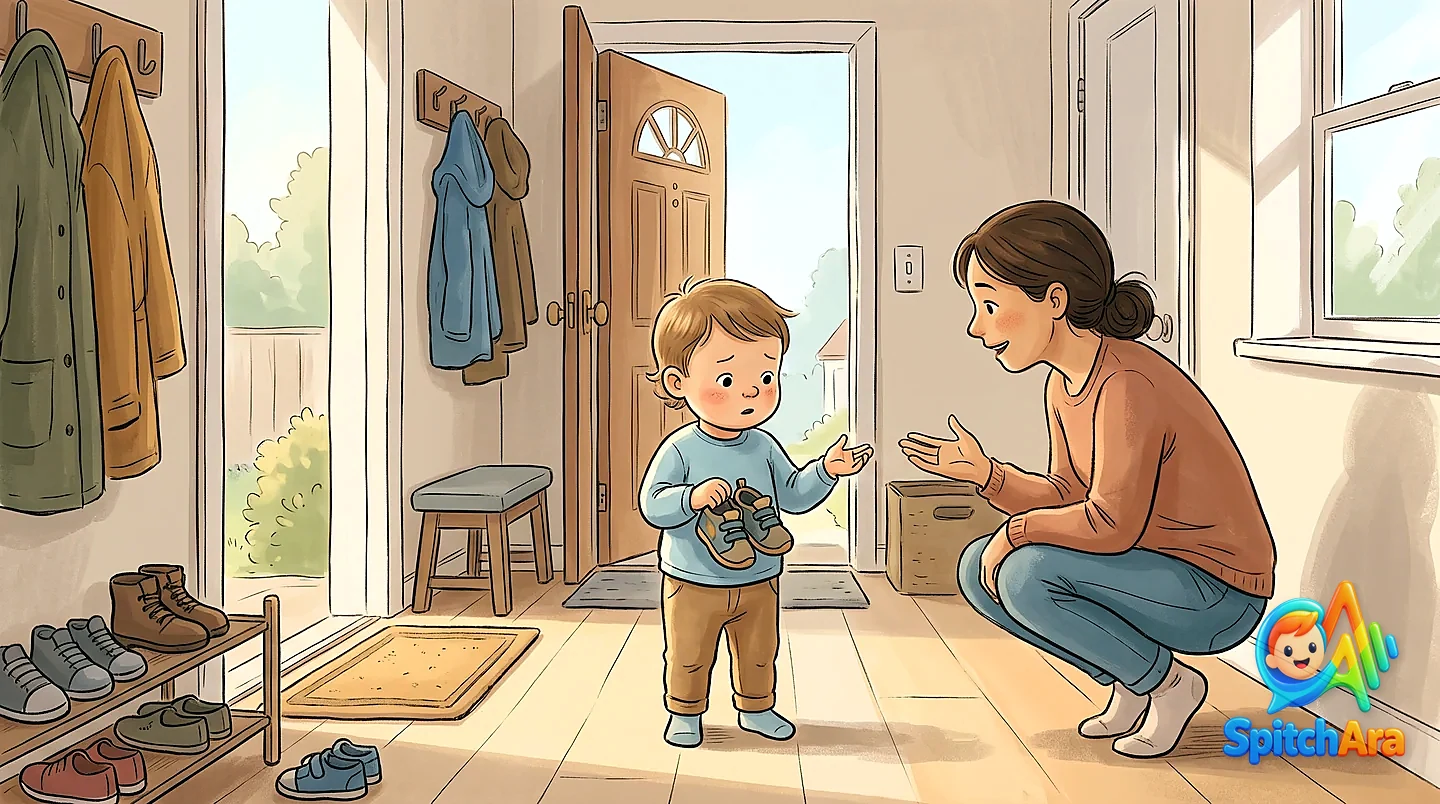
You ask your child to bring their shoes, and they do. Later, a request to put the shoes beside the bag receives no response. It is tempting to conclude that the child is ignoring you. Yet the second request contains more information, a different location and perhaps fewer familiar clues.
Understanding language is not an all-or-nothing ability. A child may follow a familiar routine with help from objects, gestures and context while finding a new instruction harder. The useful response is to make the message clearer and observe what helps, rather than treating every missed instruction as a behaviour problem.
Notice the clues already supporting the message
When you say “Bath time” beside a running tap, your child has more than words to work with. The sound, room and usual sequence all contribute. That is ordinary communication, not a trick. It becomes important when you are trying to describe what the child understands.
Compare situations without setting traps. You might notice that your child follows “Get your cup” at the table but looks uncertain when the cup is in another room. Record the difference if it matters. Do not remove helpful clues simply to test the child repeatedly.
A speech-language assessment can explore understanding alongside expression and other relevant information. A caregiver's examples are useful, but they do not by themselves establish the cause of a difficulty (National Institute on Deafness and Other Communication Disorders, 2022).
Make the important information easy to find
Before giving an instruction, consider whether the child can reasonably notice it. Move within comfortable range, reduce competing speech and refer to the relevant object. You do not need to demand eye contact. A child can orient to the task or object in another way.
Then give a manageable message. “Put the cup on the table” may be easier to follow than a long explanation containing several actions and a correction halfway through. If there are two steps, you can give the first, allow it to happen, and then offer the next. This is support, not an assumption that the child is incapable.
NHS guidance recommends short, simple instructions in early language development (National Health Service, 2023). The appropriate level depends on the child. The aim is clarity, not permanently restricting what you say or turning family conversation into commands.
Show the relationship you are describing
Words such as “in,” “under,” “before” and “after” describe relationships. During a familiar activity, you can make those relationships visible. “The spoon is in the cup” has an immediate reference when both objects are present.
For instance, imagine tidying a few toys. The adult puts one car in the box and comments, “Car in.” The child puts a block beside the box. “The block's beside it,” the adult says. This is a chance to describe what happened, not a reason to call the child's placement wrong. If the practical task requires the block in the box, the adult can show and explain that separately.
Avoid piling several teaching goals onto one routine. If the child is working out where the toys belong, it may not be the moment to introduce colours, quantities and a sequence of three instructions. One clear relationship is easier to share and discuss afterwards.
Check understanding without constant quizzing
Questions such as “Do you understand?” may not tell you much. A child may say yes because it is familiar or because they want the conversation to continue. Instead, observe how the activity proceeds and offer a practical clarification when needed.
You can also give a genuine choice with visible options: “The red cup or the blue cup?” Accept a point or another established response. If the child chooses an unexpected option, do not assume misunderstanding immediately. They may simply prefer it. Clarify only when the result suggests the message was unclear.
When you do need to check an important instruction, make the check supportive. “Let's do the first part together” can reveal where help is needed without making the child feel examined. For safety-related situations, provide the necessary supervision rather than relying on a language test.
Separate comprehension from willingness and comfort
A child may understand a request and decline it. They may also be tired, uncomfortable, absorbed in another activity or unable to carry out the physical action. These possibilities matter because a clearer sentence will not solve every difficulty.
Suppose a child does not put on a coat. Before repeating the instruction more firmly, check whether the sleeve feels uncomfortable, the coat is hard to manage or leaving the house is upsetting. A refusal communicates something about the situation even when the reason is not yet clear.
NIDCD notes that language difficulties can be mistaken for behaviour problems (National Institute on Deafness and Other Communication Disorders, 2023). The reverse caution is useful too: do not assume every disagreement is a comprehension problem. Look for patterns and discuss persistent concerns with someone qualified to assess them.
Include the language the child knows best
If your family uses several languages, consider who said the instruction, in which language and in what context. A child may know a routine in one language but not yet recognize every word in another. This information belongs in an assessment, not in a conclusion that multilingualism is harmful.
Keep meaningful home languages in daily life. NIDCD states that learning multiple languages does not cause developmental language disorder (National Institute on Deafness and Other Communication Disorders, 2023). If you are concerned, ask how the child's understanding across languages will be considered and whether an interpreter or appropriately skilled professional is needed.
Make a useful record and a manageable change
A note might say, “When I said ‘put the shoes by the bag,’ he looked around. After I pointed to the bag, he put them there.” This describes the support that helped. It does not label the child as inattentive or prove a diagnosis.
For the next few routines, choose one adjustment: reduce competing talk, give one step at a time or show the object you mean. Notice whether it makes participation easier. If concerns persist, bring the examples to a health or speech-language professional, including any changes in hearing or previously established skills. Clear communication at home and professional assessment can move forward together.
References
Centers for Disease Control and Prevention. (2026, February 16). Concerned about your child’s development? https://www.cdc.gov/act-early/families/concerned.html
National Health Service. (2023, April 26). Help your baby learn to talk. https://www.nhs.uk/baby/babys-development/play-and-learning/help-your-baby-learn-to-talk/
National Institute on Deafness and Other Communication Disorders. (2022, October 13). Speech and language developmental milestones. https://www.nidcd.nih.gov/health/speech-and-language
National Institute on Deafness and Other Communication Disorders. (2023, May 8). Developmental language disorder. https://www.nidcd.nih.gov/health/developmental-language-disorder
Roberts, M. Y., Curtis, P. R., Sone, B. J., & Hampton, L. H. (2019). Association of parent training with child language development: A systematic review and meta-analysis. JAMA Pediatrics, 173(7), 671–680. https://doi.org/10.1001/jamapediatrics.2019.1197
World Health Organization. (2022, April 27). Caregiver skills training for families of children with developmental delays or disabilities: Introduction. https://www.who.int/publications/i/item/9789240048836
