
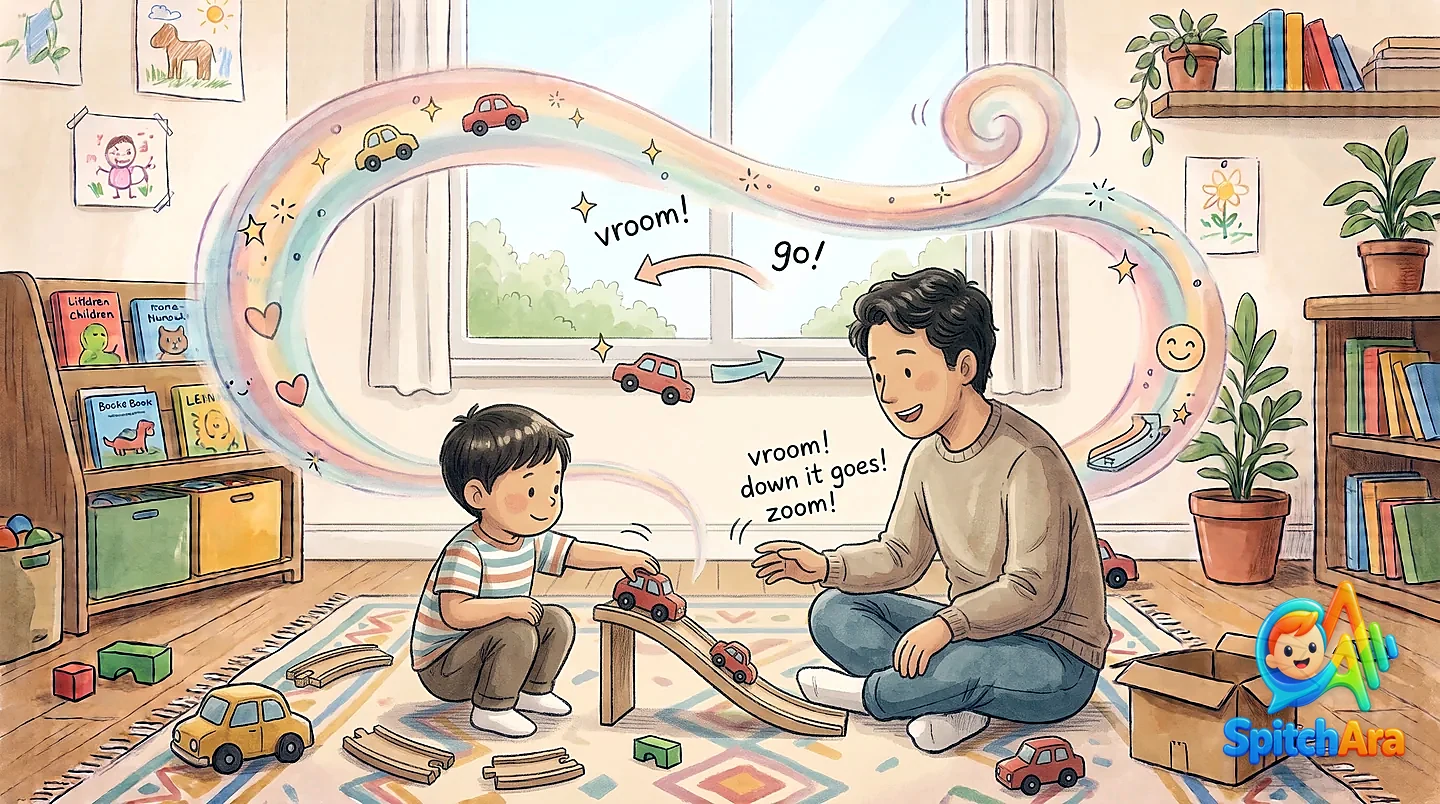
A toy car rolls under the sofa. Your child crouches to look, then hands you another car. It would be easy to start naming colours or asking, “What is this?” But the situation already offers a more interesting conversation: something is missing, someone might help, and the second car might be joining the search.
Toy-car play is useful when the words follow the action and the child's intention. You do not need a collection of vehicles, a special track or a lesson plan. One suitable car and a shared patch of floor can be enough. The point is to make an exchange possible, not to extract a correct label.
Discover what the child is doing first
Before introducing a new game, watch a little. Does your child roll the car, examine its wheels, line it up with others or carry it from room to room? Those actions tell you where to begin. If you immediately build a ramp while the child is absorbed in a wheel, you may be inviting them into your activity rather than joining theirs.
Suppose your child turns a wheel with one finger. You could sit nearby and say, “Round and round,” while watching the same movement. If they bring the car closer, you can acknowledge that invitation. If they move it away, give them room. Sharing an interest does not mean taking control of the object.
Next, consider access. A stable surface, a larger vehicle or a shorter distance may make participation easier. Keep parts appropriate for the child's age and needs, supervise as necessary and avoid small detachable pieces. A child who cannot push the car by hand may participate by choosing a direction, signalling “go” or asking an adult to move it.
Choose words that do something in the scene
Vehicle names are only a small part of the language available. Actions such as “go,” “stop,” “turn,” “fall” and “find” connect closely to what happens. Location words such as “under,” “inside” and “behind” become meaningful when the child sees the car disappear or return. You can introduce these naturally without treating them as a vocabulary list.
For example, when a car reaches the edge of a cushion, “Down it goes” describes the movement. If the child tries again, use the same useful phrase or simply watch. Repetition can arise from the child's chosen activity; the adult does not have to restart the scene solely to produce another teaching trial.
NHS guidance supports describing shared experiences, repeating useful words in context and adding a little language to a child's contribution (National Health Service, 2023). Applied here, that means the car supplies a topic. It does not mean every child needs to learn the same words through the same toy.
Add a small story when the child invites one
A story can begin with a tiny problem. Perhaps the car needs a parking place, a bridge made from a sturdy book or a passenger represented by a large suitable figure. Introduce one idea and observe whether your child picks it up. If they return to rolling the car, follow that choice instead of insisting on a pretend journey.
Imagine a child parks a car beside a cup. The adult might say, “A garage?” with a curious tone. If the child puts the car inside, the adult can continue, “Inside the garage.” If the cup was merely in the way, the child may move it. Both responses clarify the scene, and neither needs correction.
You can then give the child room to determine what happens next. A car can get stuck, arrive, leave, wait or change direction. These events create reasons to comment and seek help. However, do not deliberately trap a favourite toy and refuse assistance until the child speaks. A real minor difficulty is enough to model “Help with the car” while providing help.
Respond to the message before improving the sentence
If your child says “Car,” the next response depends on what they mean. When they are offering it to you, “My turn with the car” may fit. When they point under the chair, “The car's under there” is more relevant. An expansion adds meaning to the actual exchange; it is not a fixed instruction to make every sentence longer.
Keep your response manageable. A long explanation about engines, wheels and destinations may crowd out a child's contribution. On the other hand, single-word speech is not a rule for every interaction. Use ordinary, clear language and adjust to what the child seems able to follow.
If the child communicates with an established AAC system, keep it accessible. You can use the same system to model a relevant message while speaking, without requiring imitation. AAC may complement speech or provide another way to communicate; its selection and access should be individualized (American Speech-Language-Hearing Association, n.d.).
Make turn-taking flexible
Two cars can allow parallel play before anyone exchanges an object. You might roll yours alongside the child's car, pause near a bridge and notice whether they respond. This is often less intrusive than repeatedly asking for the car they are holding.
A turn can also mean choosing a route, placing a large obstacle or signalling when the adult should release the car. The important feature is that each person's action can affect the shared activity. Equal numbers of pushes are less useful than genuine participation.
If a sibling joins, explain the child's communication signals. For instance, “When she pushes the car towards you, she's offering a turn. When she pulls it back, wait.” Avoid making the sibling responsible for therapy. They can be a play partner whose own interests and boundaries also matter.
Notice whether the activity still belongs to both of you
There is a practical check midway through play: can the child change the plan? If every move triggers another question, correction or instruction, slow down. Return to a comment about what is happening and let the next action belong to the child.
When the child is finished, acknowledge the ending. “Parking the cars” can become a shared closing routine, but tidying need not be another language test. A child can point to the box, carry a car or watch you put it away.
If you keep notes, record an actual exchange: “He said ‘stuck’ when the car stopped beside the cushion; I moved the cushion and he rolled it again.” Such an example preserves the context that a word count misses. If you have wider concerns, share it with the professional supporting your child. The next play session can then build on what was useful rather than on a list of words the child failed to repeat.
References
American Speech-Language-Hearing Association. (n.d.). Augmentative and alternative communication (AAC). https://www.asha.org/practice-portal/professional-issues/augmentative-and-alternative-communication/
Centers for Disease Control and Prevention. (2026a, February 16). Concerned about your child’s development? https://www.cdc.gov/act-early/families/concerned.html
National Health Service. (2023, April 26). Help your baby learn to talk. https://www.nhs.uk/baby/babys-development/play-and-learning/help-your-baby-learn-to-talk/
Roberts, M. Y., Curtis, P. R., Sone, B. J., & Hampton, L. H. (2019). Association of parent training with child language development: A systematic review and meta-analysis. JAMA Pediatrics, 173(7), 671–680. https://doi.org/10.1001/jamapediatrics.2019.1197
World Health Organization. (2022, April 27). Caregiver skills training for families of children with developmental delays or disabilities: Introduction. https://www.who.int/publications/i/item/9789240048836
