
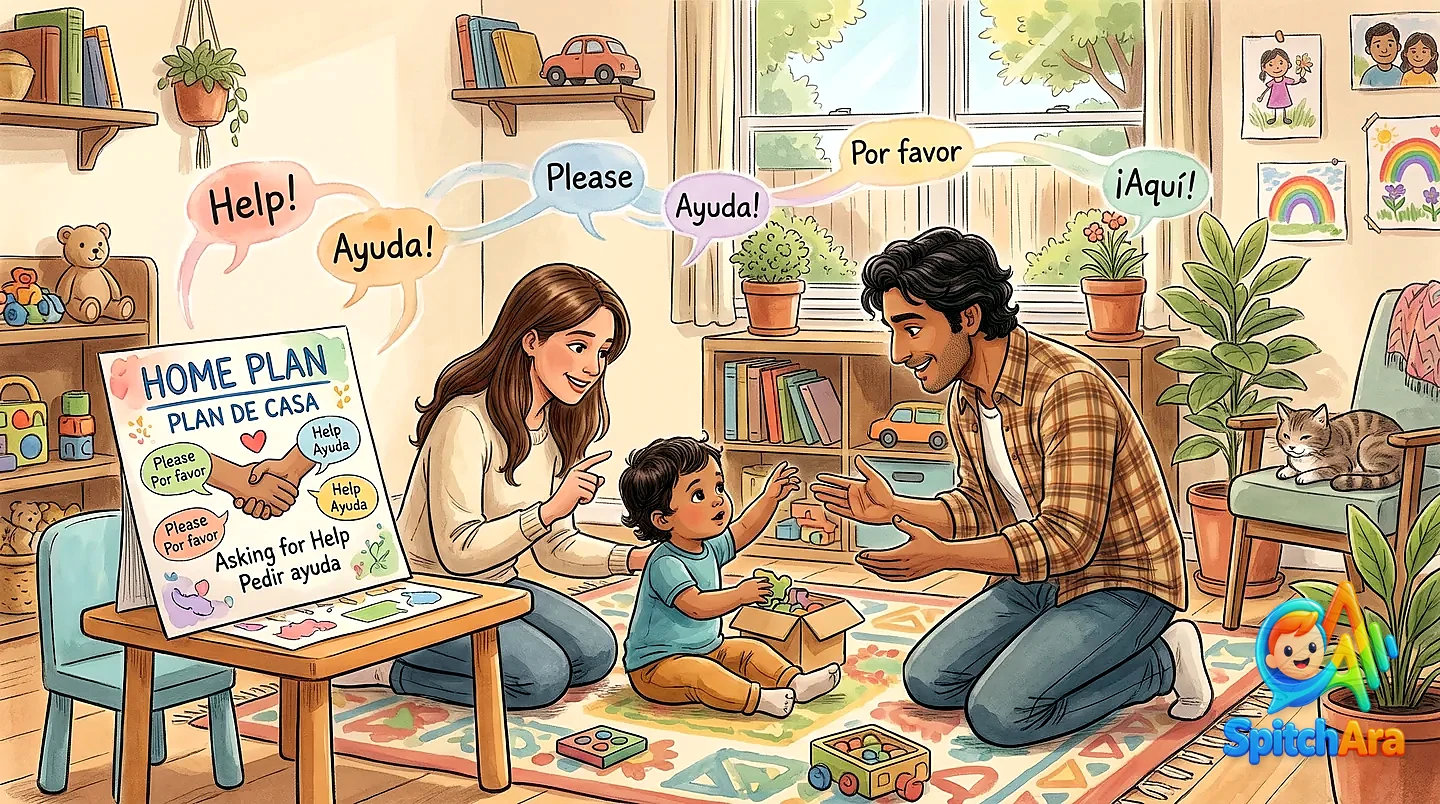
Picture a brief game on the floor. The ball rolls towards your child, stops at their knee, and is pushed back a moment later. Nobody has asked a question, yet both people have contributed. A simple exchange like this can make the rhythm of a conversation visible: one person does something, the other responds, and the next turn depends on that response.
Turn-taking games for communication do not need strict rules or a demand for speech before every action. Choose a game the child can influence, make your own turn understandable, and accept the ways they already communicate. The point is shared participation, not waiting obediently for an adult to grant access to a toy.
Choose a game with an obvious exchange
A rolling ball, two cars on a ramp, or a shared drawing can provide a clear beginning. The child should be able to see what your turn involves and how they can join. If the game is difficult to access physically or confusing to follow, simplify it before adding language.
For example, sit where a ball can move easily between you, using positioning appropriate for the child. Roll it gently and describe the action once. When it reaches the child, wait for a response without demanding a particular movement. They may push it, touch it, indicate that you should help, or choose to stop.
If the child cannot return the ball independently, the game needs an accessible role. Their turn might be choosing where the ball goes or signalling when to roll. Do not confuse a movement barrier with a lack of interest in communication.
Make the child's contribution affect the game
An exchange becomes meaningful when the child's message changes what happens. If they indicate “again,” another turn follows when appropriate. If they indicate “stop,” the game stops. If they choose a different object, you consider the new idea.
This can be harder than it sounds when an adult has planned a particular sequence. A child may want to roll the ball under a chair rather than back to the adult. You can join that idea: “Under the chair” and then look together. The conversation has changed direction, but it has not necessarily disappeared.
The NHS includes shared games and ordinary interaction in its language guidance (National Health Service, 2023). The specific game is less important than whether both people have a real role. A carefully timed activity in which only the adult decides what happens is not automatically a conversation.
Add language to the action rather than placing it in the way
You might say “My turn” as you act and “Your turn” when the opportunity moves to the child. However, these phrases should explain the exchange, not become commands that dominate it. Sometimes “Car down” or “Ball coming” better describes the event the child cares about.
If the child says “go,” respond to the meaning. You can add “Car goes” while releasing the car. If the child uses a sign or picture, you can provide the spoken phrase while honouring that message too.
Do not require a word before every turn. Such a rule can turn a freely shared game into repeated testing. The adult can model language without making speech a ticket to participation.
Wait without turning the pause into pressure
A brief pause can give the child room to contribute. Watch what happens during it. Are they preparing an action, looking towards a support, or showing that they are finished? The answer should shape your response.
Waiting has become pressure when the child is distressed, the adult keeps repeating the prompt, or a needed object is withheld until the expected answer appears. In that situation, help or simplify. There is no universal number of seconds that makes every interaction appropriate.
Imagine that the child reaches towards a car on the ramp. The adult pauses, the child signs “again,” and the car rolls. The pause created an opening. If the child instead struggles to reach their communication board, the adult should restore access rather than continue waiting for a response that is currently difficult to make.
Keep all communication methods available
Communication can combine speech, gestures, signs, pictures, or devices. AAC is individualized and may support or replace speech depending on the person's needs (Communication Health Support Association, 2026). A turn-taking game should accommodate those methods rather than temporarily removing them.
Think about the range of messages the game allows. “More” is useful, but so are “different,” “help,” “stop,” “funny,” and a way to choose a partner. Ask the child's professional how to support these messages within their established system if you are unsure.
A child may also communicate through an action that is easy to overlook. Bringing a second car to your hand can be an invitation. Moving the ramp may be a suggestion. Check the meaning rather than treating every nonverbal action as something outside the game.
Adapt the game when another child joins
A sibling may be eager to help and still take most of the turns. Explain the shared purpose in simple terms: everyone needs a way to make something happen. Give the sibling a meaningful role without asking them to become the child's therapist.
You might use two cars so that the game does not depend on surrendering one highly valued object. The children can send cars down together, choose a destination, or build the ramp with adult support. Turn-taking does not always require a single object moving in a strict circle.
If competition or frustration takes over, reduce the complexity. Parallel play with occasional shared moments may be more manageable than a formal sequence. The family can return to a simpler exchange without calling it a failure.
Notice whether the exchange becomes easier
Useful observations include the child initiating a turn, correcting your interpretation, choosing a variation, or signalling the end. These examples show participation. They are not a clinical score and should not be treated as proof of an overall developmental change.
If you are following a professional plan, share one concrete example. “He selected ‘different’ after three ball turns, and we changed to the car” gives the clinician a clear picture. “He did turn-taking well” leaves the process unclear.
For the next game, choose one accessible action and make room for the child's response. Follow the meaning of that response, even when it changes your plan. A useful turn is one that belongs to the child, not merely one that arrives at the correct moment in an adult's script.
References
Centers for Disease Control and Prevention. (2026a, February 16). Concerned about your child’s development? https://www.cdc.gov/act-early/families/concerned.html
Communication Health Support Association. (2026, May 8). Augmentative and alternative communication (AAC). https://helpingyoucommunicate.org/article/augmentative-and-alternative-communication-aac
National Health Service. (2023, April 26). Help your baby learn to talk. https://www.nhs.uk/baby/babys-development/play-and-learning/help-your-baby-learn-to-talk/
National Institute on Deafness and Other Communication Disorders. (2022, October 13). Speech and language developmental milestones. https://www.nidcd.nih.gov/health/speech-and-language
World Health Organization. (2022, April 27). Caregiver skills training for families of children with developmental delays or disabilities: Introduction. https://www.who.int/publications/i/item/9789240048836
