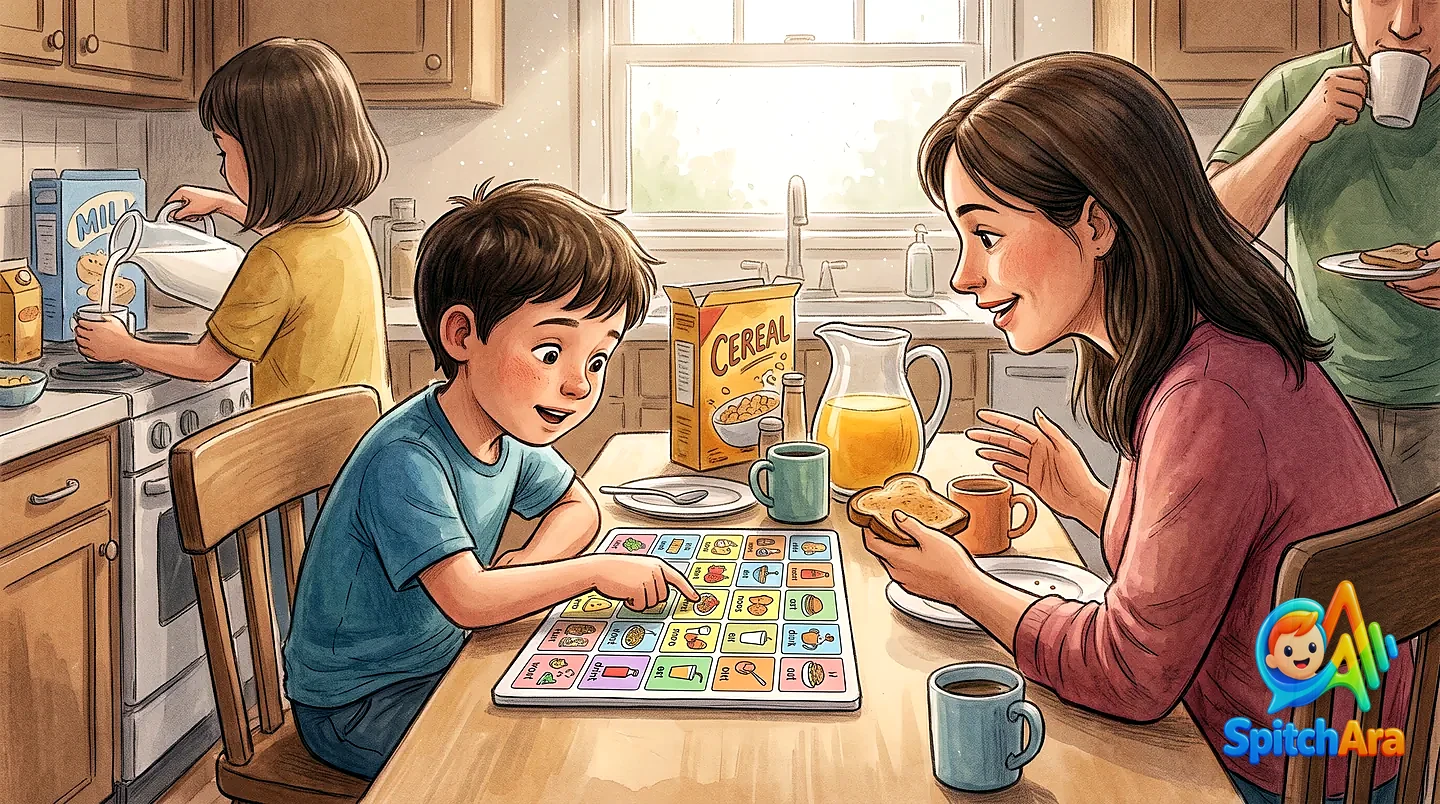
A communication board can look reassuringly simple: a sheet with pictures and words. Yet the board's usefulness depends on what happens around it. Can the child reach it? Do the symbols make sense? Does an adult respond when the child selects “stop,” or is the board used only to ask for another snack?
A board becomes a communication tool when its messages influence everyday interaction. It should be selected and used within an individualized plan, especially when a child has significant communication or access needs. The practical work is not just printing symbols. It is making the board available, meaningful and responsive.
Choose a routine with a clear purpose
Begin with a situation in which the child has something worth saying. A play activity might need “go,” “stop,” “different” and a way to comment. Getting dressed might need help, discomfort and choices. The vocabulary should reflect the child's real life rather than only what adults want the child to request.
Discuss the broader vocabulary plan with a speech-language professional. A small activity board may be useful in one setting, but it should not become the child's only means of expression if it cannot support a wider range of messages. Access, symbol representation and language organization need individual consideration (American Speech-Language-Hearing Association, n.d.).
Imagine a board beside a toy ramp. If it contains only “more,” the child can request another turn but cannot easily say the car fell, choose a different vehicle or ask to finish. The limitation belongs partly to the available vocabulary, not necessarily to the child's ability or interest.
Place it where communication can happen
The board needs a stable, reachable position that works for the child's access method. A sheet sliding across the table can be frustrating. A board placed behind the adult may be visible but unusable. Ask the professional to help with positioning when movement, vision or other access needs are involved.
Consider the routine's practical demands. A board near a sink may need protection from water; one used outside may need a portable format. Keep a suitable backup when the main copy is unavailable. The aim is reliable access, not a beautifully preserved sheet that stays in a drawer.
Other people also need to know where the board belongs. If it moves between home and preschool, agree who carries it and how a missing or damaged copy is replaced. Small logistical failures can become large communication barriers.
Show how the board carries a message
Adults can model a relevant symbol while speaking naturally. During a game, you might point to “go” as you release a car. Later, you can select “different” when choosing another activity. The model should fit something you genuinely mean, not become a series of commands to touch symbols.
A review of aided AAC modelling found varied interventions that generally supported expressive communication outcomes (Biggs et al., 2018). It does not prescribe one modelling rate or guarantee that a child will copy a symbol after a certain number of demonstrations. Ask the clinician to show an approach suited to the child's system and needs.
If the child watches without selecting anything, continue the interaction. Observation can be part of learning. If they use a gesture instead, respond to it. The board adds an option; it should not invalidate communication that already works.
Treat selections as contributions rather than exercises
When the child selects a message, respond to its possible meaning. If “stop” is selected during a game, pause and check. If a selection seems accidental, stay calm and clarify rather than scolding or ignoring it automatically.
For example, a child may select “finished” while still holding a toy. They could mean the current activity is over, they want the adult to stop helping, or they are exploring the symbol. The next response should help clarify: pause, offer space and see what the child does. Do not insist that the symbol has one meaning regardless of context.
Avoid physically moving the child's hand onto a symbol to create an apparent message. Access assistance should preserve the child's choice and be guided by the relevant professional. It matters that adults can distinguish a child's communication from their own prompting.
Build a conversation beyond requesting
A board can support comments, questions, opinions and social interaction. During a book, the child might communicate that something is funny or choose a character to discuss. During a family game, they might tell someone whose turn it is or point out a missing piece.
These uses may require adults to slow down and leave room for a topic they did not plan. If every exchange begins with an adult question, the child has fewer chances to initiate. Try modelling a comment and then observing what the child adds.
Include vocabulary for refusal and changes of mind. Communication rights encompass meaningful choices and the ability to refuse, not only socially convenient requests (National Joint Committee for the Communication Needs of Persons With Severe Disabilities, n.d.). A board that offers no way to disagree is missing an important part of communication.
Keep the board familiar while reviewing its limits
If a symbol is difficult to find, note the problem and discuss it rather than rearranging the entire board immediately. Stable locations can support familiarity, but the system also needs to grow and remain relevant. Changes should have a purpose and include support for the child and partners.
Check language and cultural fit. Family names, familiar foods and meaningful expressions may matter more than generic vocabulary chosen by someone outside the home. If several languages are used, ask how the system can support them without making access unnecessarily complex.
Record one useful exchange
A note such as “She selected different when I brought the same book; I offered another and she joined me” shows a message, a response and an outcome. That is more informative than “Used board five times.”
Bring both successes and barriers to follow-up. If the board does not travel, lacks useful messages or is ignored by adults, those are problems to solve together. The goal is a child with more influence over daily life, not a family that can demonstrate correct use of a laminated page.
References
American Speech-Language-Hearing Association. (n.d.). Augmentative and alternative communication (AAC). https://www.asha.org/practice-portal/professional-issues/augmentative-and-alternative-communication/
Biggs, E. E., Carter, E. W., & Gilson, C. B. (2018). Systematic review of interventions involving aided AAC modeling for children with complex communication needs. American Journal on Intellectual and Developmental Disabilities, 123(5), 443–473. https://doi.org/10.1352/1944-7558-123.5.443
Centers for Disease Control and Prevention. (2026a, February 16). Concerned about your child’s development? https://www.cdc.gov/act-early/families/concerned.html
National Joint Committee for the Communication Needs of Persons With Severe Disabilities. (n.d.). Communication bill of rights (3rd ed.). American Speech-Language-Hearing Association. https://www.asha.org/njc/communication-bill-of-rights/
Roberts, M. Y., Curtis, P. R., Sone, B. J., & Hampton, L. H. (2019). Association of parent training with child language development: A systematic review and meta-analysis. JAMA Pediatrics, 173(7), 671–680. https://doi.org/10.1001/jamapediatrics.2019.1197
World Health Organization. (2022, April 27). Caregiver skills training for families of children with developmental delays or disabilities: Introduction. https://www.who.int/publications/i/item/9789240048836
