
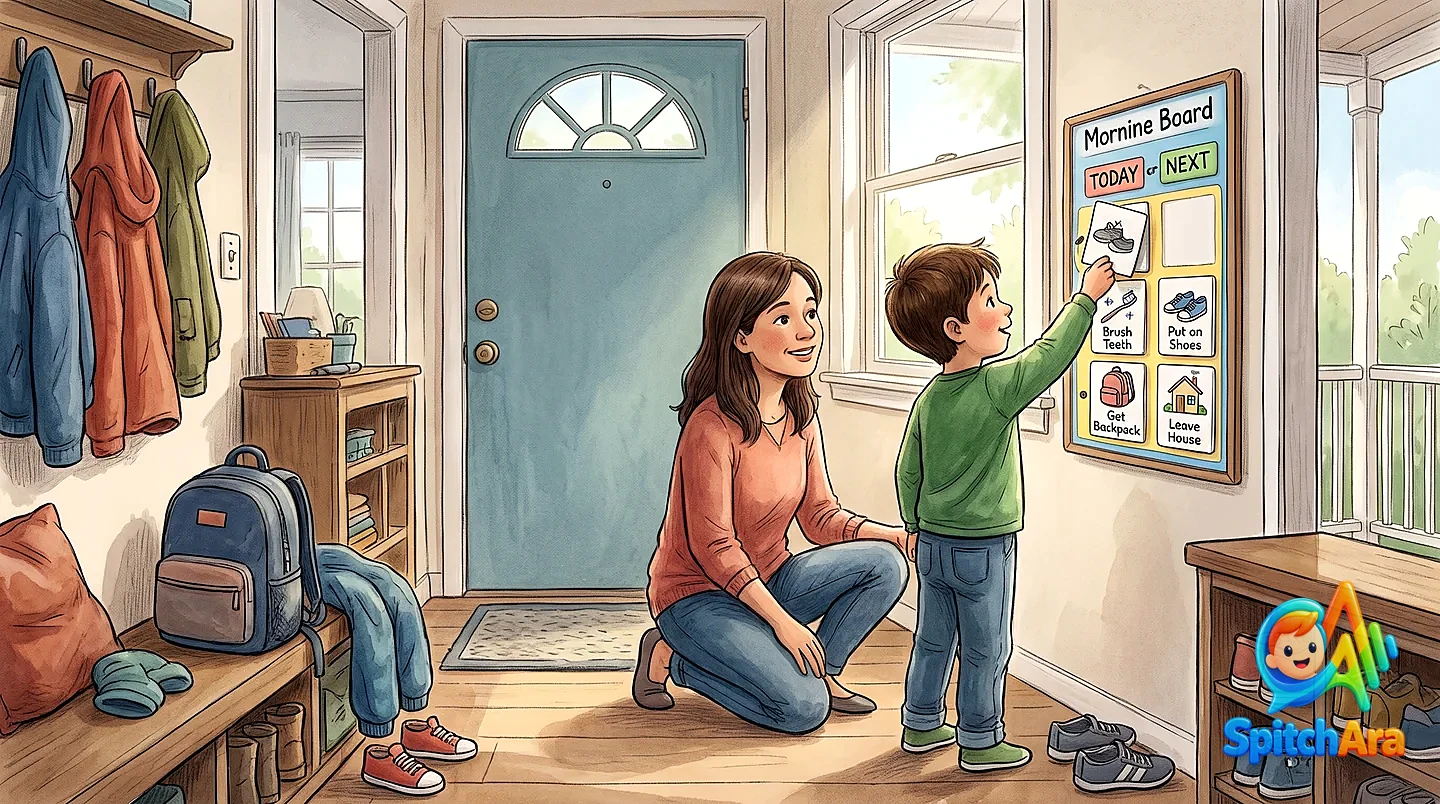
Your child is absorbed in play when an adult announces that it is time to leave. The instruction may be clear to the adult, but the child has to work out several things at once: what is ending, what happens next and whether something important will return later. A visual support can sometimes make that sequence easier to understand.
Visual routine supports make information available to look at again. They might use real objects, photographs, symbols or written words. Their value depends on whether the child understands them and whether they address a real difficulty. A picture schedule is not automatically helpful simply because it is tidy or colourful.
Identify the uncertainty you want to reduce
Choose one routine before creating a full-day schedule. Is the child unsure what comes after breakfast? Do they need to know which adult is collecting them? Is a change of plan hard to explain? A specific question helps you choose a support with a purpose.
For example, a photograph of the actual swimming bag might help explain an outing more clearly than a generic swimming icon. A child who reads may prefer a short written note. Another child may need an object associated with the next activity. The best format is the one the child can use meaningfully, not the one an adult finds most attractive.
Research on home and community visual supports includes a wide variety of approaches and outcomes. A scoping review identified 34 studies and highlighted issues such as individualization, accessibility and family support (Rutherford et al., 2020). This suggests trying a well-matched support and reviewing it rather than expecting one format to work for every child.
Teach the meaning within the real routine
Do not assume the picture explains itself. Show it as the corresponding activity happens and use a short, natural explanation. Over time, the child may connect the representation with the event. A professional can help determine whether the chosen symbols or objects are understandable.
Imagine using two photographs for getting ready to go out: shoes and the front door. The adult shows the shoe photograph while helping with shoes, then refers to the door photograph when leaving. The sequence stays connected to actual events. It is not a separate quiz in which the child must name each picture.
If the child uses the support differently from expected, observe before correcting. They may be interested in the photograph itself, unclear about its meaning or expressing a preference. The next step is to clarify the purpose and adjust the support, not repeatedly demand that they follow it.
Keep the sequence short enough to be useful
A full board covered in activities may be too much information for a simple transition. Start with the amount needed to answer the child's question. That might be what is happening now and what comes next, or a small sequence of familiar steps.
This is not a rule that every child needs a two-step board. Some prefer a broader overview, particularly when knowing the rest of the day helps them prepare. Others need information closer to the moment. Ask what the child appears to use and discuss uncertainties with the professional.
Make the support physically accessible. A schedule behind a door or high on a wall may be visible to adults but unavailable to the child. A portable copy may help during an outing, while a stable display may suit a home routine.
Explain changes honestly
Life does not always follow the plan. A trip may be cancelled, a visitor may arrive late or a favourite activity may be unavailable. A useful visual system needs a way to communicate those changes rather than pretending the original sequence still applies.
Show the new information and explain it simply. If you use a symbol for change, teach its meaning through supported examples rather than expecting the child to accept it immediately. Acknowledge disappointment and offer a meaningful choice where possible.
Do not use the schedule as an argument that the child must tolerate an unsuitable activity. If a task is painful, confusing or overwhelming, the fact that it is pictured does not make it appropriate. Review the activity and the environment as well as the way it is presented.
Combine information with a way to respond
A routine support often tells the child what adults plan to do. The child also needs a way to ask a question, request help, choose an option or say no. A schedule should not replace their communication system.
For example, a child looking at a picture of the park may want to ask who is coming, whether a toy can come too or whether the trip is happening now. Their AAC system or familiar gestures can support that side of the exchange. Adults should not treat every response as a request to remove a picture.
Communication rights include understanding information and expressing preferences or refusal (National Joint Committee for the Communication Needs of Persons With Severe Disabilities, n.d.). A helpful routine support therefore works within a two-way interaction, not as a silent instruction board.
Share a simple plan with other adults
Explain what each support means, when it is used and how the child can respond. If one adult uses a photograph to mean “soon” and another uses it to mean “now,” the inconsistency may create confusion. Agree on the meaning without insisting that everyone speaks in identical sentences.
Keep the materials manageable. A system that requires extensive preparation every evening may become difficult to sustain. Ask the team for a simpler version if the practical burden is too high. The family's capacity is part of whether a support will work in daily life.
Review what becomes easier
Notice whether the child uses the information, asks clearer questions or moves through a routine with more understanding. A quieter transition alone does not establish why the change occurred, and a difficult day does not prove the support has failed.
Record a concrete example: “After seeing the bag photograph, he brought his shoes. When the plan changed, he pointed to the park picture and we explained the new activity.” Bring examples to the professional and adapt the support accordingly.
Begin with one uncertainty and one understandable representation. The goal is not perfect adherence to a schedule. It is a child who has clearer information about the day and a meaningful way to respond to it.
References
Centers for Disease Control and Prevention. (2026a, February 16). Concerned about your child’s development? https://www.cdc.gov/act-early/families/concerned.html
Dowdall, N., Melendez-Torres, G. J., Murray, L., Gardner, F., Hartford, L., & Cooper, P. J. (2020). Shared picture book reading interventions for child language development: A systematic review and meta-analysis. Child Development, 91(2), e383–e399. https://doi.org/10.1111/cdev.13225
National Institute on Deafness and Other Communication Disorders. (2022, October 13). Speech and language developmental milestones. https://www.nidcd.nih.gov/health/speech-and-language
National Joint Committee for the Communication Needs of Persons With Severe Disabilities. (n.d.). Communication bill of rights (3rd ed.). American Speech-Language-Hearing Association. https://www.asha.org/njc/communication-bill-of-rights/
Roberts, M. Y., Curtis, P. R., Sone, B. J., & Hampton, L. H. (2019). Association of parent training with child language development: A systematic review and meta-analysis. JAMA Pediatrics, 173(7), 671–680. https://doi.org/10.1001/jamapediatrics.2019.1197
Rutherford, M., Baxter, J., Grayson, Z., Johnston, L., & O'Hare, A. (2020). Visual supports at home and in the community for individuals with autism spectrum disorders: A scoping review. Autism, 24(2), 447–469. https://doi.org/10.1177/1362361319871756
