
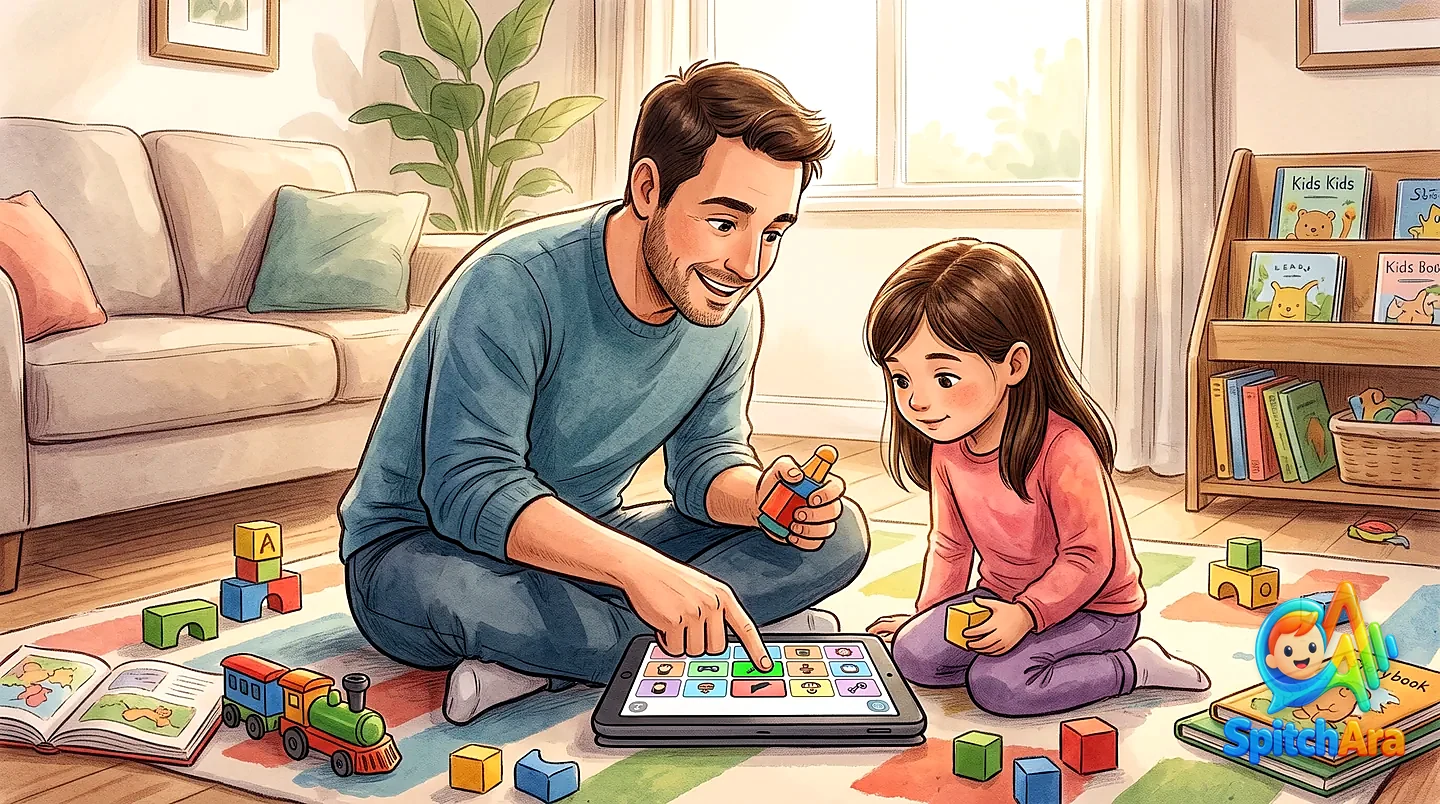
You point to “go” on a communication display while a toy car starts down a ramp. Your child watches, then reaches for the car. You respond and continue the game. Nobody has asked the child to copy the symbol, yet you have shown how the system can carry a message within an ordinary activity.
That is the basic idea behind modelling AAC: a communication partner uses the system to express something meaningful. The child gets to see language used, rather than being expected to operate a tool that adults rarely touch. How modelling should look depends on the child's system, access and individualized plan (Romski et al., 2010).
Model something you actually mean
Choose a message that fits the moment. During play, “go,” “stop,” “different” or a comment may be useful. At a meal, a message might concern preference or assistance. The adult's selection should relate to the exchange, not simply demonstrate where a button is located.
For example, an adult looking at a surprising picture might select “funny” while reacting naturally. The child may laugh, turn the page or offer another message. The adult follows that contribution. The system has been part of a conversation rather than the object of a test.
Avoid pretending that every adult need is real when it is not. Manufactured problems and exaggerated confusion can make interaction feel artificial. There are enough genuine opportunities to comment, choose and ask for help throughout a normal day.
Distinguish a model from a prompt to perform
A model gives an example. A prompt asks or cues the child to respond. Both terms may appear in a professional plan, but they should not be confused. If every adult model is followed by “Now you do it,” the child experiences a demand rather than simply seeing language used.
A systematic review distinguished several approaches to aided AAC modelling across 48 studies and found generally favourable expressive-communication outcomes, with variation in methods and measures (Biggs et al., 2018). The research does not establish one universal routine for every child. Ask the professional what kind of modelling they recommend and why.
In everyday interaction, allow the child to respond in their available way. A gesture, spoken word or change in the play can be a meaningful turn. You do not need to disregard it because it was not produced on the device.
Start with a manageable part of the system
Adults can feel overwhelmed by a large display. Ask for a practical demonstration using a routine you already share with the child. Learn where a few relevant messages are and how to reach them without interrupting the interaction for a long search (World Health Organization, 2022).
This does not mean removing most of the child's vocabulary to make the adult comfortable. The professional can help distinguish partner learning from the child's language access. You may need your own reference copy or practice time rather than a simplified system imposed on the child.
If you make a mistake, repair it calmly. “That wasn't the word I wanted” is an ordinary communication event. Modelling does not require flawless navigation, and a caregiver's uncertainty can be addressed through training rather than hidden from the team.
Position the system for shared access
Make sure the child can still use their system while you model. Do not hold a device out of reach, cover important parts of the display or take it away for a demonstration. Some families use a partner copy or a low-tech version, depending on the plan.
Physical access may require specialist advice. A child using eye gaze, switches or another selection method may need particular positioning and timing. Follow the agreed approach rather than assuming that direct pointing is suitable for everyone (World Health Organization, 2024).
ASHA emphasizes individualized AAC assessment and partner support (American Speech-Language-Hearing Association, n.d.). If modelling is physically awkward, that is a reason to review the setup. It is not evidence that the child is unable to learn from a communication partner.
Leave room after your contribution
Once you have modelled a message, pause comfortably and notice what the child does. Do not fill every moment with another selection or spoken explanation. The interaction needs room for the child's topic and pace.
Imagine building with blocks. The adult models “fall” when a tower tips. The child then points towards a wide block. Instead of repeating “fall” several times, the adult follows the new idea: perhaps the child wants a broader base. This is how modelling can remain responsive rather than becoming a script that competes with play.
If the child does not respond visibly, continue naturally or change the activity when appropriate. Avoid interpreting one quiet exchange as proof that modelling is ineffective. Look at patterns over time with the professional, including access, engagement and the usefulness of the vocabulary.
Model a range of purposes
Requests are an obvious starting point, but communication also includes opinions, questions, refusal, humour and sharing information. If adults model only “more” and “want,” the child sees only a narrow slice of what the system can do.
Try a comment during a book, a genuine “help” during a task or a choice about who joins a game. Make “stop” meaningful when it is used. A communication system should support the child's influence over an activity, not only their compliance with it.
Keep language and culture in view. Use natural messages in the languages relevant to the child's relationships. Ask the team how to handle language switching or vocabulary that is missing, rather than translating mechanically or abandoning a home language.
Review your side of the conversation
Useful questions include: Did my model fit what was happening? Was the child able to access the system? Did I wait? Did I respond to their contribution, even when it was different from the one I expected?
A note might read, “I modelled different when choosing another book. Later, she selected different during the same routine, and we changed books.” This describes an event without claiming that one demonstration caused learning. Bring such examples, including unsuccessful ones, to follow-up.
Choose one familiar routine for your next attempt and ask the professional to help you use the system naturally within it. The aim is an adult who can share language through AAC and a child whose own messages have room to develop.
References
American Speech-Language-Hearing Association. (n.d.). Augmentative and alternative communication (AAC). https://www.asha.org/practice-portal/professional-issues/augmentative-and-alternative-communication/
Biggs, E. E., Carter, E. W., & Gilson, C. B. (2018). Systematic review of interventions involving aided AAC modeling for children with complex communication needs. American Journal on Intellectual and Developmental Disabilities, 123(5), 443–473. https://doi.org/10.1352/1944-7558-123.5.443
Centers for Disease Control and Prevention. (2026a, February 16). Concerned about your child’s development? https://www.cdc.gov/act-early/families/concerned.html
Roberts, M. Y., Curtis, P. R., Sone, B. J., & Hampton, L. H. (2019). Association of parent training with child language development: A systematic review and meta-analysis. JAMA Pediatrics, 173(7), 671–680. https://doi.org/10.1001/jamapediatrics.2019.1197
Romski, M. A., Sevcik, R. A., Adamson, L. B., Cheslock, M., Smith, A., Barker, R. M., & Bakeman, R. (2010). Randomized comparison of augmented and nonaugmented language interventions for toddlers with developmental delays and their parents. Journal of Speech, Language, and Hearing Research, 53(2), 350–364. https://doi.org/10.1044/1092-4388(2009/08-0156)
World Health Organization. (2022, April 27). Caregiver skills training for families of children with developmental delays or disabilities: Introduction. https://www.who.int/publications/i/item/9789240048836
World Health Organization. (2024, January 2). Assistive technology. https://www.who.int/news-room/fact-sheets/detail/assistive-technology
