
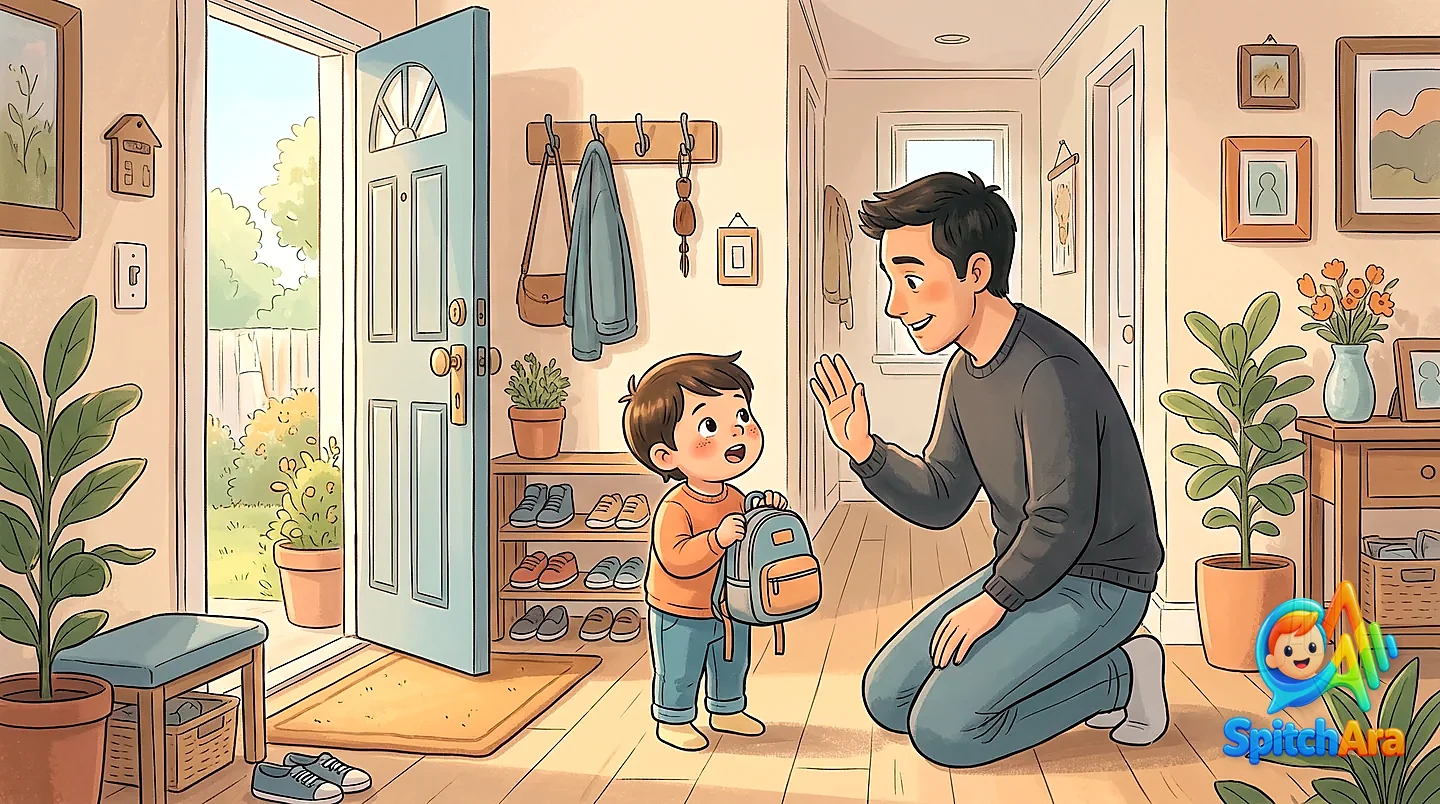
Your child says a line from a familiar programme while standing beside the door. The words do not mention leaving, yet the timing makes you wonder whether that is what they mean. Another day, the same line appears during play. You are not sure how to respond.
Repeated words or phrases are often called echolalia. Repetition can be immediate or occur after a delay, and its purpose may depend on the situation. The useful starting point is curiosity: notice the context, respond to a possible message and remain open to being wrong. A repeated phrase is neither automatically meaningless nor a reliable diagnosis on its own.
Describe the pattern before naming its meaning
Write down the actual words, what happened just before them and what followed. “She repeated ‘Are you ready?’ when I put on my shoes” preserves more information than “She uses scripts.” You can also note whether the phrase appeared to be directed towards someone, whether the child was distressed and how the adult responded.
These observations help distinguish a familiar pattern from an isolated guess. If the phrase repeatedly appears before an outing, it may be connected with that routine. Even then, the child could be anticipating, asking, protesting or remembering. One phrase can do more than one job.
ASHA's autism guidance recognizes that echolalia can have communicative functions and recommends considering it within a broader language assessment (American Speech-Language-Hearing Association, n.d.). This is a reason to investigate meaning carefully, not to decide that every repeated phrase has a hidden translation that an adult must uncover.
Respond tentatively and watch what changes
Suppose the child repeats a line while looking at a closed door. You might say, “Are you telling me about going out?” If the child moves towards their shoes, you have more information. If they turn away or repeat the phrase with frustration, your interpretation may not fit.
Respond to the situation as well as the words. A child who appears uncomfortable may need less noise, more space or help with an immediate problem before any discussion of language. If the phrase accompanies enjoyment, joining the activity may be more appropriate than asking several clarifying questions.
It is acceptable to say, “I'm not sure what you mean.” Offer a familiar way to show or select a message. Acknowledging uncertainty protects the child's meaning better than confidently translating a phrase incorrectly.
Offer language without erasing the original contribution
If you have a reasonable understanding of the message, you can offer a short relevant model. For instance, when a child repeats a question about drinking while reaching for a cup, “You want water” may fit. Provide the appropriate response without insisting that they replace their phrase before receiving a drink.
Keep the model connected to the child's intention. A correction such as “Don't say it like that” can interrupt the exchange without explaining a useful alternative. Equally, repeating a model many times does not make it more meaningful if the adult has misunderstood the situation.
An AAC system can provide additional ways to clarify, refuse or add information. It does not need to compete with repeated speech. A child can retain a familiar phrase while gaining more accessible options for communication.
Separate respectful support from claims about a protocol
Listening to repeated language, following a child's interests and avoiding unnecessary correction are practical choices. They should not automatically be treated as proof of a particular theory about how every autistic child develops language.
A systematic review found no empirical intervention studies supporting approaches described as Gestalt Language Processing or Natural Language Acquisition within its search, completed in March 2024 (Bryant et al., 2025). That finding concerns the evidence for those approaches. It does not establish that every activity associated with them is harmful or that a child's repeated language lacks meaning.
If a professional recommends a staged programme, ask what evidence supports the specific recommendation, how the child's needs were assessed and how progress will be reviewed. A clear explanation should distinguish a theory, an observation and a treatment result. It should also allow the plan to change when it is not helping.
Notice the situations in which language becomes easier
Some children use more flexible language in familiar play than during direct questioning. Others rely more on familiar phrases when tired or under pressure. Record these differences without turning them into a fixed explanation of the child's mind.
For example, a hypothetical note might say, “During car play, he used the same programme line twice. When I stopped asking questions and described the car getting stuck, he pointed under the chair.” The note shows what happened. It does not prove that fewer questions caused a lasting change.
Share examples from different people and settings with the speech-language professional. Include moments that go well, not only moments that worry you. This makes it easier to identify useful support and avoids presenting the child solely through difficulties.
Avoid making silence the goal
If repetition bothers other people, the first question should be whether the child is distressed, trying to communicate or enjoying something. Simply reducing the audible phrase can leave the underlying need unanswered. Ask what alternative support would make the situation more comfortable and communicative.
There may still be practical limits around volume or shared spaces. Explain them respectfully and offer an acceptable option where possible, rather than treating the child's language as inherently wrong. A professional can help when repetition is associated with distress or interferes with daily participation.
Bring a small, useful sample to an appointment
You do not need a catalogue of every repeated phrase. Choose a few examples with context and questions: “What might this be doing here?” “How can we check without pressuring?” “Which additional communication options would help?” If recordings are requested, follow privacy arrangements and the child's comfort rather than filming constantly.
Seek assessment for persistent communication concerns, and prompt advice for loss of previously acquired skills. Meanwhile, respond to the child as a person with something worth understanding. The next exchange may begin with a repeated phrase, but it can still lead to a shared decision, a clarified need or a moment of connection (American Speech-Language-Hearing Association, n.d.-c).
References
American Speech-Language-Hearing Association. (n.d.). Autism and autism spectrum disorder. https://www.asha.org/practice-portal/clinical-topics/autism/
American Speech-Language-Hearing Association. (n.d.-a). Augmentative and alternative communication (AAC). https://www.asha.org/practice-portal/professional-issues/augmentative-and-alternative-communication/
American Speech-Language-Hearing Association. (n.d.-c). Spoken language disorders [Practice Portal]. https://www.asha.org/practice-portal/clinical-topics/spoken-language-disorders/
Bryant, L., Bowen, C., Grove, R., Dixon, G., Beals, K., Shane, H., & Hemsley, B. (2025). Systematic review of interventions based on gestalt language processing and natural language acquisition (GLP/NLA): Clinical implications of absence of evidence and cautions for clinicians and parents. Current Developmental Disorders Reports, 12, Article 2. https://doi.org/10.1007/s40474-024-00312-z
Centers for Disease Control and Prevention. (2026a, February 16). Concerned about your child’s development? https://www.cdc.gov/act-early/families/concerned.html
World Health Organization. (2022, April 27). Caregiver skills training for families of children with developmental delays or disabilities: Introduction. https://www.who.int/publications/i/item/9789240048836
