
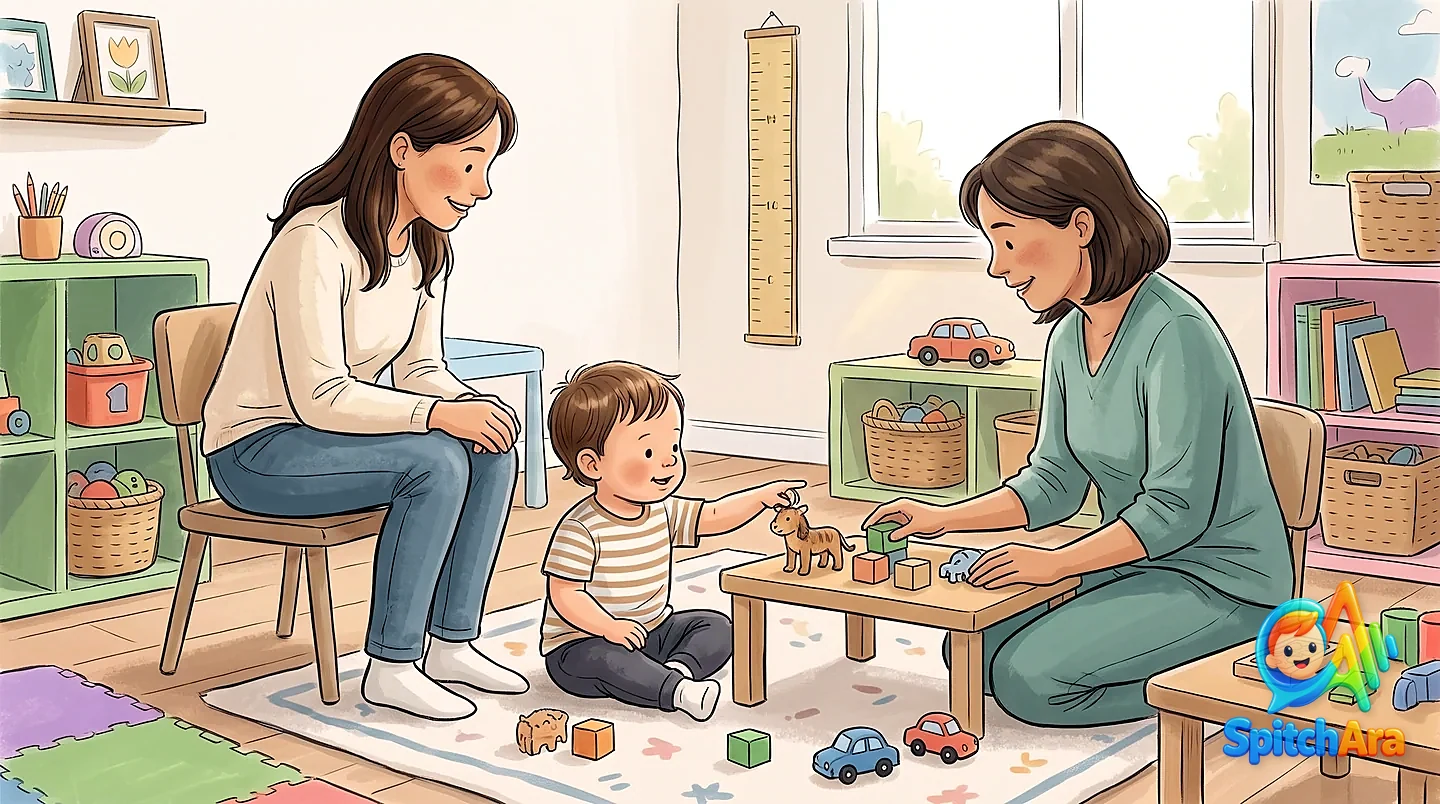
“He understands everything, but he hardly talks.” This is a common way for a caregiver to describe a two-year-old who follows familiar routines, finds a favourite toy, and seems to know what the family is saying. The observation matters. However, understanding and speaking are different parts of communication, and a reassuring moment in one area does not answer every question about the other.
If your two-year-old understands you but says very little, arrange a discussion with a qualified health or speech-language professional. Meanwhile, gather a few ordinary examples and keep communication comfortable. You do not need to prove that something is wrong before asking what should be assessed.
Look more closely at what “understands” means
Familiar routines contain clues beyond spoken language. When an adult picks up shoes and moves towards the door, a child may anticipate going outside. That response is useful, but it does not show exactly how much of the sentence the child understood.
Instead of testing repeatedly, notice naturally occurring differences. Does the child respond when an instruction is given without pointing? Do they recognise familiar words outside the usual routine? Is understanding easier with one caregiver, in one language, or in a quieter setting? Record examples without turning daily life into an examination.
The distinction matters because receptive language concerns understanding, while expressive language concerns conveying meaning. A speech-language assessment considers both, along with the wider communication picture (National Institute on Deafness and Other Communication Disorders, 2022). “Understands everything” can be a starting description, but concrete situations give the professional more to work with.
Describe the child's messages beyond spoken words
List how your child asks, refuses, shares something interesting, and seeks help. They may point to a shelf, bring an adult to a door, use a familiar sound, sign, select a picture, or say a word. Different purposes may be expressed in different ways.
For example, “She says ‘ball’ when she wants it, but brings me the broken toy when she needs help” gives a fuller picture than a vocabulary total alone. Include whether words appear spontaneously or mainly after somebody asks for a repetition. Do not treat one type of example as worthless; explain the context.
If the child uses more than one language, record examples from all of them. A professional needs to know where the child hears and uses each language. A list from only the language used at the appointment may leave important abilities or concerns invisible.
Do not use a reassuring story as a forecast
Relatives may remember somebody who began talking later and did well. Such a story can be comforting, but it cannot predict this child's development. ASHA notes that children who will catch up cannot always be distinguished at the outset from children whose language difficulties persist (American Speech-Language-Hearing Association, n.d.).
That uncertainty is a reason to ask for assessment and a plan, not a reason to assume the worst. You can appreciate the child's strengths while still asking whether hearing, language, speech, or another aspect of development needs attention.
When somebody suggests waiting, ask what the waiting period involves. What has already been assessed? What will be monitored? When will the child be reviewed? Which changes should prompt earlier contact? A planned review is more concrete than an open-ended promise that words will arrive eventually.
Prepare a short record for the appointment
Choose a few examples from different situations rather than compiling a large collection of videos. One might show a request, another a response to an everyday instruction, and another a moment of difficulty. Ask the service how it prefers to receive recordings and protect the child's privacy.
A useful note could read: “At breakfast, he pointed towards the cupboard. I asked ‘Cup?’ and he shook his head. He then brought the cereal box.” This shows the first signal, your interpretation, and the child's correction. It is more informative than simply writing “Gets frustrated when misunderstood.”
Also note relevant health and hearing history, previous assessments, languages, and any change over time. If the child has stopped using words or other established skills, make that clear when arranging care rather than leaving it buried in a long list.
Keep conversation supportive while you seek advice
Follow an activity the child already enjoys and offer brief language that fits. If the child pushes a car, “Car goes” may be enough. If they hand you a closed container, acknowledge the request and help. Do not withhold essential help while waiting for a spoken phrase (National Health Service, 2023).
You can also reduce repeated questions. An adult may ask “What is it?” because they want to hear a word, while the child simply wants to show something. “You found the bus” responds to the child's message and provides language without requiring a performance.
These everyday responses are not a substitute for a tailored intervention. If a clinician recommends a strategy, ask for a demonstration and a chance to try it with feedback. Explain what works in your home and what becomes difficult. Advice should fit the child and the caregiver, not merely the page on which it is printed.
Read research without turning it into a promise
A randomized trial of 97 toddlers aged 24 to 42 months studied a caregiver-implemented intervention. It found a benefit in receptive language but not a statistically significant benefit on the broad expressive-language outcome used in the study (Roberts & Kaiser, 2015). That distinction is useful: “language improved” can conceal important differences between outcomes.
The trial does not tell you that your child needs the same number of sessions or will respond in the same way. It studied a specific intervention and population, and outcome measurement was not blinded. When considering a programme, ask which outcome its evidence supports and whether the participants resemble the children it is being recommended for.
Leave with a next step you can explain
At the end of the appointment, ask the professional to summarise what is known, what remains uncertain, and what happens next. Clarify whether a hearing assessment, further developmental assessment, therapy, or a review is recommended, and how to arrange it.
You should also know what to do while waiting and whom to contact if concerns change. Write the plan in practical terms: the next appointment, the observations to bring, and the kind of support to continue at home.
Your child's understanding is a strength worth noticing. It is also one part of a larger picture. The most helpful response to “understands but says little” is to turn that broad description into specific examples, seek appropriate assessment, and keep responding to the communication your child is already offering.
References
American Speech-Language-Hearing Association. (n.d.). Late language emergence. https://www.asha.org/practice-portal/clinical-topics/late-language-emergence/
American Speech-Language-Hearing Association. (n.d.). Spoken language disorders [Practice Portal]. https://www.asha.org/practice-portal/clinical-topics/spoken-language-disorders/
National Health Service. (2023, April 26). Help your baby learn to talk. https://www.nhs.uk/baby/babys-development/play-and-learning/help-your-baby-learn-to-talk/
National Institute on Deafness and Other Communication Disorders. (2022, October 13). Speech and language developmental milestones. https://www.nidcd.nih.gov/health/speech-and-language
Roberts, M. Y., & Kaiser, A. P. (2015). Early intervention for toddlers with language delays: A randomized controlled trial. Pediatrics, 135(4), 686–693. https://doi.org/10.1542/peds.2014-2134
Roberts, M. Y., Curtis, P. R., Sone, B. J., & Hampton, L. H. (2019). Association of parent training with child language development: A systematic review and meta-analysis. JAMA Pediatrics, 173(7), 671–680. https://doi.org/10.1001/jamapediatrics.2019.1197
