
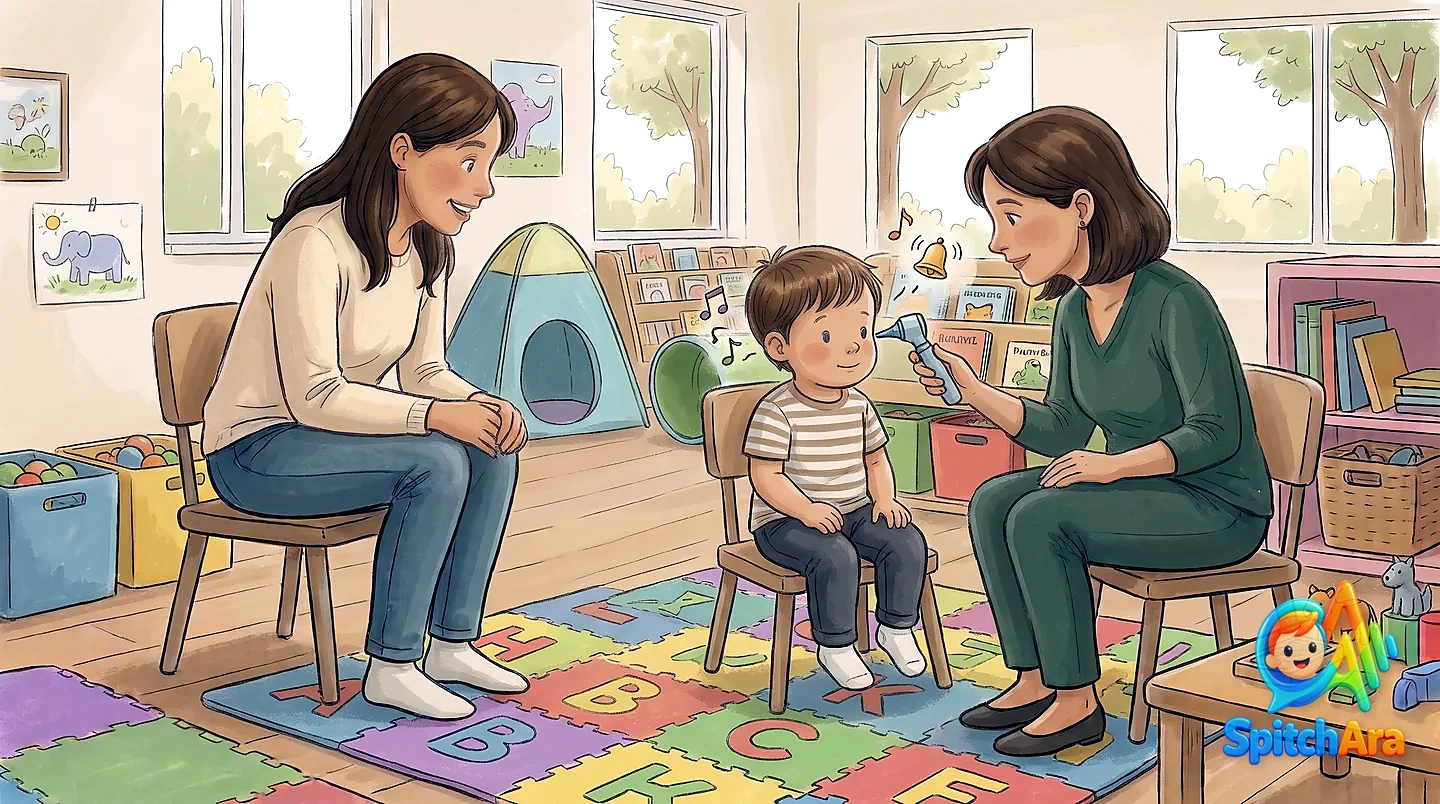
“But she hears the doorbell.” A caregiver may say this when a hearing check is suggested during a speech-language evaluation. The observation is worth sharing, yet responding to one sound does not answer every question about hearing. The referral is a way to obtain more specific information, not a declaration that the family has overlooked something obvious.
A hearing check may be part of a speech-language evaluation because access to sound can affect communication development. Ask what assessment is recommended, who will perform it, and how the result will contribute to the overall plan. You do not need to decide at home whether hearing is the explanation.
Understand what the referral is asking
When a professional recommends assessment, they are often trying to clarify one part of a larger picture. A child may use few words for different reasons, and hearing is a question that should not be answered solely by guessing from everyday behaviour (American Speech-Language-Hearing Association, n.d.-b).
The NIDCD notes that hearing testing is often included in a speech-language evaluation because hearing problems can affect development (National Institute on Deafness and Other Communication Disorders, 2022). This does not mean that a hearing difference is assumed, or that every communication concern will be explained by the result.
You can ask the referring professional to state the question plainly. Is the aim to investigate a concern, update an older result, or provide information needed for another assessment? Knowing the reason can make the appointment feel more purposeful.
A newborn screening result is part of the history
If your child passed newborn hearing screening, bring the record if available. It is relevant information. However, a pass at birth does not exclude hearing changes later in childhood (Health Resources and Services Administration, n.d.). The old result and a current concern answer different questions.
Similarly, a screening result that required follow-up is not the same as a confirmed diagnosis. Ask what follow-up occurred and whether it produced a complete result. If the paperwork is unclear, the service can help identify what information is missing.
Avoid interpreting the words “pass,” “refer,” or “inconclusive” without an explanation. Each belongs to a particular procedure and context. The useful next step is to understand what the result meant and what was recommended, rather than assuming that a single label settles hearing permanently.
Describe responses without trying to test hearing yourself
Write down what you have noticed in ordinary situations. Does the child respond differently when you are nearby or farther away? Is it harder in noise? Have you noticed changes over time? These observations may help the professional, but they are not a home hearing test.
For example, “He often responds when I stand in front of him, but not when I call from the kitchen” is a description. “He chooses not to listen” assigns a motive that may be wrong. Several explanations could affect that situation, including attention, language understanding, the environment, or hearing.
Do not create loud sounds or repeatedly startle the child to prove that they can hear. Such experiments do not provide the information an audiological assessment is designed to obtain. Share the observation and let the professional choose an appropriate method.
Prepare the history that might matter
Bring information about previous hearing tests, relevant ear or health history, and any professional reports you have been asked to provide. If there is a change in the child's response or communication, describe when it became noticeable.
It can help to separate facts from uncertainty. “There were several appointments for ear symptoms last winter, but I do not know whether hearing was tested” gives the clinician a clear gap to investigate. Guessing the result because a visit seemed reassuring can make the history less accurate.
Also explain the child's communication and access needs. How do they indicate discomfort? What helps them understand a new task? Are there movement or sensory considerations? This information can help the service prepare without requiring you to predict which test will be used.
Ask what the appointment involves
Different assessments may require different kinds of participation, and the clinician chooses methods according to the child and the question. Ask the service whether there are preparation instructions and follow those instructions rather than advice from an unrelated online account.
You can explain the visit to your child in simple terms without promising a procedure you have not confirmed. A description such as “We will meet someone who checks how you hear” may be appropriate, with further detail from the service when available.
If your child cannot comfortably complete a task, tell the clinician. Ask what can be adapted and what the incomplete information means. An unfinished appointment should lead to an explanation and a plan, not an assumption that the child has failed.
Make the result understandable before you leave
Ask what was assessed, what the findings show, and whether the information is complete. If the result is described as typical, ask whether any monitoring is still recommended. If further assessment or treatment is suggested, clarify who arranges it and when it should happen.
It is also useful to ask how the result will be shared with the speech-language professional or child's doctor. A completed test only helps the wider plan if the relevant people can use the findings. Confirm the consent and communication process rather than assuming that reports move automatically between services.
If unfamiliar technical terms are used, request a plain-language explanation. You might ask, “What does this mean for understanding speech at home or nursery?” The clinician can then connect the measurement with the practical question that brought you there.
Continue making communication accessible
While waiting for appointments or results, keep the child's usual communication supports available. Position yourself where the child can access your message comfortably, reduce unnecessary competing noise where practical, and respond to gestures or other established methods. Do not shout or remove visual supports in an attempt to practise listening.
If a hearing difference is identified, ask for an individualized plan that addresses access to language and communication. The appropriate support depends on the child and the assessment. A general article cannot choose a device, communication approach, or treatment.
The referral is one step towards understanding your child's needs more accurately. Bring what you have noticed, ask what the test can answer, and leave with the next action in clear terms. A hearing check is useful because it replaces assumptions with information that the family and professionals can act on.
References
American Speech-Language-Hearing Association. (n.d.). Spoken language disorders [Practice Portal]. https://www.asha.org/practice-portal/clinical-topics/spoken-language-disorders/
American Speech-Language-Hearing Association. (n.d.-a). Childhood hearing screening [Practice Portal]. https://www.asha.org/practice-portal/professional-issues/childhood-hearing-screening/
American Speech-Language-Hearing Association. (n.d.-b). Late language emergence [Practice Portal]. https://www.asha.org/practice-portal/clinical-topics/late-language-emergence/
Centers for Disease Control and Prevention. (2026, February 16). Concerned about your child’s development? https://www.cdc.gov/act-early/families/concerned.html
Health Resources and Services Administration. (n.d.). Deafness and hearing loss. https://newbornscreening.hrsa.gov/conditions/deafness-and-hearing-loss
National Institute on Deafness and Other Communication Disorders. (2022, October 13). Speech and language developmental milestones. https://www.nidcd.nih.gov/health/speech-and-language
