
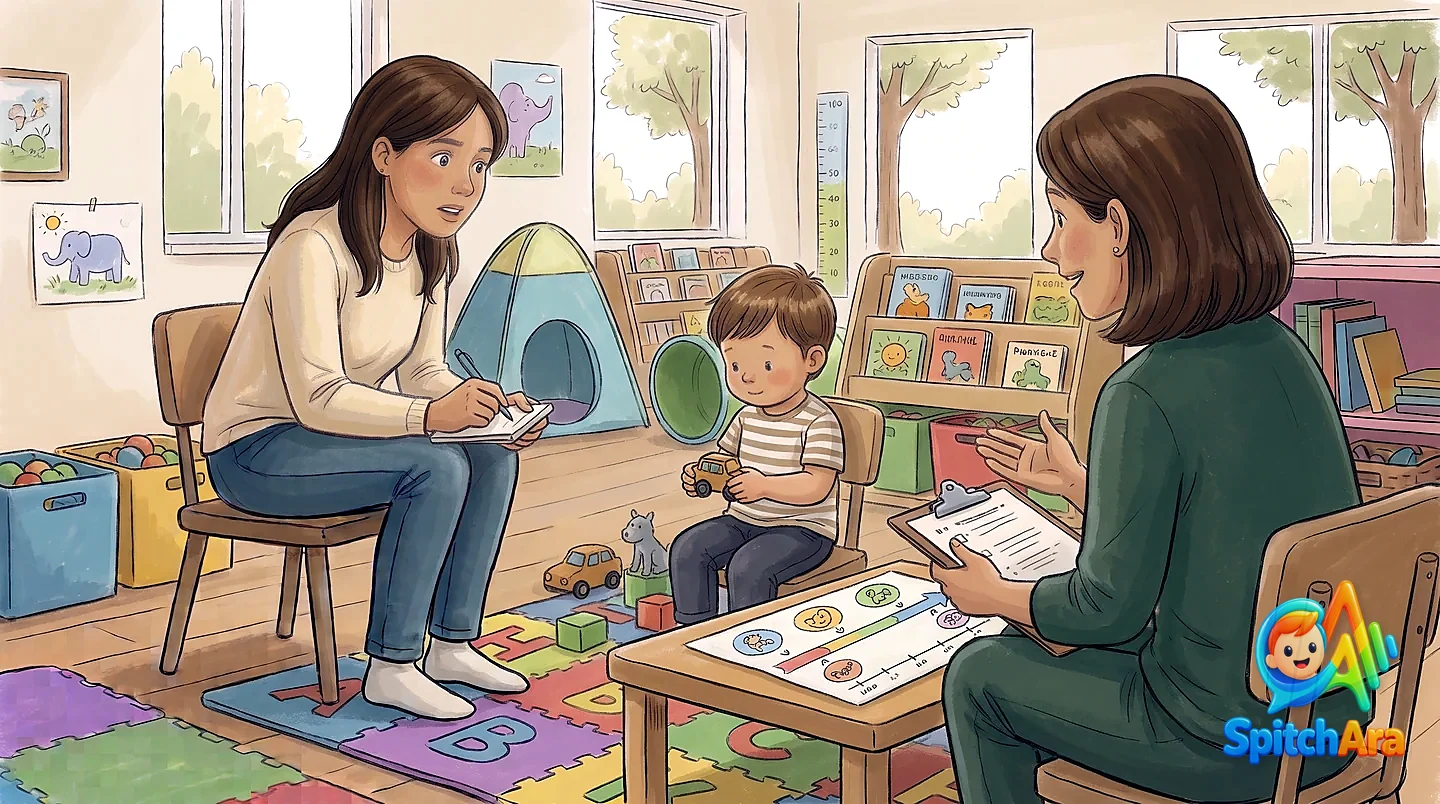
“Let's give it a little more time.” A caregiver may hear this after mentioning that a child says few words. Sometimes the phrase comes with an assessment, a review date, and a clear reason. Sometimes it is simply reassurance. The difference matters because a family needs to know what happens during the waiting period and what would change the plan.
If you are worried about speech or language, ask for professional advice and a concrete explanation before accepting open-ended waiting. You can recognise your child's strengths while still asking what needs to be assessed. A relative's experience or one good day cannot answer all the questions about your child.
Ask what has already been assessed
Begin with the basis of the recommendation. Has the professional considered understanding as well as expression? Hearing? The child's wider development and languages? Everyday participation? A brief impression and a comprehensive evaluation provide different kinds of information.
ASHA notes that late language emergence can involve expression alone or both expression and understanding, and that prognosis is not always clear at the outset (American Speech-Language-Hearing Association, n.d.). Therefore, “few words” should lead to more specific questions rather than a single assumption that the child will catch up.
You might ask, “Which observations make you comfortable monitoring for now, and which areas have not yet been checked?” This invites an explanation without requiring you to challenge the professional with a diagnosis of your own.
Define what “wait” means in practice
A monitoring plan should identify what will be observed, who will review it, and when. “Come back if you are still worried” leaves much of that unclear. A specific review arrangement gives the family a point at which the information will be reconsidered.
Ask whether any assessment or support should proceed during the interval. Monitoring one area does not necessarily mean postponing every other question. The professional can explain which steps belong now and which depend on further information.
For a hypothetical example, a family may be asked to bring examples of how the child follows everyday messages and expresses requests at a scheduled review. That is more concrete than counting all speech for several months without knowing who will interpret the record.
Ask what would prompt earlier contact
The plan should also explain its limits. Which changes mean that the family should get back in touch sooner? Who should they contact, and how? These questions are especially important when several services or waiting lists are involved.
The CDC advises acting on developmental concerns and asking about further evaluation when concerns remain (Centers for Disease Control and Prevention, 2026). You do not need to wait for an agreed review date to report a new loss of skills or a significant change. Explain the change and ask whether the timing should be reconsidered.
Keep the instructions in a form you can find. A brief note in the same place as appointment details may be more useful than a general memory that somebody said to monitor. Share the relevant plan with other regular caregivers so that they know what information matters.
Understand what research can and cannot predict
It is natural to want a number that tells you whether your child will catch up. Research can identify patterns across groups, but it cannot turn a short description into a reliable personal forecast. Fisher's systematic review found that early receptive language and expressive vocabulary were among predictors of later expressive-language outcomes (Fisher, 2017).
That finding supports asking about several aspects of language. It does not mean that a parent can use a few home tasks to calculate the child's future. The studies and measures have limits, and children vary in the situations in which they are observed.
When someone offers a confident prediction, ask what information it is based on and how uncertainty is being handled. A careful answer may be less comforting in the moment than a guarantee, but it gives the family a more useful basis for decisions.
Keep a record that serves the review
Agree on a small number of observations that matter to the question. You might record how the child seeks help, responds to familiar instructions, or adds a new way of communicating. Avoid tracking everything merely because it is possible to count.
Include context. “She used ‘open’ after I said it three times” differs from “She brought the box and said ‘open’ before I spoke.” Both may be relevant, but the distinction helps the professional interpret what happened.
Record difficulties as descriptions rather than judgements. “He walked away after several questions” leaves room to explore the reason. “He refuses to learn” does not. If you cannot tell what a signal meant, write that uncertainty instead of forcing it into a success or failure category.
Ask for support that fits the waiting period
If home strategies are recommended, ask for a demonstration and a clear purpose. Which aspect of communication is the strategy intended to support? How should it be adapted if the child becomes uncomfortable? What would a useful observation look like?
Choose a manageable routine rather than filling the day with practice. A caregiver can follow the child's interest, offer a brief model, and respond to gestures or other established methods without turning each interaction into a test. The activity should help communication now, not become a condition for receiving further care.
If the suggested plan is unrealistic for your family, explain the barrier. Work schedules, language access, several children, disability, and caregiver exhaustion all affect what is feasible. A plan that cannot be carried out needs adjustment, not blame.
Revisit the plan when the evidence changes
At the review, compare the examples with the original question. Has the pattern changed? Are there new concerns? Did the home support improve participation even if spoken words changed little? Ask the professional how those observations affect the next recommendation.
If uncertainty remains, clarify whether further assessment is appropriate and how to arrange it. Continuing to monitor should be a deliberate decision with a reason, not the default result of an appointment ending without a plan.
The useful alternative to anxious waiting is not constant testing. It is a clear agreement about assessment, support, observation, and follow-up. Once those parts are explicit, the family can spend less energy guessing what “more time” means and more energy responding to the child's communication today.
References
American Speech-Language-Hearing Association. (n.d.). Late language emergence. https://www.asha.org/practice-portal/clinical-topics/late-language-emergence/
American Speech-Language-Hearing Association. (n.d.). Spoken language disorders [Practice Portal]. https://www.asha.org/practice-portal/clinical-topics/spoken-language-disorders/
American Speech-Language-Hearing Association. (n.d.-a). Augmentative and alternative communication (AAC). https://www.asha.org/practice-portal/professional-issues/augmentative-and-alternative-communication/
Centers for Disease Control and Prevention. (2026, February 16). Concerned about your child’s development? https://www.cdc.gov/act-early/families/concerned.html
Fisher, E. L. (2017). A systematic review and meta-analysis of predictors of expressive-language outcomes among late talkers. Journal of Speech, Language, and Hearing Research, 60(10), 2935–2948. https://doi.org/10.1044/2017_JSLHR-L-16-0310
Roberts, M. Y., Curtis, P. R., Sone, B. J., & Hampton, L. H. (2019). Association of parent training with child language development: A systematic review and meta-analysis. JAMA Pediatrics, 173(7), 671–680. https://doi.org/10.1001/jamapediatrics.2019.1197
