
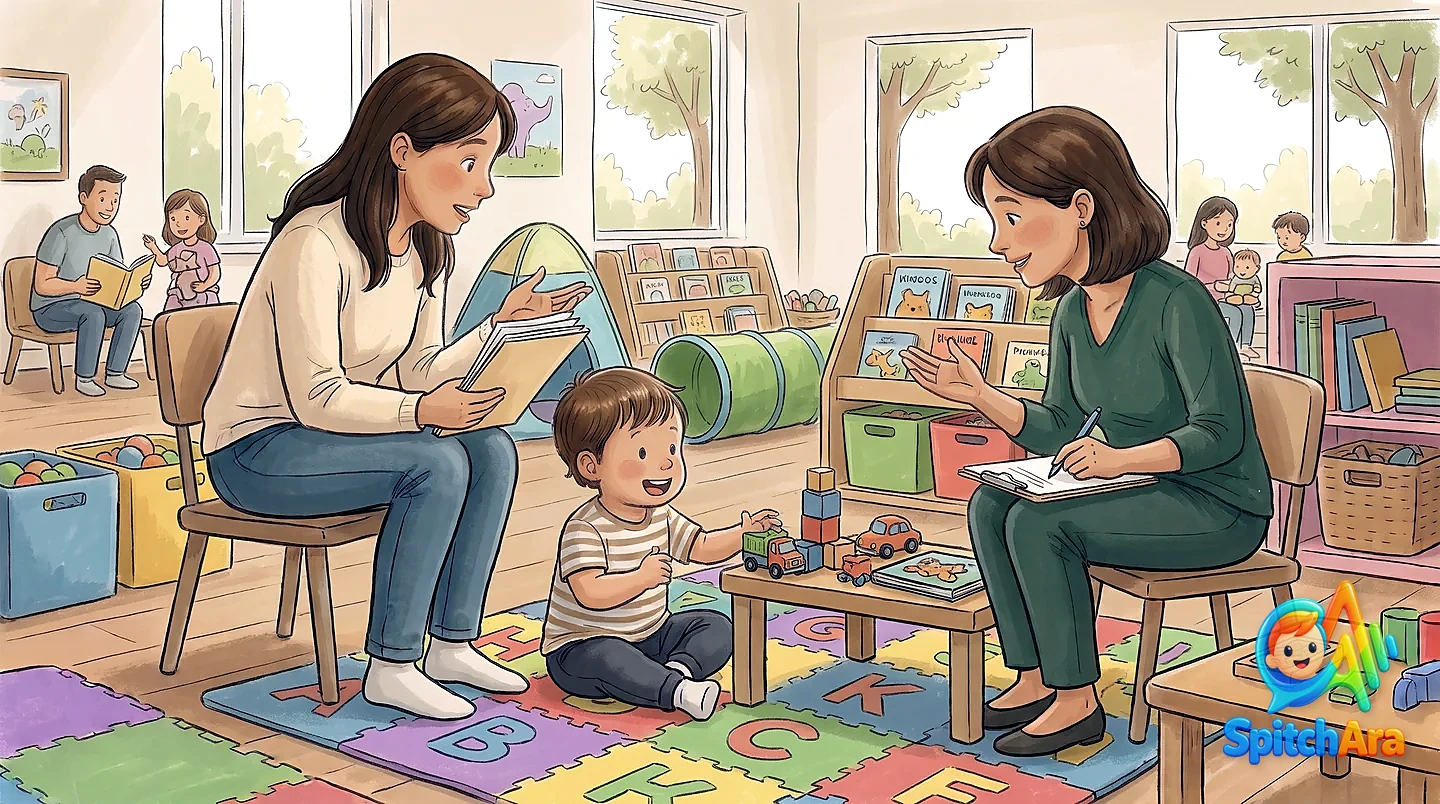
The appointment is booked, and suddenly every detail feels important. Should you write down every word? Bring all the toys? Record the child speaking at home in case they become quiet in the clinic? Preparation can help, but it should not become another source of pressure for the family.
For a first speech-language appointment, bring a concise description of your concern, relevant records, and a few examples of everyday communication. Ask the service what it wants in advance. The professional's job is to assess the child, not to judge how thoroughly a parent has prepared a folder.
Put your main question near the top
Begin with one or two sentences about why you sought the appointment. “She uses words at home but unfamiliar adults rarely understand her” is a focused starting point. So is “He follows familiar routines, but we are unsure how much he understands without gestures.”
Then describe what you hope to understand. You may want to know whether further assessment is needed, how to make communication easier at home, or what a nursery should do when the child cannot explain a need. These are practical questions that can guide the discussion.
Avoid trying to fit the child to a diagnosis before the appointment. You can mention a term you have encountered and ask whether it is relevant, but the clearest evidence you bring is what happens in daily life.
Choose examples with a beginning and an outcome
A useful example explains the situation, the child's message, and how another person responded. “At snack time, she pointed towards the cupboard. I offered a cup, she shook her head, then brought the biscuit container” contains more information than “She communicates well with me.”
Include a successful exchange and a difficult one. The successful example shows what helps. The difficult example shows where support may be needed. If you only bring the most worrying moments, the professional may miss abilities that can be used in the plan.
If a signal is ambiguous, keep that uncertainty. “We think this sound means ‘again’ because he uses it after the swing stops” is a reasoned observation. It is still different from knowing that the sound has the same meaning in every situation.
Gather relevant records without collecting everything
Ask which previous reports, hearing information, referral details, or developmental records the service needs. The NIDCD describes speech-language evaluation as considering communication and general development, with hearing assessment often included (National Institute on Deafness and Other Communication Disorders, 2022). That makes hearing history relevant even when the appointment is described as being about speech (American Speech-Language-Hearing Association, n.d.-a).
If another service already holds a report, ask how information should be shared and what consent is needed. A clear record of previous recommendations can prevent the family from having to reconstruct the entire history from memory.
You do not need to search for every old message or photograph. Prioritise information that answers a current question. If you are unsure whether a document matters, list it and ask rather than delaying the appointment while trying to organise a perfect archive.
Explain the child's languages and communication methods
Write down the languages the child hears and uses regularly, including who uses them and in which settings. If the appointment language is not the family's strongest language, request appropriate language support in advance. Do not assume that a relative must interpret complex assessment information.
Also describe the child's established communication methods. These may include speech, signs, gestures, pictures, a device, or another access method. Bring the supports normally used, unless the service gives a specific reason otherwise.
A child may communicate differently when a familiar support is unavailable. Telling the clinician about that difference helps them understand the session. It does not mean that every task must be completed in exactly the same way as at home; it means the assessment needs informed interpretation.
Ask before making or sending recordings
A short recording can sometimes help show a familiar interaction, but the service should explain whether it is useful and how to share it securely. Do not assume that more recordings create a better assessment. A small, relevant example may answer the question more clearly.
If you record, avoid repeatedly prompting the child to demonstrate a skill for the camera. The resulting clip may show performance under repeated prompting rather than ordinary communication. Explain the context, including anything the adult did to elicit the response.
Protect the privacy of siblings and other people in the recording. Ask who will see it, where it will be stored, and whether it becomes part of a clinical record. Those are reasonable questions about information handling, not obstacles to care.
Prepare for the format of the appointment
For an in-person visit, ask about the setting, expected duration, breaks, and what the child may need. A familiar comfort item or usual access equipment may make participation easier. Explain movement, sensory, or health needs ahead of time when possible.
For an online visit, clarify the caregiver's role and the technology required. Professional telepractice guidance emphasises individual suitability and practical access, including the environment and available support (American Speech-Language-Hearing Association, n.d.). A video link alone does not guarantee that every assessment can be completed appropriately.
Test the connection without turning the child into a rehearsal subject. Find out whom to contact if it fails. If the room is not quiet or private at the proposed time, tell the service so that you can discuss a workable alternative.
Let the clinician see the child rather than a rehearsed version
During the appointment, answer questions honestly and add context when something differs from home. If the child does not respond, avoid immediately repeating every prompt or supplying the answer. Ask the clinician how they would like you to help (American Speech-Language-Hearing Association, n.d.-c).
At the same time, speak up if the child is uncomfortable or cannot access the task. The professional may be able to adjust the materials, pace, position, or method. Assessment should not depend on silently tolerating a barrier that the caregiver can explain.
You can take notes, but you do not need to transcribe the session. Capture the main findings and next steps. If the explanation is unfamiliar, ask for an example using something your child does at home.
Leave knowing who does what next
Before the appointment ends, clarify whether more information is needed, what support is recommended, and when you should expect a report or follow-up. Ask who arranges any referral and whom to contact if no appointment arrives (Centers for Disease Control and Prevention, 2026).
For home advice, request a demonstration of one manageable change. Then describe how it would fit your family's routine. If it does not fit, say why. A plan becomes useful when the people expected to carry it out understand it and can realistically do so.
Your preparation has done its job when the professional can see the child's everyday communication more clearly and you can explain the next step. A short page, a relevant report, and a few honest examples are a strong place to begin.
References
American Speech-Language-Hearing Association. (n.d.). Childhood hearing screening [Practice Portal]. https://www.asha.org/practice-portal/professional-issues/childhood-hearing-screening/
American Speech-Language-Hearing Association. (n.d.). Spoken language disorders [Practice Portal]. https://www.asha.org/practice-portal/clinical-topics/spoken-language-disorders/
American Speech-Language-Hearing Association. (n.d.). Telepractice. https://www.asha.org/practice-portal/professional-issues/telepractice/
American Speech-Language-Hearing Association. (n.d.-a). Augmentative and alternative communication (AAC). https://www.asha.org/practice-portal/professional-issues/augmentative-and-alternative-communication/
Centers for Disease Control and Prevention. (2026, February 16). Concerned about your child’s development? https://www.cdc.gov/act-early/families/concerned.html
National Institute on Deafness and Other Communication Disorders. (2022, October 13). Speech and language developmental milestones. https://www.nidcd.nih.gov/health/speech-and-language
